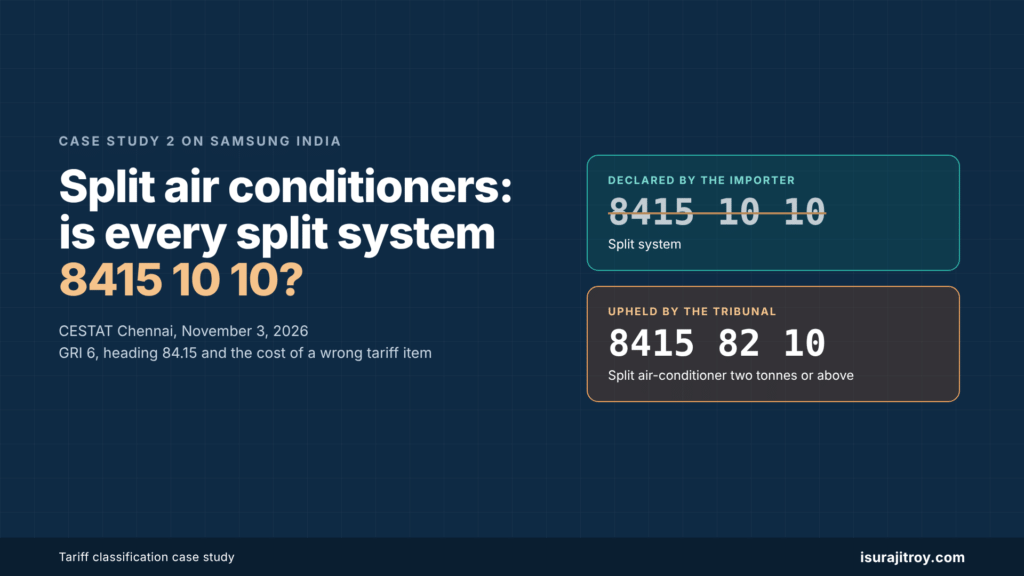
This is the second case study on Samsung India Electronics Pvt. Ltd. The first one covered IC-Codecs that customs wanted in heading 85.17. In that case, decided in July 2024, the Customs, Excise and Service Tax Appellate Tribunal (CESTAT) agreed with Samsung and kept the goods in heading 85.42. This time Samsung lost.
On November 3, 2026, CESTAT Chennai dismissed Samsung’s appeal on imported split air conditioners. Samsung had declared them under India’s tariff item 8415 10 10 (“Split System”). Customs reassessed them under 8415 82 10 (“Split air-conditioner two tonnes or above”), and the Tribunal agreed. The Division Bench applied the answer of a Larger Bench of the Tribunal, which on September 24, 2026 held that 2-ton split air conditioners incorporating a refrigerating unit are classified under 8415 82 10 as the “appropriate and specific” entry.
Tribunal benches had disagreed on similar goods since 2016. The case shows how a code that can be defended at the six-digit HS level can still fail under a national tariff, and what an importer should check before choosing an eight-digit item.
Case: Samsung India Electronics Pvt. Ltd. v. Commissioner of Customs (Chennai II), CESTAT Chennai, Regional Bench, Court No. III, Customs Appeal No. 42491 of 2015, Final Order No. 41162/2026, decided November 3, 2026. Full text on Indian Kanoon.
At a glance
| Point | Detail |
| Goods | Split air conditioners imported from Samsung Electronics Co. Ltd., Korea. The Larger Bench described the goods before it as 2-ton split air conditioners incorporating a refrigerating unit. |
| Importer’s classification | 8415 10 10, “Split System”, under subheading 8415 10 (window or wall types, self-contained or “split system”) |
| Customs’ classification | 8415 82 10, “Split air-conditioner two tonnes or above”, under 8415 82 (“Other, incorporating a refrigerating unit”) |
| Deciding authority | Larger Bench of CESTAT, September 24, 2026, followed by the Division Bench |
| Stated reason | “specific entry has to be given primacy over a generic entry and most specific entry needs to be applied” |
| Result | Appeal dismissed; 8415 82 10 upheld |
| Duty, interest and penalty | Not stated in the final order |
Why this case is worth studying
Both sides agreed the goods were air conditioning machines of heading 84.15. The dispute was about how to move down inside that heading, from the six-digit subheadings to India’s eight-digit tariff items. Importers often give this step less care than the choice of heading.
India’s tariff items are built on the HS but add their own words. Under heading 8415 the word “split” appears in five tariff lines, and three of them add a capacity of “two tonnes or above”. An importer who stops at the first line that fits the product’s trade name can end up with an item the authorities reject, even when the six-digit reasoning holds.
The case also shows precedent risk. Between 2016 and 2026, CESTAT benches decided disputes on similar air conditioners in different ways. A Larger Bench has now settled the question for 2-ton split units with a refrigerating unit, at least within the Tribunal.
The goods
The final order says little about the goods. It records that Samsung imported “Split Air Conditioners” from its group company in Korea and filed a bill of entry for their clearance. The Larger Bench answer, quoted in the order, calls the goods “2-ton capacity split air conditioners incorporating a refrigerating unit”.
The order does not give the models, quantities, value, dates of import, duty difference, mounting type (wall, ceiling cassette or floor-standing), whether the units were ducted, whether they had a heating function, or whether any penalty was imposed. Those details would be in the Order-in-Original (No. 37449/2015 of May 11, 2015), which was not available to the author. This article does not guess at them.
A split air conditioner has two units. The outdoor unit holds the compressor and condenser. The indoor unit holds the evaporator and a fan. They are joined by refrigerant piping and wiring. A “2 ton” unit has a cooling capacity of about 24,000 BTU per hour (one ton of refrigeration is 12,000 BTU per hour). Many split units can also heat by reversing the refrigerant cycle through a reversing valve.
Timeline
- May 11, 2015: Order-in-Original No. 37449/2015 classified the goods under 8415 82 10 after a show cause notice.
- August 30, 2015: The Commissioner of Customs (Appeals-II), Chennai rejected Samsung’s appeal (Order-in-Appeal No. 708/2015).
- 2015: Samsung filed Customs Appeal No. 42491 of 2015 before CESTAT Chennai.
- Later: The Division Bench noted conflicting Tribunal decisions and referred the question to the President for a Larger Bench.
- September 24, 2026: The Larger Bench answered the reference.
- October 14, 2026: The Division Bench heard the appeal.
- November 3, 2026: The appeal was dismissed (Final Order No. 41162/2026).
The imports took place in 2015 or earlier. The dispute ran for more than eleven years.
The question
Are 2-ton split air conditioners incorporating a refrigerating unit classified under tariff item 8415 10 10 as a “Split System”, or under 8415 82 10 as a “Split air-conditioner two tonnes or above”?
The legal provisions
Heading 84.15 and its subheadings
Heading 84.15 reads: “Air conditioning machines, comprising a motor-driven fan and elements for changing the temperature and humidity, including those machines in which the humidity cannot be separately regulated.”
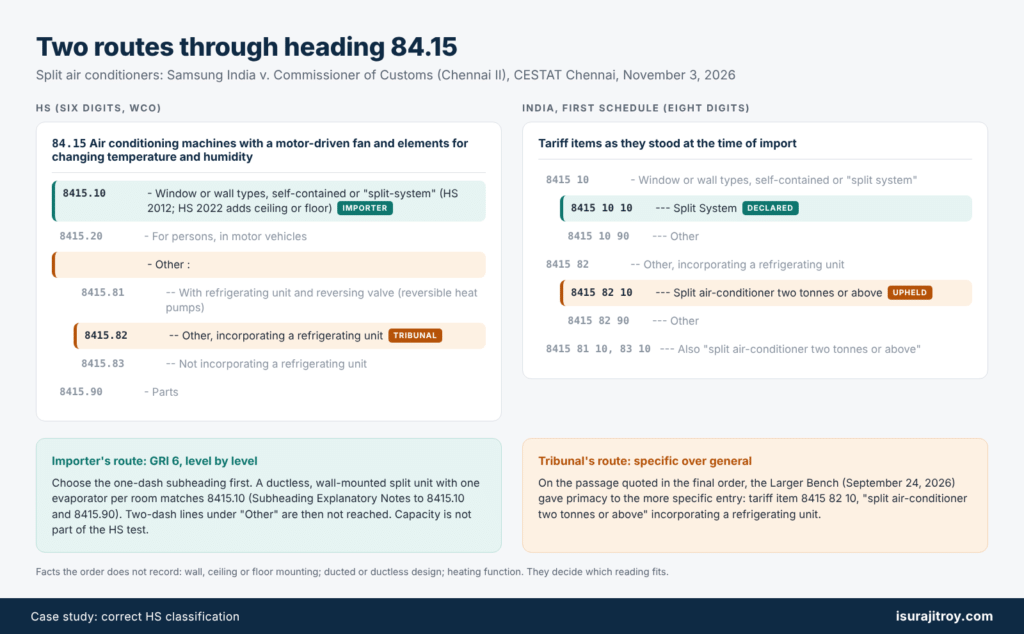
The HS edition is relevant here. Samsung’s goods were imported in 2015 or earlier, under HS 2012. At that time the first one-dash subheading, 8415.10, read “Window or wall types, self-contained or ‘split-system'”. In India the words “ceiling” and “floor” were added to 8415 10 later, by amendment. HS 2022, the current edition, reads as follows:
| Level | Subheading | HS 2022 text |
| One-dash | 8415.10 | – Of a kind designed to be fixed to a window, wall, ceiling or floor, self-contained or “split-system” |
| One-dash | 8415.20 | – Of a kind used for persons, in motor vehicles |
| One-dash | (group) | – Other : |
| Two-dash | 8415.81 | — Incorporating a refrigerating unit and a valve for reversal of the cooling/heat cycle (reversible heat pumps) |
| Two-dash | 8415.82 | — Other, incorporating a refrigerating unit |
| Two-dash | 8415.83 | — Not incorporating a refrigerating unit |
| One-dash | 8415.90 | – Parts |
In both editions, “split-system” machines are named in the one-dash subheading 8415.10, and 8415.82 sits one level lower, under the one-dash “Other”. The six-digit text does not mention capacity.
India’s tariff items under heading 8415
The First Schedule to the Customs Tariff Act, 1975 divides these subheadings into eight-digit tariff items. The text in force for imports of 2015 to 2016, as reproduced in the DRI adjudication order quoted in Mitsubishi Electric India v. Commissioner of Customs (CESTAT Mumbai, 2022), was:
| Tariff item | Description |
| 8415 10 | – Window or wall types, self-contained or “split system”: |
| 8415 10 10 | — Split System |
| 8415 10 90 | — Other |
| 8415 20 | – Of a kind used for persons in motor vehicles: |
| 8415 20 10 / 20 90 | — For buses / — Other |
| – Other | |
| 8415 81 | — Incorporating a refrigerating unit and a valve for reversal of the cooling or heat cycle (reversible heat pumps): |
| 8415 81 10 | — Split air-conditioner two tonnes or above |
| 8415 81 90 | — Other |
| 8415 82 | — Other, incorporating a refrigerating unit: |
| 8415 82 10 | — Split air-conditioner two tonnes or above |
| 8415 82 90 | — Other |
| 8415 83 | — Not incorporating a refrigerating unit: |
| 8415 83 10 | — Split air-conditioner two tonnes or above |
| 8415 83 90 | — Other |
| 8415 90 00 | – Parts |
This is where the dispute comes from. “Split” appears under 8415 10 with no capacity limit, and again under each of the three two-dash subheadings with a capacity of “two tonnes or above”. Commercial tariff databases show the same eight-digit lines today under the current wording of 8415 10. Check the First Schedule published by CBIC for your date of import before relying on any of these lines.
Note 4 to Section XVI
A split air conditioner consists of an outdoor unit and an indoor unit. Note 4 to Section XVI treats them as one machine:
“Where a machine (including a combination of machines) consists of individual components (whether separate or interconnected by piping, by transmission devices, by electric cables or by other devices) intended to contribute together to a clearly defined function covered by one of the headings in Chapter 84 or Chapter 85, then the whole falls to be classified in the heading appropriate to that function.”
Air conditioning is the function of heading 84.15, so the two units presented together are one air conditioning machine of that heading. When the units are presented separately, the WCO Explanatory Note to heading 84.15 places them in the heading as parts under Note 2 (b) to Section XVI. The Subheading Explanatory Note to 8415.90 places them in subheading 8415.90 and describes them as units “for split-system air conditioning machines of subheading 8415.10”.
The WCO Explanatory Notes to heading 84.15
The Explanatory Note to heading 84.15 says that these machines may be single “through-the-wall” units or “split-systems” that work when connected together: a condenser unit for external installation plus an evaporator unit for internal installation. It adds that such split systems are ductless and use a separate evaporator for each area to be air conditioned, for example each room.
The Subheading Explanatory Note to 8415.10 (HS 2022) says that the “split-system” type air conditioners “are ductless and utilize a separate evaporator for each area to be air conditioned”, that the indoor unit “may be mounted in various locations, for example, in a wall or window, or on a ceiling or floor”, and that the subheading “excludes ducted central air conditioning systems which utilize ducts to carry refrigerated air from an evaporator to several areas to be cooled”.
At the HS level, the test for 8415.10 is about design and mounting: ductless, one evaporator per area, fixed in place. Capacity is not part of it. The present note’s reference to ceiling and floor reflects the current subheading text. Under the earlier “window or wall types” wording, the mounting position was itself contested, as section 11 explains.
The GRIs that apply
GRI 1 settles the heading. Classification “shall be determined according to the terms of the headings and any relative Section or Chapter Notes”. Heading 84.15 and Note 4 to Section XVI do that here.
GRI 6 governs the subheadings:
“For legal purposes, the classification of goods in the subheadings of a heading shall be determined according to the terms of those subheadings and any related Subheading Notes and, mutatis mutandis, to the above Rules, on the understanding that only subheadings at the same level are comparable. For the purposes of this Rule the relative Section and Chapter Notes also apply, unless the context otherwise requires.”
The WCO Explanatory Note to Rule 6, paragraph (II)(a), sets the order of work. One-dash subheadings are compared first, on their own texts. Only when the right one-dash subheading has been chosen, and only if it is subdivided, are its two-dash subheadings considered (“then, and only then”). Paragraph (III) adds that the scope of a two-dash subheading cannot extend beyond that of its one-dash subheading.
GRI 3 (a) states the specificity principle: “The heading which provides the most specific description shall be preferred to headings providing a more general description.” The Explanatory Note to Rule 3 (a), paragraph (IV), gives two guides: a description by name is more specific than one by class, and a description that identifies the goods more clearly is more specific than one that identifies them less completely. GRI 3 applies only when goods are prima facie classifiable under two or more headings, and under GRI 6 it compares subheadings only at the same level.
India’s Supreme Court has held that the HSN and its Explanatory Notes should guide the reading of the Indian tariff where the entries follow the HS (CCE v. Wood Craft Products Ltd., 1995, as relied on by CESTAT in Nichirin Imperial Autoparts). For a fuller explanation of each rule, see Decoding the GRIs: a practical guide for trade compliance professionals.
The Customs case for 8415 82 10
The final order does not set out the Department’s arguments. Drawing on the Larger Bench passage and the earlier decisions, the Department’s case would likely rest on these grounds:
- Tariff item 8415 82 10 names the goods by type and capacity: a split air conditioner of two tons or more. Tariff item 8415 10 10 says only “Split System”.
- The more specific entry is preferred. In ETA General v. Commissioner of Customs (CESTAT Chennai, July 26, 2016), the Tribunal applied the maxim “generalia specialibus non derogant” and placed a 2-ton split unit under 8415 83 10.
- The trade knows these goods by capacity. ETA General treated the common understanding of the goods as the true test and held that the importer had not shown otherwise.
- Where an exemption is claimed, the importer must bring its goods within the exemption. In ETA General, the importer claimed a basic customs duty exemption under Notification No. 85/2004-Cus, and the Tribunal held that the burden of proving the classification that unlocked the exemption was on the importer.
- A further argument, not recorded in these orders: if every split unit went to 8415 10 10 regardless of size, the three “two tonnes or above” items would cover only units outside 8415 10, such as ducted ones, and would have less work to do than their wording suggests.
- Among the three capacity-based items, the goods incorporate a refrigerating unit, so 8415 82 10 is the one that fits. The Larger Bench rejected 8415 83 10 because that entry is for split units “not incorporating a refrigerating unit”.
Samsung’s case for 8415 10 10
Samsung’s arguments are not recorded in the final order. The arguments that succeeded for importers in the earlier decisions are these:
- The goods are split systems in the ordinary and trade sense: an outdoor condensing unit and an indoor evaporator unit, ductless, one evaporator per room. Subheading 8415 10 and tariff item 8415 10 10 name exactly that.
- Subheading 8415 10 is a one-dash subheading. The capacity-based items sit under the one-dash “Other”. Under GRI 6, goods that fit a named one-dash subheading are not classified under “Other”.
- The Subheading Explanatory Note to 8415.10 sets a design test and excludes only ducted central systems. The Subheading Explanatory Note to 8415.90 calls split-system units machines “of subheading 8415.10”.
- In Daikin Air-Conditioning India v. Principal Commissioner of Customs (CESTAT Mumbai, September 11, 2020), the Tribunal held that “the General Rules of Interpretation, with emphasis on hierarchical elimination of non-conformity” do not allow classification under a residuary description when conformity with the specific description has not been shown to be wrong. It also held that there is no descriptive restriction in 8415 10 that excludes units with heating capability.
- “Refrigerating unit” in 8415 8x is not defined. In Daikin and in International Aircon v. Commissioner of Customs (CESTAT Mumbai, September 11, 2020), the Tribunal reasoned that if “refrigerating unit” simply meant the cooling unit that every air conditioner has, the structure of the subheadings would make little sense. It read the term as referring to something more than the normal cooling facility, and held that the Department had to prove it was present.
How the Tribunal decided
The Division Bench did not decide the merits itself. At the hearing, both sides pointed out that two earlier decisions conflicted: Daikin (Mumbai, 2020), which accepted 8415 10 10, and ETA General (Chennai, 2016), which upheld 8415 83 10 for 2-ton split units. The Bench referred the question to the President of the Tribunal for a Larger Bench.
The Larger Bench answered on September 24, 2026. The final order quotes its conclusion:
“We hold that the decision in M/s Daikin AirConditioning Pvt. Ltd. (supra) does not lay down the correct law insofar as it classifies split air conditioners of 2-ton capacity under CTH 84151010. We further hold that the view taken in M/s ETA General Pvt. Ltd. (supra) classifying such goods under CTH 8415 83 10 is also not correct, as the said entry pertains to split air conditioners not incorporating a refrigerating unit. Since the impugned goods are undisputedly 2-ton capacity split air conditioners incorporating a refrigerating unit, their appropriate and specific classification is under CTH 8415 82 10.”
The Division Bench summed up the Larger Bench’s reasoning in one line: a “specific entry has to be given primacy over a generic entry and most specific entry needs to be applied.” It held that Samsung’s declared classification was not correct and dismissed the appeal.
The Larger Bench order itself was not published on Indian Kanoon when this article was written, so its full reasoning could not be reviewed. The comments below work only from the passage quoted in the final order.
The decision
The appeal was dismissed and tariff item 8415 82 10 was upheld. Benches of the Tribunal are bound by a Larger Bench answer, so the question is settled within the Tribunal for 2-ton split units with a refrigerating unit. A further appeal lies to the Supreme Court under Section 130E of the Customs Act, 1962, because a classification dispute is an order relating to the rate of duty.
The final order is silent on money. It does not state the duty demanded, interest, any penalty, or whether an exemption was at stake. Readers should not assume a penalty in Samsung’s case. Section 13 shows what other importers of similar goods faced.
Reading the decision against the Harmonized System
This is the path a classifier would follow under the GRIs, using the text in force when the goods were imported.
- GRI 1: The goods are air conditioning machines with a motor-driven fan and elements for changing temperature and humidity. They fall in heading 84.15. No Section or Chapter Note excludes them.
- Note 4 to Section XVI: The outdoor and indoor units, connected by piping and cables, contribute to the single function of air conditioning. The whole is classified in heading 84.15.
- GRI 6, one-dash level: The candidates are 8415.10 (then “Window or wall types, self-contained or ‘split-system'”), 8415.20 (motor vehicles), “Other” and 8415.90 (parts). A ductless, wall-mounted split unit with one evaporator per room matches 8415.10. Ducted units, and possibly ceiling or floor units under the pre-amendment wording, would go to “Other”.
- GRI 6, two-dash level: The subheadings 8415.81 to 8415.83 are reached only if “Other” was chosen at the one-dash level (Explanatory Note (II)(a) to Rule 6).
- National level: Within 8415 10, “Split System” (8415 10 10) fits a split unit better than “Other” (8415 10 90).
Followed this way, the path ends at 8415 10 10 for a ductless, wall-mounted split unit, whatever its capacity. On the passage quoted in the final order, the Larger Bench appears to have reached 8415 82 10 by comparing the eight-digit descriptions directly and preferring the more detailed one. If that is what it did, it applied a GRI 3 (a) style comparison across items that sit under different one-dash subheadings, which the Explanatory Note to Rule 6 does not allow at the HS level.
The two readings can be reconciled if the units in question were outside the 8415.10 description, for example ducted units or, under the older “window or wall” wording, ceiling cassettes. On those facts, 8415 82 10 would be correct on a GRI 6 path too. The final order does not record the mounting or whether the units were ducted.
Testing both sides
The case that the Tribunal got it right
- India may add its own eight-digit items, and its tariff is law. The legislature wrote “Split air-conditioner two tonnes or above” three times. A reading that leaves those items with only ducted or unusual units to cover gives them less effect than their wording suggests.
- Indian courts treat the HSN Explanatory Notes as a guide, not as binding text. They have long applied the principle that a specific entry is preferred over a general one, and ETA General applied it to these goods.
- Capacity is printed on each unit’s rating plate. An entry that uses it gives officers and importers an objective test.
- Under the pre-amendment text, 8415 10 covered “window or wall types”. In International Aircon, the Department argued that ceiling-mounted and ceiling-suspended split units could not fall in 8415 10 10 for that reason. Larger split units are often ceiling cassettes or floor-standing units, so the mounting question may favor the Department in some cases.
- Since the 2011 amendment of Section 17 of the Customs Act, importers self-assess. The duty to choose the correct tariff item, and to show the facts that support it, sits with the importer.
The case that Samsung was right
- Subheading 8415 10 names “split system” machines, and tariff item 8415 10 10 names them again. Goods described by name at the one-dash level should not move into the “Other” group because a lower line also mentions them.
- GRI 6 and the Explanatory Note to Rule 6 compare subheadings only at the same level, and a two-dash line cannot reach beyond its one-dash parent. The capacity items are under “Other”, so they cover only split units that are not of the 8415.10 kind.
- The WCO’s own notes treat split systems as 8415.10 goods: the Subheading Explanatory Note to 8415.10 sets a design test without capacity, and the Subheading Explanatory Note to 8415.90 calls split-system units machines “of subheading 8415.10”.
- GRI 3 applies only when goods are prima facie classifiable in two places. Daikin and International Aircon held that the Department had first to show why the goods did not fit 8415 10 10, and that it had not.
- Two Mumbai benches read “refrigerating unit” in 8415 8x as something more than the ordinary cooling unit. On that reading, 8415 82 10 does not describe an ordinary split air conditioner at all.
- At the six-digit level, India has undertaken under the HS Convention to apply the HS subheadings and the GRIs. A 2-ton ductless wall-mounted split unit is 8415.10 in the HS.
Points the record leaves open
- Mounting and ducting: Were the units wall-mounted, ceiling cassettes or floor-standing, and were they ducted? Under the text in force at the time, both facts could change the result.
- Heating function: Under the Larger Bench’s approach, a unit with a reversing valve would point to 8415 81 10 (“reversible heat pumps”) and not to 8415 82 10. On a GRI 6 path, a reversing valve changes nothing, because 8415.10 has no heating restriction. The Larger Bench described the goods only as “incorporating a refrigerating unit”.
- “Refrigerating unit”: The Larger Bench passage treats the presence of a refrigerating unit as undisputed. Whether it adopted a meaning different from Daikin and International Aircon is not known.
- The Larger Bench reasoning: Only its conclusion is public through the final order.
- The ducted-unit reconciliation is not settled either. In International Aircon, the Tribunal set aside the reclassification of all the goods, including ducted units, because the Department had not established the meaning of “refrigerating unit”.
Risk points: how an importer can end up with the wrong item
The final order does not say why Samsung chose 8415 10 10, and nothing below is a finding about Samsung or its intent. These are the points at which an importer of goods like these can go wrong, drawn from the tariff structure and from the comparable cases.
1. Stopping at the first word match
The product is sold as a “split AC”. The tariff says “Split System”. Keyword matching works until the tariff uses the same word in more than one line. Under heading 8415 it uses “split” in five.
2. Treating the HS code as the national code
A supplier’s export documents usually carry a six-digit code, and 8415.10 can be a defensible six-digit code for a ductless split unit. The importer then adds two digits by picking the first matching line under 8415 10. The Indian authorities read the eight-digit items as a whole, including the capacity lines under “Other”. A sound six-digit answer does not settle the eight-digit item. See how country-specific tariff variations affect your global supply chain.
3. Relying on one line of precedent
Samsung’s imports predate all of these decisions, so this point cannot explain its choice. It applies to importers who came later. From 2016 to 2026, ETA General went against the importer, while Daikin, International Aircon and Mitsubishi Electric went in its favor. An importer that relied on the favorable decisions without allowing for the conflict took on the risk that the conflict would be resolved against it. Whether earlier bills of entry can still be reopened depends on limitation and on the facts of each case, as section 13 explains.
4. Letting a concession shape the choice
In the earlier split air conditioner cases, the tariff item decided whether a free trade agreement exemption applied. ETA General, Daikin and International Aircon all claimed a basic customs duty exemption under Notification No. 85/2004-Cus (India–Thailand), which covered goods of subheading 8415 10. When one code unlocks a zero rate, the classification needs extra care and a written record of why it is right. Whether any concession was at stake for Samsung’s Korean-origin goods is not stated in the order.
5. Thin product facts in the classification file
Mounting type, ducted or ductless design, capacity and the presence of a reversing valve can each change the tariff item. If the import file holds only a model number and a trade name, nobody can check the code against the tariff. In ETA General, the importer relied before the Tribunal on technical drawings that had not been before the lower authorities, and the Tribunal gave them no weight. See building an audit-proof HS classification file.
6. Relying only on the Explanatory Notes
The Subheading Explanatory Notes to 8415.10 and 8415.90 support the importer’s reading. Indian tribunals give the Explanatory Notes great weight, and the Mumbai benches relied on them, but the Larger Bench preferred the more detailed national entry. A position built on the Explanatory Notes alone can fail when the national tariff adds its own words. See the role of the Explanatory Notes in resolving classification disputes.
7. No advance ruling
When the case law is divided, an advance ruling under Chapter VB of the Customs Act gives the applicant a binding answer before import. It binds only the applicant and the customs officers dealing with it, but for a regular importer of contested goods it is the most direct way to get certainty.
What a wrong code can cost
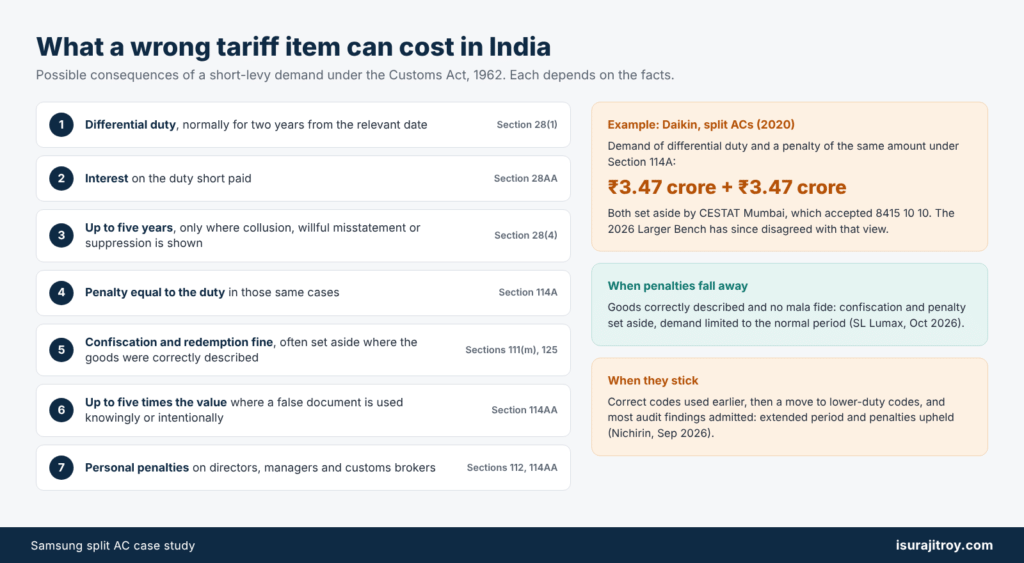
Samsung’s final order does not record a penalty. The consequences of a wrong tariff item in India depend on the facts:
- Differential duty can be demanded under Section 28, normally within two years from the relevant date.
- Interest is payable under Section 28AA.
- The period extends to five years under Section 28(4) only where collusion, willful misstatement or suppression of facts is shown.
- In those cases, a penalty equal to the duty can be imposed under Section 114A.
- Confiscation under Section 111(m), with a redemption fine, is often sought, but the Tribunal has repeatedly held that a classification claim with a correct description of the goods does not attract it.
- A penalty of up to five times the value of the goods under Section 114AA requires that a person knowingly or intentionally used a false or incorrect document.
Importers of similar goods faced these demands:
- In Daikin (2020), the Principal Commissioner demanded differential duty of ₹3,46,64,737 (about ₹3.47 crore) and imposed a penalty of the same amount under Section 114A. CESTAT Mumbai set both aside because it accepted Daikin’s classification.
- In the Mitsubishi Electric case (CESTAT Mumbai, February 28, 2022), the DRI’s adjudicating authority found that in 561 of 1,030 consignments of air conditioners and parts, the goods had been classified under 8415 10 10, 8415 10 90 or 8415 90 00 when other items applied, and ineligible concessions claimed. It imposed penalties on the company under Sections 114A and 114AA, personal penalties on its managing director and other senior staff, and penalties on a customs broker. The Tribunal accepted the importer’s classification and exemption claims. It set aside the Section 114A penalty to the extent it related to those issues, set aside the confiscation, and allowed the appeals of the individual employees. It remanded the countervailing duty valuation issue, on which the extended period was upheld, and left any penalty and confiscation on that issue to be decided again.
Penalties in classification cases often fall away. In SL Lumax v. Commissioner of Customs (CESTAT Chennai, October 28, 2026), the Tribunal followed the Supreme Court in Northern Plastic Ltd. (1998): a tariff claim made with a correct description of the goods is not a misdeclaration under Section 111(m). It set aside the confiscation, the redemption fine and the Section 114A penalty, and limited the demand to the normal period. In Unibourne Food Ingredients v. Commissioner of Customs (CESTAT Mumbai, November 2, 2026), the Tribunal held that penalties and confiscation on the ground of misclassification, without mala fide, were not justified, although there the importer also won on classification.
Conduct can change the outcome. In Nichirin Imperial Autoparts v. Commissioner of Customs (CESTAT New Delhi, September 21, 2026), the importer had used the correct headings earlier and then moved to headings with lower duty, and had admitted most of the discrepancies the audit found. The Tribunal held the wrong classification intentional, upheld the extended period and upheld the penalties.
Similar cases on air conditioners
| Case | Forum and date | Goods and codes | Result |
| ETA General v. Commissioner of Customs, Chennai-II | CESTAT Chennai, July 26, 2016 | 2-ton split units, described by the adjudicator as having reversible heat pumps; declared 8415 10 10 with an India–Thailand exemption claim | Importer lost; 8415 83 10 upheld |
| Daikin Air-Conditioning India v. Principal Commissioner of Customs (NS-I) | CESTAT Mumbai, September 11, 2020 | Split units including heating models; declared 8415 10 10, Department proposed 8415 81 | Importer won; demand and Section 114A penalty set aside |
| International Aircon v. Commissioner of Customs (NS-V) | CESTAT Mumbai, September 11, 2020 | Mitsubishi wall, ceiling and ducted units; declared 8415 10 10, Department proposed 8415 81 to 83 | Importer won; reclassification set aside |
| Mitsubishi Electric India and others v. ADG (Adjudication), DRI | CESTAT Mumbai, February 28, 2022 | Room split units and VRF systems; declared 8415 10 10 and 8415 90 00 | Importer won on classification and exemption; Section 114A penalty set aside to that extent; individuals’ appeals allowed; remanded on countervailing duty valuation |
| Mitsubishi Electric India v. Commissioner of Customs, Chennai-II | CESTAT Chennai, May 30, 2023 | Separately presented indoor and outdoor units over 2 tons; declared 8415 90 00 | Importer won; parts classification upheld |
| Samsung India Electronics v. Commissioner of Customs (Chennai II) | CESTAT Chennai, November 3, 2026, following the Larger Bench of September 24, 2026 | 2-ton split units incorporating a refrigerating unit; declared 8415 10 10 | Importer lost; 8415 82 10 upheld |
Takeaways for importers and classifiers
- Classify at every level, in order: the heading under GRI 1, then the one-dash subheading, then the two-dash subheading, then the national item. Record the reason at each step.
- Read every line under the heading before choosing one. If a word from the product’s name appears in more than one tariff item, rule out each of them in writing.
- Treat the six-digit HS answer and the eight-digit national answer as separate questions. The supplier’s code is a starting point for the national item.
- Collect the product facts that move the code. For air conditioners these are mounting type, ducted or ductless design, cooling capacity and whether a reversing valve is fitted. Get them from the manufacturer’s specification and keep them on file.
- Put the technical evidence before the first officer who assesses or adjudicates the goods. Evidence produced for the first time on appeal may carry little weight, as in ETA General.
- Follow the case law for your products and treat conflicting decisions as a risk to be managed.
- Choose the code first, then check the rate and any concession that follows from it. Exemption notifications attach to tariff items, and a wrong item loses the concession.
- For contested goods that you import regularly, consider an advance ruling.
- Keep the self-assessment record consistent. A change of tariff item without a documented reason can help turn a classification dispute into a penalty case, as Nichirin shows. For other avoidable errors, see the top 10 common trade compliance mistakes.
To test your own GRI reasoning, try the GRI self-assessment. For classification across the machinery and electrical chapters, see classifying electronics: how to choose between Chapters 84, 85 and 90.
Disclaimer: This case study is an educational analysis of a published Tribunal order. It is not a binding ruling or legal advice, and it makes no finding about any party’s intent. HS references are to the WCO nomenclature; the edition in force on the date of import applies (HS 2012 for the Samsung imports, HS 2022 today). HS codes are harmonized only to six digits. The eight-digit items quoted here belong to India’s Customs Tariff and should be checked against the First Schedule in force on the date of import. For a specific shipment, obtain an advance ruling or advice from a qualified professional.
Sources
- Samsung India Electronics Pvt. Ltd. v. Commissioner of Customs (Chennai II), CESTAT Chennai, Final Order No. 41162/2026, November 3, 2026.
- ETA General Pvt. Ltd. v. Commissioner of Customs, Chennai-II, CESTAT Chennai, Final Order No. 41287/2016, July 26, 2016.
- Daikin Air-Conditioning India Pvt. Ltd. v. Principal Commissioner of Customs (NS-I), CESTAT Mumbai, Final Order No. A/85765/2020, September 11, 2020.
- International Aircon Pvt. Ltd. v. Commissioner of Customs (NS-V), CESTAT Mumbai, Final Order No. A/85803/2020, September 11, 2020.
- Mitsubishi Electric India Pvt. Ltd. and others v. Additional Director General (Adjudication), DRI, CESTAT Mumbai, February 28, 2022 (listed on Indian Kanoon as “Mitsubishi Electric India Pvt Ltd vs Commissioner Of Customs-Nhava Sheva – I”).
- Mitsubishi Electric India Pvt. Ltd. v. Commissioner of Customs, Chennai-II, CESTAT Chennai, Final Order No. 40365/2023, May 30, 2023.
- Nichirin Imperial Autoparts India Pvt. Ltd. v. Commissioner of Customs, ICD Patparganj, CESTAT New Delhi, September 21, 2026.
- SL Lumax Ltd. v. Commissioner of Customs, Chennai-II, CESTAT Chennai, October 28, 2026.
- Unibourne Food Ingredients v. Commissioner of Customs, Nhava Sheva-I, CESTAT Mumbai, November 2, 2026.
- WCO, Harmonized System Nomenclature (HS 2022), heading 84.15, Note 4 to Section XVI, and the General Rules for the Interpretation of the Harmonized System
- WCO, Explanatory Notes to the Harmonized System (7th edition, 2022): heading 84.15; Subheading Explanatory Notes to 8415.10 and 8415.90; Explanatory Notes to GRI 3 (a) and GRI 6