
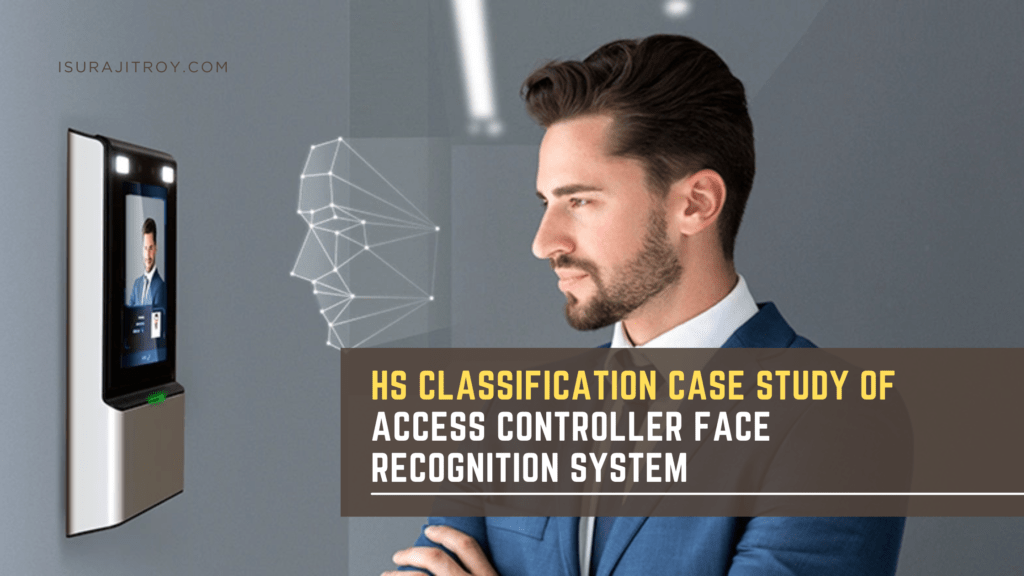
In Face IT Systems LLP v. Commissioner of Customs (Airport & ACC), Kolkata, CESTAT Kolkata held on 2 December 2025 that an “Access Controller Face Recognition System” imported from China is automatic data processing (ADP) machinery of heading 8471, not an electrical apparatus with individual functions of heading 8543. The importer had declared the terminals under India tariff item 8471 60 90 (input or output units of ADP machines) and claimed nil duty; Revenue wanted heading 8543 at 7.5% basic customs duty. The Tribunal decided the point on the expert evidence, testing the device against Note 6(A) to Chapter 84 (full text of the order, Final Order Nos. 77834-77838/2025).
The case is a clear example of a conflict that comes up often with security electronics: a device sold as an access-control product that, on the technical evidence, works as a data terminal. The analysis below uses HS 2022 terms; the national codes are Indian tariff items.
The goods
The terminals were declared as “Data Collection Terminal (based on face recognition)”. They are biometric data-capture and access-control terminals used in offices, factories, airports and other secured facilities. Each unit:
- has a biometric sensor (facial recognition or fingerprint capture);
- has a display screen and user interface;
- captures personal identification data and converts it into digital signals; and
- transmits the captured data to a central ADP system.
Expert reports placed before the Tribunal (from STQC IT Services and Jadavpur University’s Department of Power Engineering) added the facts that decided the case. The device has 4 GB of RAM and 64 GB of flash memory, runs an embedded Linux operating system, can process programs, reads camera, card and QR-code inputs, detects faces even when the person wears a mask, .
The competing headings
Heading 8471: ADP machines and units
Heading 8471 covers automatic data processing machines and units thereof. Note 6 to Chapter 84 sets the tests: Note 6(A) defines an ADP machine by four functions (storing the processing program and data, being freely programmable, performing arithmetical computations, and executing a processing program without human intervention), and Note 6(C) treats a separate unit as part of an ADP system only if it is of a kind solely or principally used with such a system, can be connected to it, and accepts or delivers data in a form the system can use. Subheading 8471.60 (HS 847160) covers input or output units.
According to the WCO Explanatory Notes, terminals, scanners and readers belong in heading 8471 only when their principal function is data input or output for an ADP system.
Heading 8543: the residual electrical heading
Heading 8543 covers “electrical machines and apparatus, having individual functions, not specified or included elsewhere in this Chapter”. It takes apparatus with a function of its own that no other heading describes. It does not apply to goods that another heading covers more specifically.
The link between the two is Note 6(E) to Chapter 84: a machine that performs a specific function other than data processing, and incorporates or works with an ADP machine, is classified in the heading for that function or, failing that, in a residual heading such as 8543. The order does not discuss Note 6(E), but Revenue’s case for 8543 depended on it: the question it raises is whether face-recognition access control is a function other than data processing. By finding the device an ADP machine on the Note 6(A) tests, the Tribunal in effect treated identification as data processing.
How the GRIs resolve it
GRI 1: heading terms and Chapter 84 notes
Under GRI 1, classification follows the terms of the headings and the Section and Chapter Notes. On the expert evidence, the Tribunal found that the device performs the functions listed in Note 6(A) and held: “The device is clearly Automatic Data Processing machinery falling under CTH 8471.” It rejected Revenue’s claim under 8543.
The Tribunal also followed two earlier decisions on fingerprint-based devices, STJ Electronics (2016 (337) ELT 140 (Tri-Del)) and Invixim Access Pvt Ltd v. CC Ahmedabad (Final Order No. 10856/2024, 9 April 2024). It treated them as squarely applicable: the technology had moved from fingerprints to faces, but the function was the same.
Where GRI 3(a) fits
GRI 3(a) prefers the heading with the most specific description, and it is sometimes used to argue this kind of case: 8471.60 names input or output units, while 8543 is a basket provision. But GRI 3 is reached only when GRI 1 and the notes cannot decide. Here Note 6 to Chapter 84 settles the heading. If GRI 3(a) were reached, it would point the same way.
Why disputes like this arise
Disputes over biometric terminals often start from: classifying by the marketing description (“access control”, “security”) instead of the technical function; reading “electrical apparatus” as covering anything that works on its own; and not recording the reasoning behind the code. Reassessments, audits and denied exemptions follow from each of them. A classification file that records the technical basis for the code, as described in building an audit-proof HS classification file, avoids most of these problems.
What was at stake: Notification No. 24/2005-Customs
The importer claimed nil basic customs duty under Notification No. 24/2005-Customs dated 1 March 2005, which grants concessions to specified goods, including certain heading 8471 products, subject to its conditions. Classification under 8543 would have meant:
- loss of the exemption;
- duty recalculated at 7.5%; and
- a demand for the difference, with interest and penalties.
In the event, the Tribunal set aside the confiscation, the redemption fine and the penalties. It also held the extended-period demand against Face IT time-barred: because earlier Tribunal decisions supported the importer’s classification, suppression could not be shown.
Practice points
- Base the classification on the GRIs and the Chapter 84 notes, not on the product’s sales category.
- Get technical evidence early. Independent test reports on memory, operating system and programmability decided this case.
- Keep the reasoning for each code in the file, ready for an audit.
- Bring in a classification specialist while the product is being designed or sourced, not after a notice arrives.
- Check valuation and origin alongside classification, since an exemption claim depends on all three.
For a related CESTAT case on electronic goods, see the Samsung IC-Codec decision; for another device classified by what it does, see the HP Presence videoconferencing system case study.