
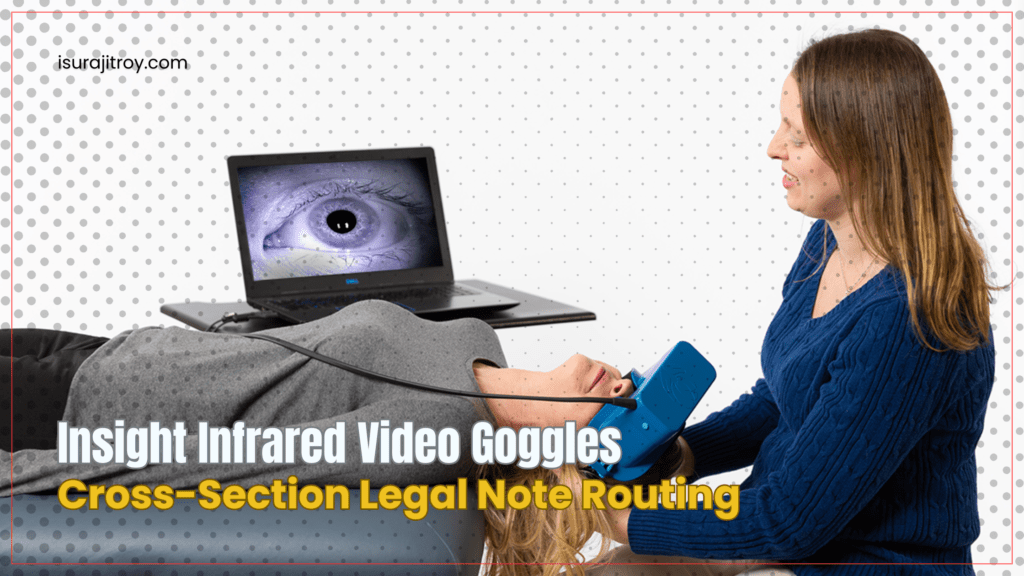
US Customs and Border Protection (CBP) classifies the Insight Infrared Video Goggles in subheading 9018.19.95 of the Harmonized Tariff Schedule of the United States (HTSUS), as electro-diagnostic apparatus. The goggles contain cameras that look like television cameras of heading 85.25, but Note 1(m) to Section XVI sends articles of Chapter 90 out of Section XVI, and CBP found the goggles, taken as a whole, to be medical instruments of heading 90.18. Within that heading, GRI 6 placed them in 9018.19 over the residual 9018.90. The ruling is HQ H334777 (2 January 2025), which revoked NY N308716.
The subject merchandise is a medical diagnostic device worn by a patient during clinical examination for vestibular disorders. The goggles resemble a virtual reality headset and consist of a plastic enclosure (body) that goes around the eyes to block out all light, attached to a front panel (cover) and a silicone strap with adjusters.
The front panel contains two infrared cameras, two switches and a cable assembly. Each camera has two infrared LEDs and one visible light LED embedded on the chip and can detect both visible and infrared light. The visible light LED is activated only when the clinician toggles the switch on the front panel. The goggles have no power source or software of their own. They rely entirely on a connected desktop or laptop computer for power and for the off-the-shelf video viewing software used to display, record and store the captured images.
Trained medical professionals (audiologists, ENT doctors and physicians) use the device to observe a patient’s eye movements under two lighting conditions: (1) infrared only (complete darkness from the patient’s perspective), which reveals abnormal eye movements that occur only when visible light is absent; and (2) visible light, which reveals eye movements that are suppressed under light. The clinician switches between the two modes during the examination to make a differential diagnosis of vestibular disorders. The video images are transmitted to the connected computer, where the clinician views and analyses them using video viewing software with a specific diagnostic template.
The prior ruling (NY N308716) classified the goggles under subheading 9018.90 (other instruments and appliances used in medical sciences: optical instruments). CBP revoked this ruling and reclassified the goggles.
Competing headings
Heading 85.25: “Transmission apparatus for radio-broadcasting or television, whether or not incorporating reception apparatus or sound recording or reproducing apparatus; television cameras, digital cameras and video camera recorders.”
The case for 85.25: the goggles contain two cameras that capture images, convert them into electronic signals and transmit those signals as video images to an external computer, which matches the EN 85.25 description of “television cameras”. EN 85.25(B) states that television cameras are “cameras that capture images and convert them into an electronic signal that is … transmitted as a video image to a location outside the camera for viewing or remote recording.” The cameras have no built-in recording capability and must be used with an ADP machine, which also matches the EN (“some of these cameras may also be used with automatic data processing machines”). If the goggles are “television cameras” of heading 85.25, Note 1(h) to Chapter 90 excludes them from Chapter 90 entirely.
Heading 90.18: “Instruments and appliances used in medical, surgical, dental or veterinary sciences, including scintigraphic apparatus, other electro-medical apparatus and sight-testing instruments; parts and accessories thereof.”
The case for 90.18: the goggles are instruments used in medical sciences, designed for and used only by trained medical professionals to diagnose vestibular disorders. They are purpose-built diagnostic devices, not general-purpose cameras put to medical use. Their form (a VR-headset-style enclosure that blocks all light), their integrated switchable IR/visible LED system and their patient-worn design have no application outside clinical vestibular examination. EN 90.18 states that the heading covers “a very wide range of instruments and appliances which, in the vast majority of cases, are used only in professional practice (e.g., by doctors, surgeons, dentists, veterinary surgeons, midwives), either to make a diagnosis, to prevent or treat an illness or to operate, etc.”
Within heading 90.18 there is a second, subheading-level dispute:
Subheading 9018.19: “Electro-diagnostic apparatus (including apparatus for functional exploratory examination or for checking physiological parameters): Other.”
Subheading 9018.90: “Other instruments and appliances and parts and accessories thereof.”
The original ruling (NY N308716) placed the goggles in 9018.90 as “optical instruments.” The revocation ruling reclassified them to 9018.19 as “electro-diagnostic apparatus.”
The conflict
The case has two tiers.
Tier 1: cross-Section heading competition (85.25 vs 90.18). The goggles contain cameras that, on their face, match the EN 85.25 description of television cameras. The goggles as a whole, however, are purpose-built medical diagnostic instruments. Two interlocking legal notes pull in opposite directions:
- Note 1(m) to Section XVI states: “This Section does not cover … (m) Articles of Chapter 90.” If the goggles are articles of Chapter 90, they are excluded from all of Section XVI, including heading 85.25.
- Note 1(h) to Chapter 90 states that the Chapter does not cover, among other goods, “television cameras, digital cameras and video camera recorders (heading 85.25).” If the goggles are “television cameras” of heading 85.25, they are excluded from Chapter 90, including heading 90.18.
Each note excludes articles that belong in the other’s territory, so the notes alone are circular. The resolution depends on what the product is. Is it a television camera that happens to be used in medicine, or a medical diagnostic instrument that happens to incorporate cameras? (For another product routed through a chain of exclusion notes across Sections, see the UV flame scanner case study.)
Tier 2: subheading competition within heading 90.18 (9018.19 vs 9018.90). If heading 90.18 prevails, GRI 6 requires a decision on whether the goggles are “electro-diagnostic apparatus” (9018.19) or “other instruments” (9018.90). That turns on the meaning of the undefined term “electro-diagnostic.”
Analysis and resolution
Step 1: GRI 1, tier 1: television camera (85.25) or medical instrument (90.18)
The camera components, taken in isolation, match the EN 85.25 description of a television camera. They capture images, convert them to electronic signals and transmit the signals as video to an external location (the connected computer) for viewing or remote recording. They have no built-in recording capability, and they are used with an ADP machine.
The goggles in their entirety, however, are not television cameras. CBP identified several characteristics and functions that distinguish them from the articles of heading 85.25.
The form. The goggles resemble a virtual reality headset, are worn by a patient, and have a plastic enclosure that goes around the eyes to block out all light. Television cameras are mounted on tripods (broadcast cameras) or fitted above screens (webcams). A patient-worn, light-blocking enclosure is, at best, atypical of television cameras.
The camera orientation. The cameras point inwards at the patient’s eyes, not outwards at the world. They capture the patient’s own eye movements for clinical observation, which is a medical diagnostic function, not general-purpose image capture.
The integrated diagnostic lighting. The infrared and visible light LEDs, controlled by a clinician-operated switch, do more than illuminate. They perform a differential diagnostic function: certain abnormal eye movements occur only in the absence of visible light, while others are suppressed by visible light. The clinician toggles between modes to see how eye movements change under each condition. The switchable IR/visible system is part of the diagnostic method, not a camera accessory.
The exclusive medical use. Only trained medical professionals (audiologists, ENT doctors, physicians) use the goggles, to diagnose vestibular disorders. They have no consumer, commercial or general-purpose application.
Conclusion on tier 1: the goggles, taken in their entirety, are instruments used in medical sciences of heading 90.18, not “television cameras” of heading 85.25. Note 1(h) to Chapter 90 does not exclude them, because they are not “television cameras”; they are medical diagnostic instruments that incorporate camera components as a subsidiary means to their diagnostic function. In turn, Note 1(m) to Section XVI excludes them from heading 85.25 because they are articles of Chapter 90.
EN 90.18 supports this: the heading covers instruments “which may be equipped with optical devices” and which “may also make use of electricity, either as motive power or for transmission, or as a preventive, curative or diagnostic agent.” The goggles’ cameras are optical devices fitted to a medical instrument, not standalone television cameras.
Step 2: GRI 6, tier 2: subheading 9018.19 (electro-diagnostic) or 9018.90 (other)
GRI 6 requires subheading classification to be determined by the terms of the subheadings at the same level (see this guide to applying the GRIs, including GRI 6). Subheading 9018.19 (“Electro-diagnostic apparatus”) and subheading 9018.90 (“Other instruments and appliances”) are at the same level and can be compared directly. Under GRI 6, the residual “other” subheading 9018.90 can apply only if the goods cannot be classified in a preceding subheading at the same level.
What does “electro-diagnostic” mean?
The term is not defined in the HTSUS or the ENs. CBP consulted Stedman’s Medical Dictionary, which gives two senses:
- Broad: “The use of electronic devices for diagnostic purposes.”
- Narrow (by convention): “The studies performed in the EMG laboratory, i.e., nerve conduction studies and needle electrode examination.”
CBP adopted the broad definition. The exemplar list in EN 90.18(V)(1) supports this reading: item (x) is a broadly described category, “Diagnostic apparatus incorporating or operating in conjunction with an automatic data processing machine for processing and visualising clinical data, etc.” This catch-all exemplar does not require the device to perform electromyography or nerve conduction studies. It requires only that the apparatus be (a) diagnostic, (b) incorporating or operating in conjunction with an ADP machine, and (c) used for processing and visualising clinical data.
The goggles satisfy all three elements of EN 90.18(V)(1)(x):
- (a) Diagnostic. Trained clinicians use the goggles to diagnose vestibular disorders by observing abnormal eye movements.
- (b) Operating in conjunction with an ADP machine. The goggles have no power source or software; they rely on a connected computer for power, video processing, display and storage.
- (c) Processing and visualising clinical data. The infrared and visible light video of the patient’s eye movements goes to the computer, where off-the-shelf video software with a diagnostic template processes and displays it for the clinician’s analysis.
The goggles also meet Stedman’s broad definition. They are electronic devices (infrared cameras, LEDs, switches and a cable assembly, all electrically powered) used for diagnostic purposes (diagnosing vestibular disorders by observing abnormal eye movements).
A commenter argued for the narrow definition, citing an eMedicine source that limits “electrodiagnosis” to electrophysiology, electromyography and nerve conduction studies. CBP rejected the argument because (1) the commenter did not address the broad first sense in Stedman’s; (2) the eMedicine definition closely matches only the narrow second sense; (3) the EN 90.18(V)(1)(x) exemplar, a broadly described diagnostic apparatus operating with an ADP machine, weighs against a narrow interpretation; and (4) the commenter did not show why the legal text requires a strictly narrow reading.
The commenter also cited HQ H304293 (blood pressure monitors classified as electro-diagnostic in 9018.19 because they “utilize electrical components in the performance of a diagnosis”) and argued that the goggles differ because they do not check physiological parameters. CBP rejected the distinction. The goggles do use electrical components (infrared cameras, LEDs) in the performance of a diagnosis: they capture abnormal eye movements under controlled lighting for vestibular assessment. That is “the use of electronic devices for diagnostic purposes.”
Result: the goggles are “electro-diagnostic apparatus” of subheading 9018.19, not “other instruments” of subheading 9018.90. Because 9018.19 gives the more specific description (electro-diagnostic apparatus against the residual “other”), GRI 6 requires classification in 9018.19. The “other” provision of 9018.90 can apply only if the product cannot be classified in a preceding provision.
Final classification
9018.19.95, HTSUS: Instruments and appliances used in medical, surgical, dental or veterinary sciences: Electro-diagnostic apparatus (including apparatus for functional exploratory examination or for checking physiological parameters): Other: Other: Other.
The case is resolved by GRIs 1 and 6. Note 1(m) to Section XVI excludes the goggles from heading 85.25; Note 1(h) to Chapter 90 does not apply because the goggles are not “television cameras.” Within heading 90.18, GRI 6 places the goggles in 9018.19; the residual 9018.90 applies only to goods not covered by a preceding subheading.
The ruling: CBP Headquarters Ruling HQ H334777 (January 2, 2025) classifies the Insight Infrared Video Goggles in 9018.19.95, HTSUS. It revoked NY N308716 (January 28, 2020), which had classified the goggles under 9018.90.20.
Classification principles
- Note 1(m) to Section XVI and Note 1(h) to Chapter 90 are interlocking exclusions, and they are resolved by the identity of the product, not of its components. When a medical instrument incorporates cameras, the question is not whether the cameras, isolated, match heading 85.25. It is whether the complete article, taken in its entirety, is a “television camera” or a medical instrument. If the article’s form, design intent, integrated clinical function and exclusive professional use establish it as a medical instrument, Note 1(m) excludes it from Section XVI, and Note 1(h) does not apply because the article is not a “television camera” within the meaning of heading 85.25. (For another Chapter 90 note deciding a classification, see the case study on Note 2(b) to Chapter 90 and parts of an analyser.)
- “Electro-diagnostic apparatus” in subheading 9018.19 has a broad and a narrow meaning, and the broad sense governs for tariff classification. Stedman’s Medical Dictionary defines “electrodiagnosis” broadly as “the use of electronic devices for diagnostic purposes” and narrowly as EMG laboratory studies. The EN 90.18(V)(1)(x) exemplar (“diagnostic apparatus incorporating or operating in conjunction with an automatic data processing machine for processing and visualising clinical data”) supports the broad interpretation. A device need not perform electromyography or nerve conduction studies to qualify as electro-diagnostic.
- GRI 6 requires the more specific subheading to be exhausted before the residual “other” can apply. Subheading 9018.19 (electro-diagnostic apparatus) and subheading 9018.90 (other instruments) are at the same level. A product can be classified in 9018.90 only if it cannot be placed in any preceding provision at the same level.
- Electronic functioning is necessary for electro-diagnostic classification but not sufficient. The fact that a device works electronically does not, by itself, make it electro-diagnostic. When a device uses electrical components (cameras, LEDs, switches) specifically to generate clinical data (images of abnormal eye movements) that a medical professional uses for diagnosis, it moves from “functioning electronically” to “using electronic devices for diagnostic purposes.”
- The exemplar list in EN 90.18(V)(1) is illustrative, not exhaustive, and it includes a catch-all. Item (x), diagnostic apparatus operating with an ADP machine for visualising clinical data, is deliberately broad and is not limited to the modalities in items (i)–(ix) (electrocardiographs, ultrasonic scanning, MRI and so on). A new diagnostic device that visualises clinical data through connected computer software can fall under this exemplar even if it uses none of the traditional electrophysiology techniques.
Summary of the headings considered
| Heading | Why it is considered | Reason for rejection or acceptance |
| Heading 85.25 (Television cameras) | Goggles contain two cameras that capture images, convert them to electronic signals and transmit video to a connected computer for viewing/recording, matching the EN 85.25 television camera definition when the cameras are considered in isolation | Rejected. The goggles in their entirety are not television cameras: the patient-worn VR-headset form, light-blocking enclosure, inward-facing cameras, switchable IR/visible diagnostic lighting and exclusive clinical use distinguish them; Note 1(m) to Section XVI excludes articles of Chapter 90 |
| Heading 90.18, sub. 9018.90 (Other instruments and appliances: optical) | Goggles are medical instruments with optical components (cameras, LEDs); the original ruling NY N308716 classified them here as “optical instruments and appliances” | Rejected at subheading level. Under GRI 6, the residual “other” of 9018.90 applies only if the goods cannot be classified in 9018.19; the subheadings are at the same level and directly comparable; the goggles meet the terms of 9018.19, so 9018.90 cannot apply |
| Heading 90.18, sub. 9018.19 (Electro-diagnostic apparatus: other) | Goggles are electronic devices (IR cameras, LEDs, switches powered via the connected computer) used for diagnostic purposes (vestibular disorder diagnosis); they operate with an ADP machine to process and visualise clinical data (eye movement images) | Classified here via GRIs 1 and 6. Meets Stedman’s broad definition of electrodiagnosis (“use of electronic devices for diagnostic purposes”); matches the EN 90.18(V)(1)(x) exemplar (diagnostic apparatus operating with an ADP machine for visualising clinical data); the electrical components directly enable the diagnostic function |
| Commenter’s narrow interpretation | Argued that “electro-diagnostic” should be limited to electrophysiology, EMG and nerve conduction studies, and that the goggles do not check physiological parameters | Rejected by CBP. Stedman’s first sense is broad; EN 90.18(V)(1)(x) is a broadly described catch-all exemplar with no EMG or nerve conduction requirement; the commenter did not address the broad definition or reconcile the EN |
Scope: this analysis applies HS 2022 and the HTSUS as cited in the 2025 ruling. From 1 January 2028, HS 2028 adds new subheadings for some diagnostic devices, so check the 2028 structure of heading 90.18 before relying on 9018.19 for future entries.