
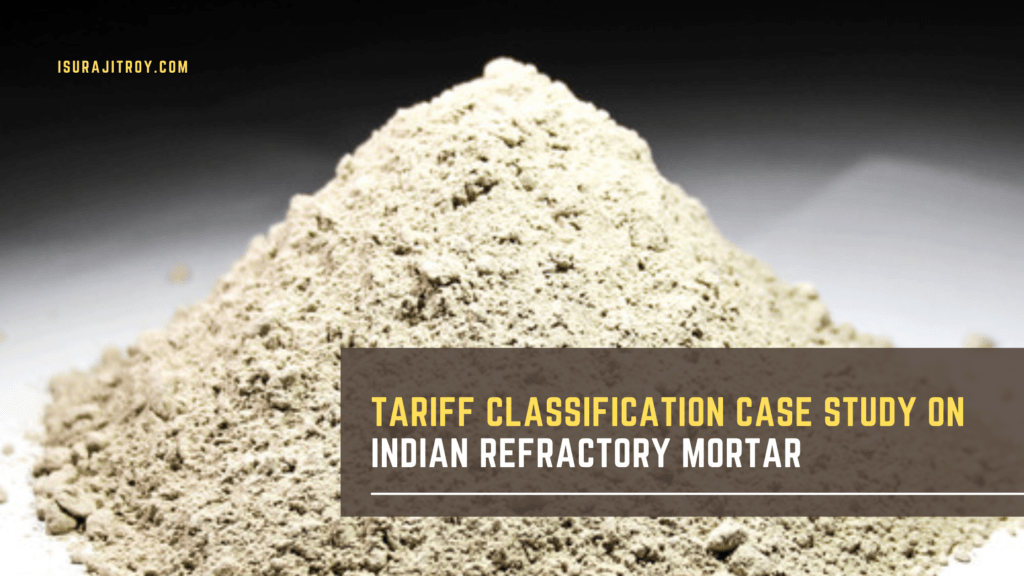
In Commissioner of Customs (Port), Kolkata v. Alliance International and others and connected appeals (Final Order No. 75441-75460/2025, 24 February 2025), CESTAT Kolkata held that “Indian Refractory Mortar”, a powder made by mixing chromite with magnesite and bentonite, falls under heading 3816 (refractory cements, mortars and similar compositions; India tariff item 3816 00 00, HS 381600), not under heading 2610 as chromium ore. The deciding provision was Note 2 to Chapter 26, which excludes from the ore headings minerals that have been submitted to processes not normal to the metallurgical industry. With the goods outside heading 2610, no export duty was payable.
The final judicial outcome dismissed the Revenue’s appeals. The case shows why chemical composition alone does not decide classification: a product that is about 70% chromium oxide was still not an ore.
Why the classification was contested
The exporter declared the product as “Refractory Mortar” under heading 3816. Customs alleged it was chromium ore concentrate under heading 2610. That would have meant:
- 30% export duty under the Second Schedule to the Customs Tariff Act, 1975;
- loss of the 3% MEIS export benefit;
- export restrictions (chromium ore was ‘restricted’ under the DGFT export policy, according to Revenue); and
- penalties.
Laboratory tests showed roughly 66.8–73.7% Cr2O3, 10.1–13.9% Fe2O3, 4.0–7.1% Al2O3, 4.7–8% MgO and 0.69–3.6% SiO2. The buyer, in Spain, used the product for frits, glazes, pigments and ceramic additives. Customs read the high chromium content as proof of an ore; the Tribunal looked at what had been done to the mineral.
The legal framework
GRI 1 and GRI 6
The case was decided under GRI 1 (the terms of the headings and the Section and Chapter Notes) and GRI 6 (the same method at subheading level). Subjective factors played no part.
The Tribunal also relied on the Supreme Court’s decision in Madhan Agro, noting that classification cannot be resolved on the basis of the perception of consumers or customers. The principle is simple:
Classification is decided by law, not by perception or trade usage.
Note 2 to Chapter 26: what counts as an ore
Note 2 to Chapter 26 is a legal note, binding under GRI 1. It defines “ores” for headings 26.01 to 26.17 as minerals of mineralogical species actually used in the metallurgical industry for the extraction of metals, even if they are intended for non-metallurgical purposes. It then excludes minerals that have been submitted to processes not normal to the metallurgical industry.
The Tribunal found that mixing chromite with magnesite and bentonite is such a process, and that the product was not used to extract metal. It concluded that the exported product does not fall under heading 2610. Because the note covers ores “even if they are intended for non-metallurgical purposes”, the processing, more than the end use, is what takes the product out of Chapter 26.
Heading 3816 and the Explanatory Notes
The Tribunal also referred to the HSN Explanatory Notes to Chapter 26 and headings 38.16 and 81.12 (on how Explanatory Notes are used in disputes, see this explainer). Heading 3816 covers prepared refractory compositions, such as mixtures of refractory aggregates with binders. The Tribunal treated the product, a processed mixture used in refractory and ceramic applications, as a refractory aggregate or additive of heading 3816.
Heading 2610 vs heading 3816
| Parameter | 2610: chromium ores and concentrates | 3816: refractory cements, mortars and similar compositions |
| Chapter | Chapter 26 (ores, slag and ash) | Chapter 38 (miscellaneous chemical products) |
| Nature of goods | Natural ores or concentrates | Prepared compositions |
| Processing | Limited to processes normal to the metallurgical industry | Mixing and blending with other materials |
| Typical use | Metal extraction | Furnace linings, refractory and ceramic use |
| Legal note or EN position | Note 2 to Chapter 26 excludes minerals processed in ways not normal to metallurgy | Explanatory Notes include mixed refractory aggregates |
| Export duty in India (at the time) | 30% (Second Schedule) | None |
The same reasoning, comparing what was done to a mineral with what the ore headings allow, appears in the case study When an ore looks like a battery scrap.
What the Tribunal said about lab reports and penalties
On the test results, the Tribunal said: “Lab report can give the chemical composition; however, the classification is decided by the proper officer.” A high chromium figure did not settle the heading; the notes did.
The adjudicating authority had imposed a penalty of ₹10 lakh under Section 114AA on a director of one of the exporters. The Tribunal dropped it, reasoning that “when no demand of duty is sustainable against the respondents, therefore, no penalty can be imposed.”
What misclassification would have cost
Had heading 2610 stood, the exporter faced a retrospective duty demand, interest and penalties, and the loss of the export incentive. Customs law penalises incorrect declarations and incomplete product descriptions as well as deliberate evasion. Beyond the money, shipments of a product treated as a restricted ore can be held, and repeated disputes damage an exporter’s standing with customs and with buyers. A documented legal basis for the code, prepared before shipment, is the first line of defence.
A method for products like this
- Identify the product:
- composition
- processing
- function
- end use
- Analyse the headings:
- apply the Section and Chapter Notes
- test the exclusions first
- Check the Explanatory Notes:
- confirm the inclusion and exclusion logic
- Record the reasoning:
- write down why each alternative heading fails
- Build the file:
- keep the classification file ready for audit (see building an audit-proof HS classification file)
Takeaways
- Tariff classification is a legal determination, not a commercial one.
- Chemical composition alone does not decide classification.
- For minerals, the processing applied is decisive under Note 2 to Chapter 26; intended use alone does not take an ore out of Chapter 26.
- Lab reports describe the goods; the headings and notes classify them.
For another case where a product looked like one thing chemically and was classified as another, see When a solvent looks like a fuel.