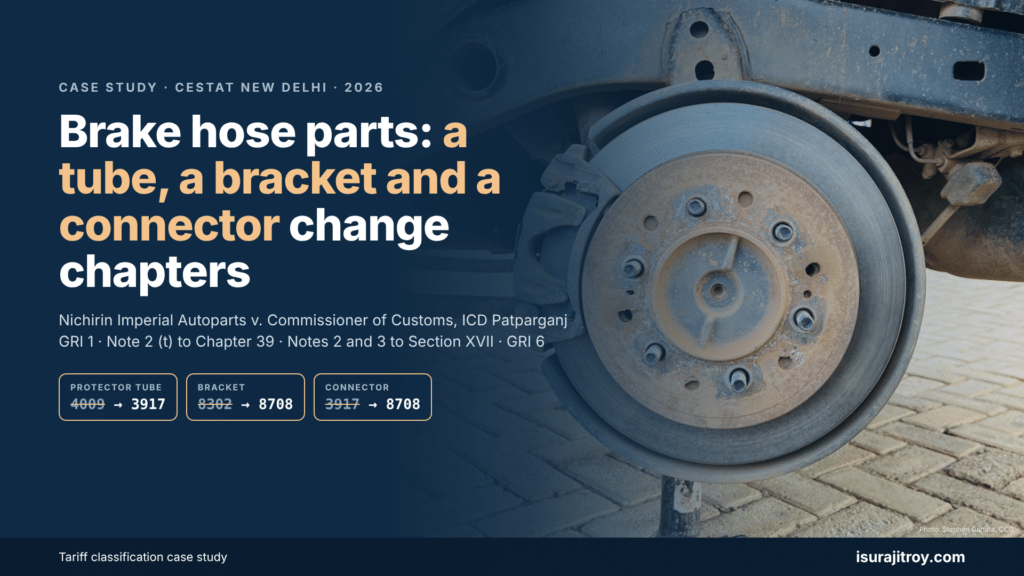
Nichirin Imperial Autoparts India Pvt. Ltd. imports brake hoses and other brake components and makes brake hose assemblies at Faridabad. A post-clearance audit found nine problems in its imports. The company accepted most of them and fought three: a protector tube, a bracket and a connector. On September 21, 2026, the Principal Bench of the Customs, Excise and Service Tax Appellate Tribunal (CESTAT) in New Delhi ruled against it on all three. The Tribunal also upheld the extended period of limitation and the penalties.
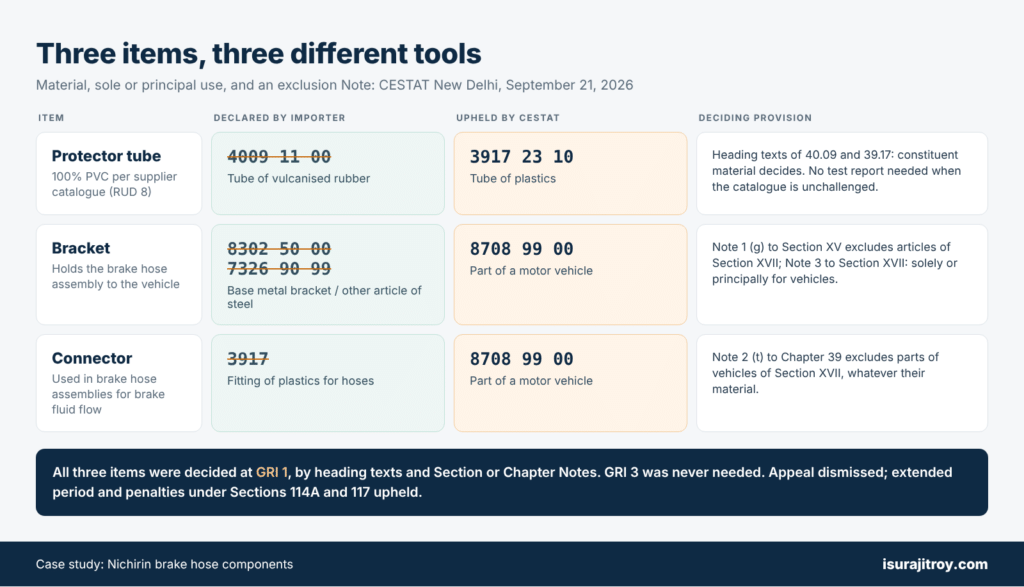
Each of the three items left the chapter the importer chose. The protector tube moved from rubber (Chapter 40) to plastics (Chapter 39) because of what it is made of. The bracket moved from base metal (Chapters 73 and 83) to vehicle parts (Chapter 87) because of what it is used for. The connector moved from plastics (Chapter 39) to vehicle parts because a Chapter Note excludes vehicle parts from Chapter 39. So one order shows three classification tools at work: constituent material, sole or principal use, and an exclusion Note.
This study follows each item through the General Rules for the Interpretation of the Harmonized System (GRIs) in order. It names the Section Notes, Chapter Notes and Explanatory Notes (ENs) that apply at each step, including the ENs to the GRIs. It also covers two provisions the order does not discuss, Note 2 to Section XVII and subheading 8708.30, which a classifier should check before relying on the result.
Case: Nichirin Imperial Autoparts India Pvt. Ltd. v. Commissioner of Customs, Inland Container Depot, Patparganj & other ICDs, CESTAT New Delhi, Principal Bench, Court No. I, Customs Appeal No. 50248 of 2025, decided September 21, 2026. Full text on Indian Kanoon.
At a glance
| Point | Detail |
| Importer | Nichirin Imperial Autoparts India Pvt. Ltd., Ballabgarh, Faridabad (imports brake hoses and other automobile brake components; also trades domestically) |
| How the dispute arose | Post-clearance audit; Final Audit Report of July 27, 2023 listed 9 discrepancies, 7 of them classification errors |
| Items contested before the Tribunal | Protector tube (Part No. T3-673-0000NAI), bracket for brake hose assembly (BR7102-02001-C3NA), connector (Part No. K94478-02000) |
| Importer’s codes | Protector tube 4009 11 00; bracket 8302 50 00 or 7326 90 99; connector 3917 |
| Codes upheld | Protector tube 3917 23 10; bracket 8708 99 00; connector 8708 99 00 |
| Deciding provisions | Heading texts of 39.17 and 40.09 (material); Note 1 (g) to Section XV and Note 3 to Section XVII (bracket); Note 2 (t) to Chapter 39 (connector) |
| Total duty demanded (all items) | ₹1,54,37,173 under Section 28(4) of the Customs Act, 1962, with interest under Section 28AA |
| Dropped by the adjudicator | ₹92,732 on an adaptor-joint |
| Concession lost | Notification No. 46/2011-Customs (India–ASEAN) on the protector tube |
| Penalties | Proposed under Sections 114A and 117; confirmed and upheld (amounts not stated in the order) |
| Result | Appeal dismissed |
Why this case is worth studying
Most parts disputes are about Section XVI, where Note 2 to that Section sends parts of machines to their own headings or to the machine. Vehicle parts work differently. Heading 87.08 covers “parts and accessories” of motor vehicles, but Section XVII decides what counts as a “part” through two Notes. Note 2 takes certain goods out of “parts” even when they are made for vehicles. Note 3 keeps in only those parts suitable for use solely or principally with vehicles.
On the other side sit the material chapters. Chapter 39 (plastics), Chapter 40 (rubber) and Section XV (base metals) each have their own Notes that push some vehicle goods out and keep others in. An importer of brake hose components is working right at this boundary. A connector moulded in plastic, a stamped steel bracket and an extruded PVC tube can each be argued into a material heading or into 87.08.
The case also shows how classification and penalty connect in India’s self-assessment system. The Tribunal held that the importer had used the Department’s codes in earlier bills of entry and then changed them. It treated that change as evidence of intent, which supported both the five-year limitation period and the penalties.
The goods
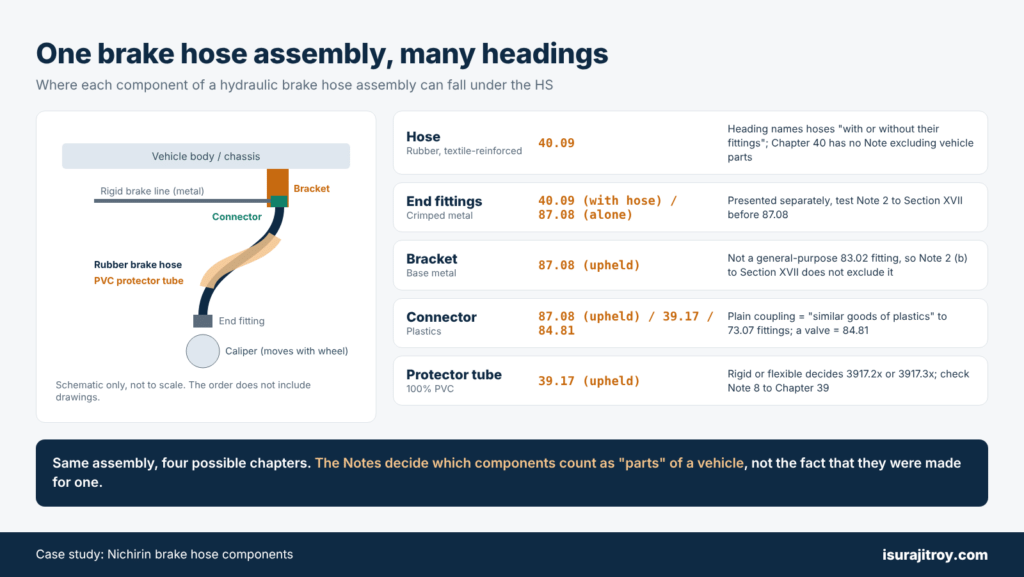
A hydraulic brake hose carries brake fluid from the rigid brake line on the vehicle body to the caliper or wheel cylinder, which moves with the wheel and suspension. A brake hose assembly typically has:
- the hose itself, usually of rubber with textile reinforcement;
- metal end fittings crimped onto the hose;
- a bracket or clip that holds the hose to the body, chassis or strut;
- sometimes a protective sleeve over part of the hose, against abrasion, heat or stone damage.
Nichirin crimps and assembles such hoses, which explains why its imports also included gauges, a crimping die and gluing and inspection jig tools.
The order gives these facts about the three contested items:
- Protector tube (Part No. T3-673-0000NAI). The supplier’s catalogue and photographs (relied upon document RUD 8) described it as 100% PVC. No test report was produced by either side.
- Bracket (BR7102-02001-C3NA). Described in the audit report as “parts for automobile” and in the order as used in the manufacture of brake hose assemblies. The order does not state its metal or shape. Because it was declared under 8302 and 7326, it was presumably of base metal, probably steel.
- Connector (Part No. K94478-02000). Declared under heading 39.17, so presumably of plastics. The Tribunal described the connectors as used in brake hose assemblies to regulate brake fluid flow and designed for integration into automobile brake systems.
The order does not give the dimensions, the drawings, whether the protector tube is rigid or flexible, whether the connector has any valve function, or the duty amount for each item. Those facts would affect several of the points below, and this study does not guess at them.
Timeline
- Earlier bills of entry: according to the Department, the importer classified these goods under the codes the Department later proposed.
- December 10, 2018: one bill of entry (No. 9181826) covered the adaptor-joint on which the demand was later dropped.
- March 24, 2023: the importer replied to the audit observations.
- May 31 and June 9, 2023: the importer paid part of the differential duty.
- July 27, 2023: the Final Audit Report listed nine discrepancies.
- November 2023: show cause notice No. 302/2023/291. The order gives its date as “71.11.2023”, which is a typographical error.
- November 13, 2024: Order-in-Original No. 11/Commr/VC/Nichrin Imperial/ICD-PPG/2024-25 confirmed the demand, except ₹92,732 on the adaptor-joint.
- July 15, 2026: CESTAT heard the appeal.
- September 21, 2026: appeal dismissed.
The copy of the order on Indian Kanoon shows the appeal number but not a Final Order number.
What the audit found
The Final Audit Report proposed these corrections:
| No. | Item | Declared | Proposed |
| 1 | Freight currency | — | Mis-declaration of freight currency |
| 2 | Gauges | CTH 9026 and 9031 | CTH 9017 |
| 3 | Protector tube, Part No. T3-673-0000NAI | 4009 11 00 | 3917 23 90 (audit report); 3917 23 10 (Tribunal) |
| 4 | Adapter, joint (“parts of automobile”) | 8466 30 20 and 8479 90 90 | 8708 99 00 |
| 5 | Bracket BR7102-02001-C3NA (“parts for automobile”) | 8302 50 00 and 7326 90 99 | 8708 99 00 |
| 6 | Crimping die for brake hose assembly | 8479 90 99 | 8207 30 00 |
| 7 | Gluing jig tools, inspector jig tools and other machinery tools | 8466 | 8207 |
| 8 | Connector, Part No. K94478-02000 | 3917 | 8708 |
| 9 | Freight value | — | Freight charges not included in assessable value |
Before the Tribunal the importer accepted items 1, 2, 6, 7 and 9. Item 4 had already been dropped by the adjudicator, and the Department did not appeal. Note that the audit report table gives 3917 23 90 for the protector tube while the Department’s argument and the Tribunal’s finding give 3917 23 10. The Indian eight-digit lines under 3917 23 should be checked against the First Schedule in force on each date of import.
The questions
- Is a PVC protector tube a tube of vulcanised rubber (heading 40.09) or a tube of plastics (heading 39.17)? And if 39.17, which subheading?
- Is a bracket for a brake hose assembly a base metal bracket (heading 83.02), another article of iron or steel (heading 73.26), or a part of a motor vehicle (heading 87.08)?
- Is a plastic connector for a brake hose assembly a fitting for hoses of plastics (heading 39.17) or a part of a motor vehicle (heading 87.08)?
- Did the switch in codes justify the extended period, confiscation and penalties?
The legal provisions
All HS texts below are quoted from the WCO HS 2022 nomenclature. Imports before January 1, 2022 were assessed under HS 2017, and the text in force on each date of import should be checked. Eight-digit lines belong to India’s Customs Tariff (First Schedule to the Customs Tariff Act, 1975) and are quoted as the order states them.
The GRIs that apply
GRI 1: “The titles of Sections, Chapters and sub‑Chapters are provided for ease of reference only; for legal purposes, classification shall be determined according to the terms of the headings and any relative Section or Chapter Notes and, provided such headings or Notes do not otherwise require, according to the following provisions.”
The WCO Explanatory Notes to GRI 1 say that titles have no legal bearing (EN (II) to GRI 1) and that the terms of the headings and the Section or Chapter Notes are “paramount” and are the first consideration (EN (V) (a) to GRI 1). For this case, that means the Section XV, Section XVII and Chapter 39 Notes are read before anyone asks which heading is “more specific”.
GRI 2 (b): “Any reference in a heading to a material or substance shall be taken to include a reference to mixtures or combinations of that material or substance with other materials or substances. Any reference to goods of a given material or substance shall be taken to include a reference to goods consisting wholly or partly of such material or substance. The classification of goods consisting of more than one material or substance shall be according to the principles of Rule 3.”
GRI 3 (a), first sentence: “The heading which provides the most specific description shall be preferred to headings providing a more general description.”
GRI 3 (c): “When goods cannot be classified by reference to 3 (a) or 3 (b), they shall be classified under the heading which occurs last in numerical order among those which equally merit consideration.”
Rule 3 applies only when goods are prima facie classifiable under two or more headings, and only “provided the terms of headings or Section or Chapter Notes do not otherwise require” (EN (II) to GRI 3). Its three limbs run strictly in order (EN (I) to GRI 3).
GRI 6: “For legal purposes, the classification of goods in the subheadings of a heading shall be determined according to the terms of those subheadings and any related Subheading Notes and, mutatis mutandis, to the above Rules, on the understanding that only subheadings at the same level are comparable. For the purposes of this Rule the relative Section and Chapter Notes also apply, unless the context otherwise requires.”
Under EN (II) (a) to GRI 6, one-dash subheadings are compared first, and the two-dash subheadings under the chosen one-dash subheading are considered “then, and only then”. EN (III) to GRI 6 adds that a two-dash subheading cannot be wider than the one-dash subheading above it.
The competing headings
Heading 39.17: “Tubes, pipes and hoses, and fittings therefor (for example, joints, elbows, flanges), of plastics.”
| Level | Subheading | Text |
| One-dash | 3917.10 | – Artificial guts (sausage casings) of hardened protein or of cellulosic materials |
| One-dash | (group) | – Tubes, pipes and hoses, rigid : |
| Two-dash | 3917.21 | — Of polymers of ethylene |
| Two-dash | 3917.22 | — Of polymers of propylene |
| Two-dash | 3917.23 | — Of polymers of vinyl chloride |
| Two-dash | 3917.29 | — Of other plastics |
| One-dash | (group) | – Other tubes, pipes and hoses : |
| Two-dash | 3917.31 | — Flexible tubes, pipes and hoses, having a minimum burst pressure of 27.6 MPa |
| Two-dash | 3917.32 | — Other, not reinforced or otherwise combined with other materials, without fittings |
| Two-dash | 3917.33 | — Other, not reinforced or otherwise combined with other materials, with fittings |
| Two-dash | 3917.39 | — Other |
| One-dash | 3917.40 | – Fittings |
Heading 40.09: “Tubes, pipes and hoses, of vulcanised rubber other than hard rubber, with or without their fittings (for example, joints, elbows, flanges).” Subheading 4009.11 is “– Without fittings” under “- Not reinforced or otherwise combined with other materials”.
Heading 73.26: “Other articles of iron or steel.” Subheading 7326.90 is “- Other”.
Heading 83.02: “Base metal mountings, fittings and similar articles suitable for furniture, doors, staircases, windows, blinds, coachwork, saddlery, trunks, chests, caskets or the like; base metal hat-racks, hat-pegs, brackets and similar fixtures; castors with mountings of base metal; automatic door closers of base metal.” Two of its subheadings matter here: 8302.30, “- Other mountings, fittings and similar articles suitable for motor vehicles”, and 8302.50, “- Hat-racks, hat-pegs, brackets and similar fixtures”.
Heading 87.08: “Parts and accessories of the motor vehicles of headings 87.01 to 87.05.”
| Level | Subheading | Text |
| One-dash | 8708.10 | – Bumpers and parts thereof |
| One-dash | (group) | – Other parts and accessories of bodies (including cabs) : |
| One-dash | 8708.30 | – Brakes and servo-brakes; parts thereof |
| One-dash | 8708.40 | – Gear boxes and parts thereof |
| One-dash | 8708.50 | – Drive-axles with differential, whether or not provided with other transmission components, and non-driving axles; parts thereof |
| One-dash | 8708.70 | – Road wheels and parts and accessories thereof |
| One-dash | 8708.80 | – Suspension systems and parts thereof (including shock-absorbers) |
| One-dash | (group) | – Other parts and accessories : |
| Two-dash | 8708.91 to 8708.95 | Radiators; silencers and exhaust pipes; clutches; steering wheels, columns and boxes; safety airbags (each with parts) |
| Two-dash | 8708.99 | — Other |
The Notes
Note 2 to Chapter 39 (opening words and item (t)): “This Chapter does not cover : … (t) Parts of aircraft or vehicles of Section XVII;”
Note 8 to Chapter 39: “For the purposes of heading 39.17, the expression “tubes, pipes and hoses” means hollow products, whether semi-manufactures or finished products, of a kind generally used for conveying, conducting or distributing gases or liquids (for example, ribbed garden hose, perforated tubes). This expression also includes sausage casings and other lay-flat tubing. However, except for the last-mentioned, those having an internal cross-section other than round, oval, rectangular (in which the length does not exceed 1.5 times the width) or in the shape of a regular polygon are not to be regarded as tubes, pipes and hoses but as profile shapes.”
Note 1 to Section XV (item (g)): “This Section does not cover : … (g) Assembled railway or tramway track (heading 86.08) or other articles of Section XVII (vehicles, ships and boats, aircraft);”
Note 2 to Section XV:
“2.- Throughout the Nomenclature, the expression “parts of general use” means : (a) Articles of heading 73.07, 73.12, 73.15, 73.17 or 73.18 and similar articles of other base metal, other than articles specially designed for use exclusively in implants in medical, surgical, dental or veterinary sciences (heading 90.21); (b) Springs and leaves for springs, of base metal, other than clock or watch springs (heading 91.14); and (c) Articles of headings 83.01, 83.02, 83.08, 83.10 and frames and mirrors, of base metal, of heading 83.06.”
Heading 73.07 is “Tube or pipe fittings (for example, couplings, elbows, sleeves), of iron or steel.” That matters for the connector.
Note 2 to Section XVII (opening words and items (a) to (c)): “The expressions “parts” and “parts and accessories” do not apply to the following articles, whether or not they are identifiable as for the goods of this Section : (a) Joints, washers or the like of any material (classified according to their constituent material or in heading 84.84) or other articles of vulcanised rubber other than hard rubber (heading 40.16); (b) Parts of general use, as defined in Note 2 to Section XV, of base metal (Section XV), or similar goods of plastics (Chapter 39); (c) Articles of Chapter 82 (tools);” The list continues to item (l), and item (e) covers machines of headings 84.01 to 84.79 and articles of heading 84.81.
Note 3 to Section XVII: “References in Chapters 86 to 88 to “parts” or “accessories” do not apply to parts or accessories which are not suitable for use solely or principally with the articles of those Chapters. A part or accessory which answers to a description in two or more of the headings of those Chapters is to be classified under that heading which corresponds to the principal use of that part or accessory.”
The Explanatory Notes
These are the WCO’s official interpretation (HS Explanatory Notes, 7th edition, 2022). They are paraphrased here, with short quotations.
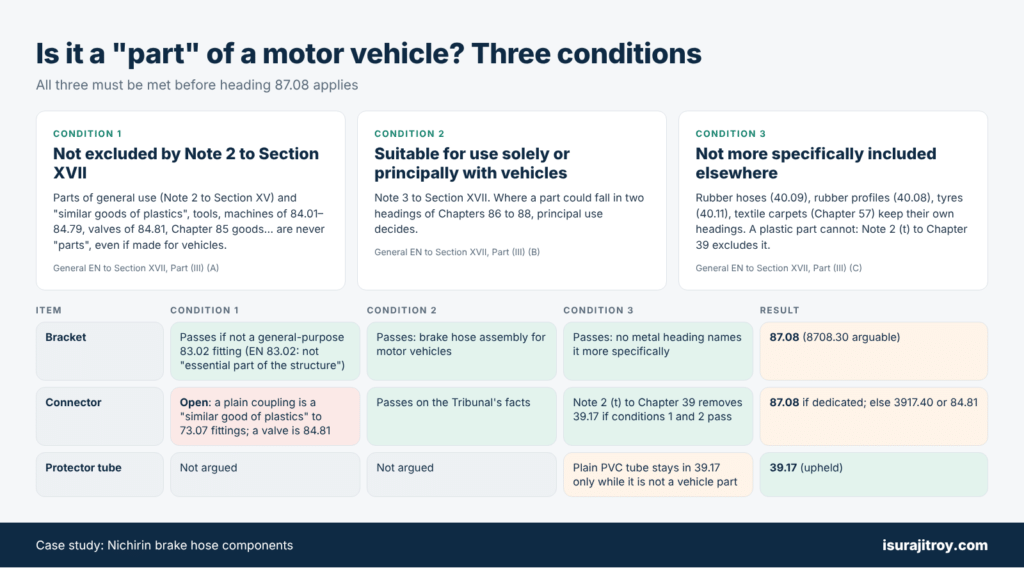
- General EN to Section XVII, Part (III), Parts and accessories. Parts and accessories fall in Chapters 86 to 88 only if they meet three conditions together: they are not excluded by Note 2 to the Section (paragraph (A)); they are suitable for use solely or principally with the articles of those Chapters (paragraph (B)); and they are not more specifically included elsewhere in the Nomenclature (paragraph (C)).
- Paragraph (A) (2) of that EN gives examples of excluded parts of general use: cables, chain, nails, bolts, nuts, washers, springs, and locks, fittings or mountings for coachwork such as hinges, door handles and grip bars. It adds that such goods of base metal go to Chapters 73 to 76, 78 to 81 or 83, and that “similar goods of plastics fall in Chapter 39”.
- Paragraph (B) (1) explains that when a part could fall in Section XVII and in another Section, its principal use decides. Its example is braking systems and steering gear used on both lorries and mobile machines, which go to Section XVII because their principal use is with lorries.
- EN to heading 87.08 repeats two conditions (identifiable as suitable for use solely or principally with vehicles of headings 87.01 to 87.05, and not excluded by the Section XVII Notes). Its list includes, under (A), chassis parts such as “supports and brackets for the coachwork, engine, running-boards, battery or fuel tanks”, and under (H), brakes “and parts thereof (plates, drums, cylinders, mounted linings, oil reservoirs for hydraulic brakes, etc.)”.
- EN to heading 83.02 describes the heading as covering general purpose classes of base metal accessory fittings and mountings, which stay there even when designed for a particular use such as automobile door handles. It says the heading does not extend to goods forming an essential part of the structure of the article. Its group (C) covers mountings and fittings suitable for motor vehicles, “not being parts or accessories of Section XVII”. Group (G) describes the brackets of the heading together with hat-racks, coat racks and towel racks.
- EN to heading 39.17 restates Note 8 to Chapter 39, confirms that the heading includes plastic fittings for tubes, pipes and hoses, and says such tubes and fittings may be rigid or flexible.
- EN to heading 40.09 covers tubes and hoses wholly of vulcanised rubber or reinforced with textile or metal, and keeps them in the heading when presented with fittings provided they keep the character of tubing.
What the Tribunal relied on
The Tribunal cited Commissioner of Central Excise v. Wood Craft Products Ltd. (Supreme Court, 1995) for the rule that the HSN is to be consulted where the tariff is ambiguous, and Commissioner of Central Excise, Salem v. Madhan Agro Industries (India) Pvt. Ltd. (Supreme Court, 2024) for the rule that the HSN and its ENs are binding guidance unless the First Schedule says otherwise.
Item 1: the protector tube
The parties’ positions
The importer declared 4009 11 00, a tube of vulcanised rubber, not reinforced, without fittings, and claimed the India–ASEAN concession under Notification No. 46/2011-Customs on that basis. The Department relied on the supplier’s catalogue and photographs, which said the tube was 100% PVC, and proposed 3917 23 10. The importer produced nothing to contradict the catalogue. It argued only that no test report had been obtained.
How the Tribunal decided
The Tribunal held that under both headings the constituent material is the test: a PVC tube goes to 39.17 and a vulcanised rubber tube goes to 40.09. The catalogue was evidence of the material, the importer had not challenged it, and the absence of a test report did not help the importer. The goods were held classifiable under 3917 23 10 and the concession was denied.
Walking the GRIs
Step 1, GRI 1, heading texts. Heading 40.09 names “tubes, pipes and hoses, of vulcanised rubber”. Heading 39.17 names “tubes, pipes and hoses … of plastics”. Both are material headings, so the question is what the tube is made of.
Step 2, GRI 1, Chapter Notes on the material. Note 1 to Chapter 40 defines “rubber”. Synthetic rubber is defined in Note 4 to Chapter 40 by a vulcanisation, elongation and recovery test. PVC is a thermoplastic polymer of vinyl chloride. It is a plastic within Note 1 to Chapter 39, not a synthetic rubber under Note 4 to Chapter 40. Note 2 (l) to Chapter 39, which sends synthetic rubber to Chapter 40, does not apply. If the catalogue is right, heading 40.09 is out at GRI 1 and nothing at GRI 3 is needed.
Step 3, GRI 1, Note 8 to Chapter 39. The Tribunal did not discuss this Note, but it is a condition for heading 39.17. A “tube” there must be a hollow product “of a kind generally used for conveying, conducting or distributing gases or liquids”, with a round, oval, qualifying rectangular or regular polygonal internal cross-section. A protector tube does not carry fluid in use; it sheaths a hose that does. The words “of a kind generally used” point to the type of product, not to the use of the imported item, so a plain extruded round PVC tube cut to length would usually still qualify. A spiral-wrap sleeve, a slit tube or a tube with a non-qualifying cross-section might not. It would then be a profile shape of heading 39.16 or an article of heading 39.26. The catalogue and photographs should be checked against Note 8.
Step 4, GRI 1, Note 2 (t) to Chapter 39. This is the same Note that decided the connector. If the protector tube is a “part” of a motor vehicle within Section XVII, Chapter 39 excludes it. The Department did not argue that, and the Tribunal did not consider it. Under the three-condition test in the General EN to Section XVII (Part (III)), a tube cut to length for one hose assembly might be suitable for use solely or principally with vehicles. Paragraph (C) of that EN keeps some vehicle goods in their own headings when they are “more specifically included elsewhere”, for example rubber profile shapes in heading 40.08. But that rule cannot help a plastic tube, because Note 2 (t) removes vehicle parts from Chapter 39 entirely. The same tube in vulcanised rubber would stay in 40.09, since Chapter 40 has no equivalent exclusion. So the protector tube’s position in Chapter 39 depends on its being a plain tube rather than a dedicated vehicle part. If it had been argued as a part, 8708.30 (brakes; parts thereof) would have been the candidate, as discussed under the connector.
Step 5, GRI 2 (b) and GRI 3. Commercial PVC contains plasticisers, stabilisers and fillers. GRI 2 (b) and EN (XI) to GRI 2 (b) extend heading 39.17 to goods consisting partly of plastics, and EN (XII) to GRI 2 (b) says this does not apply where the added material changes the character of the goods. Neither applies to a PVC compound. GRI 3 is not reached.
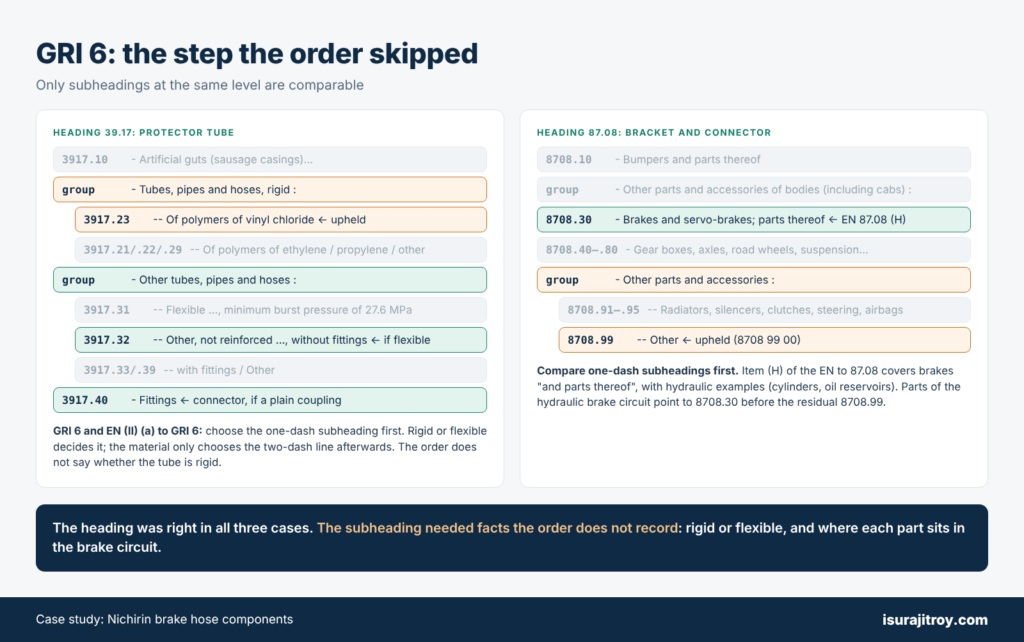
Step 6, GRI 6, subheadings. This is where the order is incomplete. Inside heading 39.17, the one-dash subheadings are compared first (EN (II) (a) to GRI 6):
- 3917.10, sausage casings: no;
- “Tubes, pipes and hoses, rigid”;
- “Other tubes, pipes and hoses”;
- 3917.40, fittings: no.
Subheading 3917.23 (“Of polymers of vinyl chloride”) is a two-dash subheading under “rigid”. It can be reached only if the tube is rigid. The HS does not define “rigid” for heading 39.17, and the EN to the heading says tubes in the heading may be rigid or flexible. If the protector tube is flexible, the two-dash choice is under “Other tubes, pipes and hoses”. That would probably be 3917.32 (“Other, not reinforced or otherwise combined with other materials, without fittings”), unless it meets the 27.6 MPa burst pressure test of 3917.31, which a protective sleeve would not be designed for. A PVC sleeve over a brake hose has to bend with the hose as the suspension moves, so flexibility is a real question. The order treats the choice of 3917 23 10 as following from the material alone.
Only after the one-dash choice is made does the material decide the two-dash line. Inside the “rigid” group, PVC goes to 3917.23. Subheading Note 1 to Chapter 39 governs how polymers and copolymers are allocated among subheadings and would matter only if the compound were a copolymer.
Step 7, national line and concession. The Tribunal’s eight-digit line is 3917 23 10, and the audit report’s table shows 3917 23 90. Notification No. 46/2011-Customs grants rates by tariff line for goods of ASEAN origin, so the concession claimed under 4009 11 00 could not carry over. Whether a concession was available under the correct 3917 line is a separate question the order does not address.
Outcome
Heading 39.17 is well supported by the uncontested catalogue. The subheading needs a fact the record does not show: whether the tube is rigid or flexible.
Item 2: the bracket
The parties’ positions
The importer declared the bracket under 8302 50 00 (“brackets and similar fixtures”) or 7326 90 99 (“other articles of iron or steel”). The Department argued that a bracket forming an integral part of a brake hose assembly used in motor vehicles is a vehicle part of heading 87.08, and that parts principally used with Chapter 87 vehicles belong in Section XVII, not Section XV. The order records that the importer did not contest the show cause notice’s position that the bracket was not of general-purpose use, and that it had itself described the goods as “parts of automobile” in the import documents.
How the Tribunal decided
The Tribunal read the three heading texts, then Note 1 (g) to Section XV (which excludes articles of Section XVII) and Note 3 to Section XVII (sole or principal use). It found both conditions in the EN to Chapter 87 were met: the bracket was suitable for use solely or principally with motor vehicles, and nothing showed it was excluded by the Section XVII Notes. It upheld 8708 99 00.
Walking the GRIs
Step 1, GRI 1, candidate headings. Three headings have a prima facie claim:
- 83.02 names “brackets and similar fixtures” of base metal and also “mountings, fittings and similar articles suitable for … coachwork”;
- 73.26 covers other articles of iron or steel, but only as a residual heading;
- 87.08 covers parts of motor vehicles.
Step 2, GRI 1, put 73.26 aside. The last paragraph of Note 2 to Section XV excludes articles of Chapter 83 from Chapters 72 to 76 and 78 to 81. Heading 73.26 is residual within Chapter 73. If the bracket is an article of 83.02 or a part of 87.08, it cannot be in 73.26. The real contest is 83.02 against 87.08.
Step 3, GRI 1, the loop between the Notes. This is the core of the item, and it shows why an exclusion Note cannot be applied in isolation.
- Note 1 (g) to Section XV excludes “other articles of Section XVII”. If the bracket is an 87.08 part, Section XV cannot have it.
- But Note 2 (b) to Section XVII says “parts” does not include “Parts of general use, as defined in Note 2 to Section XV”. Note 2 (c) to Section XV includes “Articles of heading … 83.02” in that definition. If the bracket is an article of 83.02, it cannot be a “part” for heading 87.08, “whether or not … identifiable as for the goods of this Section”.
- And group (C) of the EN to heading 83.02 covers motor vehicle fittings “not being parts or accessories of Section XVII”.
Read together, the Notes do not ask which heading is more specific. They ask a prior question: is the bracket, by its nature, an article of heading 83.02? If it is, Note 2 (b) to Section XVII settles the matter in favour of 83.02, even though the bracket was made for a car. If it is not, Note 1 (g) to Section XV and Note 3 to Section XVII send it to 87.08.
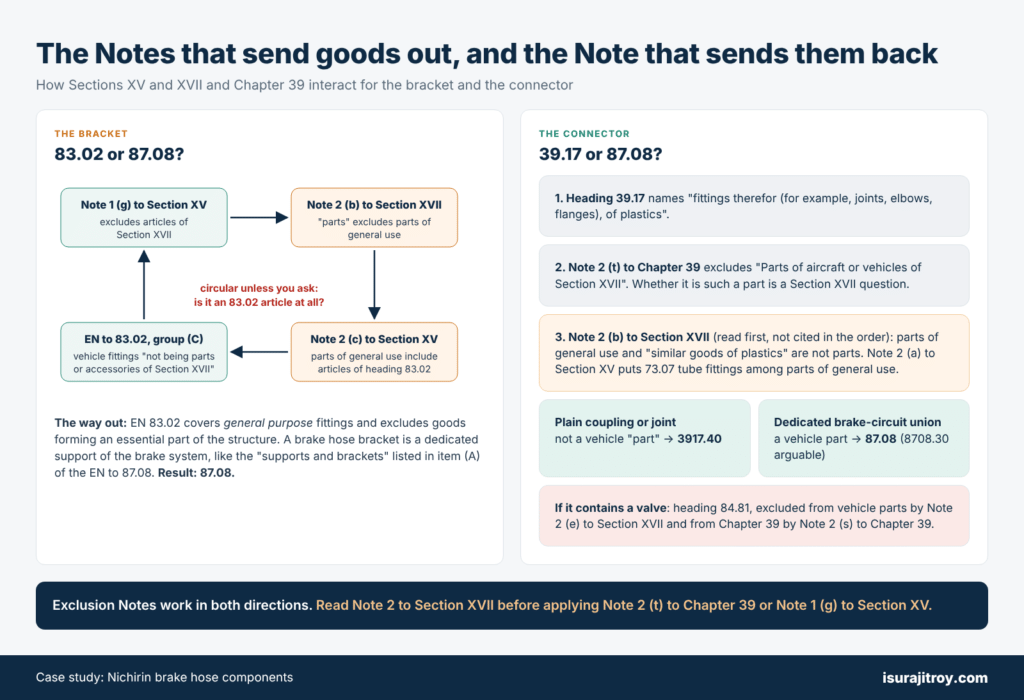
Step 4, is the bracket an 83.02 article? The EN to heading 83.02 answers this better than the order does.
- The heading covers “general purpose classes” of accessory fittings and mountings. The EN examples of vehicle fittings in group (C) are ornamental beading strips, foot rests, grip bars, rails and handles, blind fittings, interior luggage racks, window opening mechanisms and ash trays. They are fittings attached to the body for the occupants’ convenience.
- The brackets in group (G) are of the hat-rack and coat-rack kind: fixtures to hang or hold household or office articles.
- The heading “does not, however, extend to goods forming an essential part of the structure of the article”.
A brake hose bracket fixes a pressurised brake line in a set position so that it cannot chafe, kink or touch moving parts. It is part of a safety system, not a general purpose fitting. On the facts described, it is not in a general purpose class of 83.02, so Note 2 (b) to Section XVII does not exclude it. The EN to heading 87.08 supports this: item (A) lists “supports and brackets for the coachwork, engine, running-boards, battery or fuel tanks”, that is, structural brackets dedicated to vehicle systems. And paragraph (A) (2) of the General EN to Section XVII lists only coachwork fittings (hinges, door handles, grip bars, window mechanisms) as the Chapter 83 goods excluded from vehicle parts.
The Tribunal reached the same result by a shorter route. It treated the “not of general use” point as conceded. A classifier should not rely on a concession: the argument above is what would hold if the point were contested.
Step 5, GRI 1, Note 3 to Section XVII. The bracket is designed for a brake hose assembly fitted to motor vehicles. It is suitable for use solely or principally with vehicles of headings 87.01 to 87.05. The second sentence of Note 3 (a part answering to two or more headings of Chapters 86 to 88 goes to the heading of its principal use) would matter only if the bracket could also be a part of, say, a motorcycle of heading 87.11. The order mentions heading 87.14 only in passing for the connector.
Step 6, GRI 3 is not needed. Once the Notes are applied, only one heading is left. GRI 3 (a) is never reached, which is why EN (II) to GRI 3 warns against using Rule 3 against a Note. The order’s paragraph 13(2) attributes the principal-use rule to “GRI, Rule 3”. That rule is the second sentence of Note 3 to Section XVII, and it decides between headings of Chapters 86 to 88 only.
Step 7, GRI 6, subheading. Here the order and the Department may have the wrong subheading. Comparing one-dash subheadings of 87.08 under EN (II) (a) to GRI 6, the choice is between:
- 8708.30, “Brakes and servo-brakes; parts thereof”; and
- the one-dash group “Other parts and accessories”, under which 8708.99 sits.
The EN to heading 87.08, item (H), describes brake parts with examples from the hydraulic circuit: cylinders and “oil reservoirs for hydraulic brakes”. A hydraulic brake system includes the lines and hoses that carry the fluid. If the brake hose assembly is a part of the brakes, a bracket dedicated to it is a part of a part of the brakes. That points to 8708.30. 8708.99 is the residual line and can be reached only if no named one-dash subheading fits.
There is one caveat. Rubber brake hoses with fittings are normally classified in heading 40.09, not 87.08, because heading 40.09 names hoses “with or without their fittings” and Chapter 40 has no Note excluding vehicle parts. That does not stop the bracket being a brake part: the bracket is metal and is not covered by 40.09. But it shows the parts chain should be argued as “bracket → hydraulic brake system → vehicle”, not “bracket → rubber hose → vehicle”.
In India’s tariff, 8708 30 00 and 8708 99 00 are separate eight-digit lines. Whether the rates differ for the period of import should be checked. A wrong subheading is still a wrong classification in the bill of entry, and the same error can carry into origin claims and trade statistics.
Item 3: the connector
The parties’ positions
The importer declared the connector under heading 39.17 as a fitting of plastics for hoses. The Department argued that it is a part of a motor vehicle of heading 87.08, and, according to the order, pointed to no infirmity in the adjudicator’s findings. In paragraph 4 the order records the importer as acknowledging that the bracket and connector were “inadvertently declared to be the parts of automobile instead of components for manufacturing automobile parts”. That wording is hard to reconcile with a declaration under 39.17, and the order does not explain it.
How the Tribunal decided
The Tribunal identified the competing lines as 3917 40 00 (fittings of plastics), 8708 99 00 and 8714 10 90 (parts of motorcycles). It relied on Note 2 (t) to Chapter 39: if the goods are parts of vehicles, Chapter 39 excludes them “irrespective of the constituent of the goods”. It added that the connectors regulate brake fluid flow, are designed for integration into automobile brake systems, and are not generic plumbing fittings. Applying the common parlance test as well, it held 3917 40 00 was wrong.
Walking the GRIs
Step 1, GRI 1, candidate headings. Heading 39.17 names “fittings therefor (for example, joints, elbows, flanges), of plastics”. A plastic connector joining hose sections is described by those words. Heading 87.08 is a candidate only if the connector is a “part” under the Section XVII Notes.
Step 2, GRI 1, the order in which the Notes are read. Note 2 (t) to Chapter 39 excludes “Parts of … vehicles of Section XVII”. Whether something is such a part is decided by Section XVII’s own Notes. So Note 2 to Section XVII must be read before Note 2 (t) to Chapter 39 can operate. The order does not mention Note 2 to Section XVII at all.
Step 3, GRI 1, Note 2 (b) to Section XVII. This Note excludes from “parts” the parts of general use of base metal “or similar goods of plastics (Chapter 39)”. Under Note 2 (a) to Section XV, parts of general use include articles of heading 73.07, tube or pipe fittings such as couplings, elbows and sleeves. A plastic hose coupling is the plastics counterpart of a 73.07 fitting. Paragraph (A) (2) of the General EN to Section XVII confirms the approach: for parts of general use, goods of base metal go to their metal chapters “and similar goods of plastics fall in Chapter 39”.
If the connector is a plain hose coupling or joint, it is a “similar good of plastics” to a part of general use. It is then not a “part” for Section XVII, whether or not it is identifiable as for vehicles. Note 2 (t) to Chapter 39 then has nothing to act on, and the connector stays in 3917.40. On that reading the importer’s code was right, and the Tribunal’s reasoning skipped the step that decides it.
Step 4, when the connector is not a general-use fitting. The Tribunal’s facts point the other way. It found that the connector regulates the brake fluid flow and is designed specifically for integration into automobile brake systems. Two readings follow:
- If the connector is a shaped junction block or banjo-type union that also mounts or locates the hose in the brake circuit, it is more than a coupling. It is not “similar” to a 73.07 fitting, so Note 2 (b) does not exclude it. Note 3 to Section XVII is met, Note 2 (t) to Chapter 39 excludes it from Chapter 39, and heading 87.08 applies, as the Tribunal held.
- If the connector really regulates flow, for example with a check valve or restrictor, it may be an appliance of heading 84.81 (“taps, cocks, valves and similar appliances for pipes, … tanks, vats or the like”). Articles of heading 84.81 are excluded from vehicle “parts” by Note 2 (e) to Section XVII and from Chapter 39 by Note 2 (s) to Chapter 39. The connector would then fall in 84.81, neither of the codes the parties argued. Nothing in the order suggests the connector has a valve, so this is a point to check against the drawing, not a conclusion.
Step 5, common parlance. Indian courts use the common parlance or trade understanding test when the tariff does not settle a question. Under GRI 1, though, the Notes are paramount (EN (V) (a) to GRI 1). Here the Notes settle it once the facts about the connector’s design are known. The common parlance finding adds little to the HS analysis, and it cannot override Note 2 (b) to Section XVII if the connector is a general-use fitting.
Step 6, GRI 3. Not reached. If the analysis ends in 87.08, it ends there by Notes. If it ends in 39.17 or 84.81, it also ends there by Notes.
Step 7, GRI 6. If heading 87.08 applies, the same subheading point arises as for the bracket. A connector in the hydraulic brake circuit is a brake part under item (H) of the EN to heading 87.08, which points to 8708.30, not 8708.99. If heading 39.17 applies, 3917.40 is a one-dash subheading with no subdivisions.
Outcome
Heading 87.08 is defensible if the connector is a dedicated brake circuit component. But the order does not test the step that decides it, Note 2 (b) to Section XVII, and both the connector’s description and its design matter.
Limitation, confiscation and penalties
The importer argued that its goods were documented and physically examined at import, so nothing was hidden; that a classification claim is a matter of belief and not an offence (relying among others on Northern Plastics Ltd. and Santosh Kumar Ghosh); and that without suppression there could be no extended period, no confiscation under Section 111(m) and no penalty under Section 114A (relying on Videomax Electronics, Chemphar Drugs & Liniments, Shreeji Shipping and Coastal Energy).
The Tribunal rejected this. It gave four reasons:
- The importer had admitted most of the audit findings and paid the duty on them.
- Under self-assessment, Section 46(4) of the Customs Act, 1962 obliges the importer to make a true and correct declaration, including classification.
- The wrong declaration produced a duty benefit.
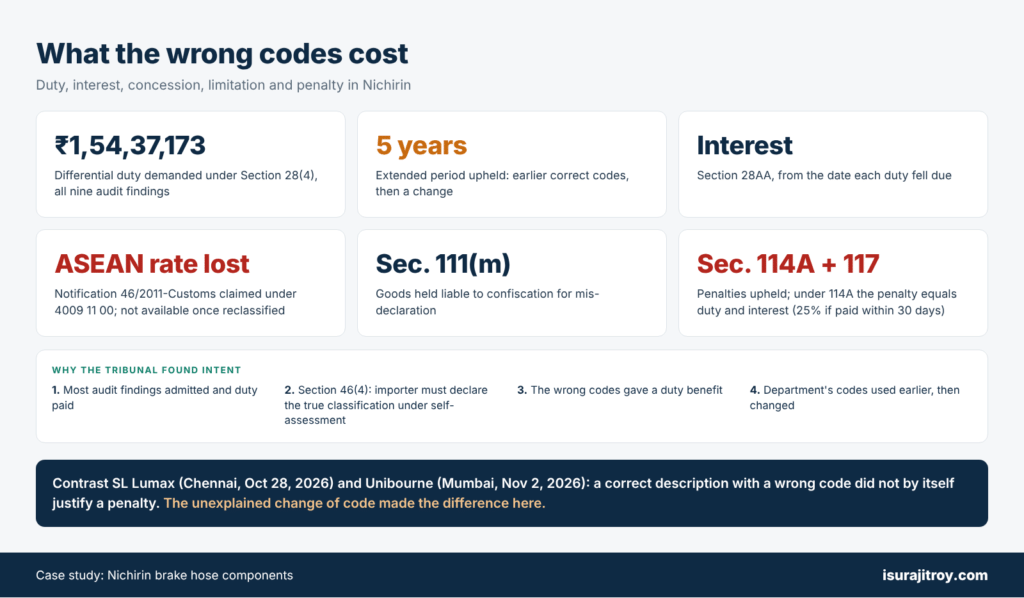
- The importer had used the Department’s codes earlier and then changed them. The Tribunal said this showed the misclassification was intentional.
It upheld the extended period under Section 28(4) and, “for the same reasons”, the penalties. The order does not separately discuss Section 111(m), Section 117 or the importer’s case law.
The fourth reason does the work. A correct description with a disputed code is usually treated as a difference of opinion, not suppression. Contrast SL Lumax Ltd. (CESTAT Chennai, October 28, 2026) and Unibourne Food Ingredients (CESTAT Mumbai, November 2, 2026), where the Tribunal held that a wrong classification claim with a correct description does not by itself justify confiscation or penalty. In Nichirin, the change from earlier codes without a recorded reason gave the Department the intent finding it needed.
For a classifier, the lesson is about records. If an importer changes the code for a product it imports regularly, the file should say why: a new product specification, a ruling, a tariff change, legal advice. The Tribunal could not find any such reason in Nichirin’s record.
Reading the order against the Harmonized System
The result on the protector tube is well supported at heading level. The bracket result is right in my view, but for a reason the order does not state fully. The connector result depends on a Note the order never cites. Five points in the reasoning are worth flagging for anyone who cites the order later.
- The GRI summary in paragraph 12. The order says that under GRI 1 “the most specific entry has to be considered”, and that under GRI 3(c) the “later entry is to be preferred over the former one”. GRI 1 directs classification by the terms of the headings and the Notes; specificity belongs to GRI 3 (a). GRI 3 (c) is a last resort that applies only when 3 (a) and 3 (b) both fail, among headings that equally merit consideration (EN (I) and (XII) to GRI 3). The paragraph also says GRI 4 is about “akin” goods, which is right, but GRI 4 applies only when Rules 1 to 3 cannot classify the goods (EN (I) to GRI 4).
- The principal-use rule. Paragraph 13(2) attributes it to “GRI, Rule 3”. It is the second sentence of Note 3 to Section XVII.
- Note 2 to Section XVII. Not mentioned. It is the first of the three conditions in the General EN to Section XVII and decides whether the bracket and connector are “parts” at all.
- GRI 6. Not applied. The protector tube’s subheading depends on rigid or flexible, and the bracket and connector may belong in 8708.30.
- Note 8 to Chapter 39. Not mentioned. It defines the tubes of heading 39.17, and a protector sleeve should be tested against it.
None of these points necessarily changes the duty result. Several would matter in a later dispute on similar goods, and the order is now likely to be cited in other brake component cases.
Devil’s advocate: testing both sides
The case that the Tribunal got it right
- The supplier’s catalogue was the best evidence of material, and the importer offered nothing against it. Classification follows facts, and the burden of producing the facts that support a declared code sits with the importer under self-assessment.
- The bracket and connector were made for one purpose, a brake hose assembly for motor vehicles. Note 3 to Section XVII is plainly met, and the EN to heading 87.08 lists dedicated brackets.
- The importer described both items as “parts of automobile” in its own documents and did not contest the “not of general use” finding. A tribunal decides the dispute the parties present.
- A brake circuit connector designed for integration into automobile brake systems is not a plumbing fitting. Note 2 (b) to Section XVII is about genuinely general-purpose goods.
The case that the importer had arguments it did not make
- Note 2 (b) to Section XVII, read with Note 2 (a) to Section XV and paragraph (A) (2) of the General EN to Section XVII, keeps plastic hose couplings in Chapter 39 even when made for vehicles. If the connector is a coupling, 3917.40 was right.
- The order’s GRI summary is wrong in two places, and the principal-use rule is cited to the wrong provision. A tribunal reasoning from “most specific entry” under GRI 1 may not have read the exclusion Notes in the right order.
- The protector tube may be flexible, which would put it in 3917.3x and not in 3917.23. The concession analysis would then attach to a different eight-digit line.
- On penalty, the goods were described by part number and examined at import. A change of code is not by itself suppression, as SL Lumax and Unibourne show.
Points the record leaves open
- The physical description of each item: metal and shape of the bracket, design of the connector (coupling, union, junction block or valve), rigid or flexible tube, and whether the tube meets Note 8 to Chapter 39.
- The duty difference for each contested item, the penalty amounts, and whether any amount related to items the importer did not contest.
- The reason for the earlier change of codes.
- Whether 8708 30 00 and 8708 99 00 carried different rates for the period of import.
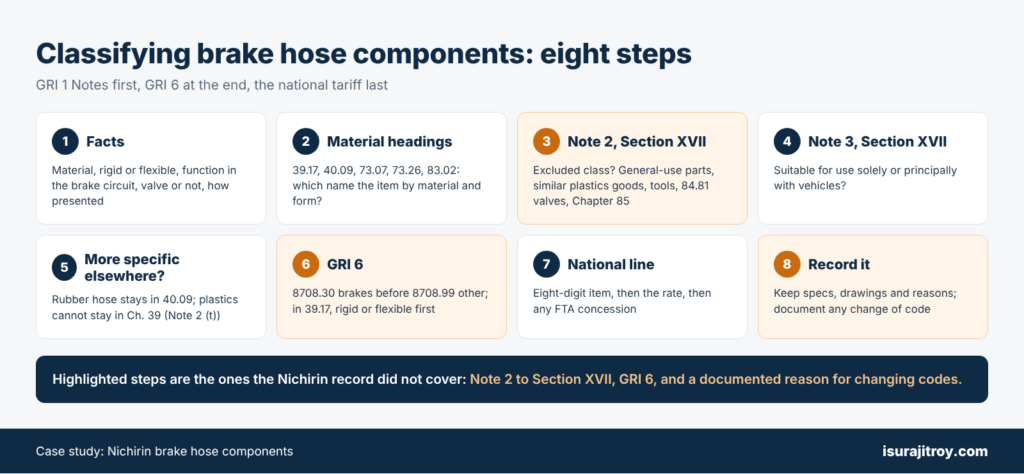
The classification process for brake hose components
The case suggests a fixed order of questions for any component of a vehicle brake system:
- Facts first. Material by weight, construction, rigid or flexible, function in the circuit, whether it has a valve, and how it is presented (cut to length, with fittings, as part of an assembly).
- Material headings. Identify the headings that name the item by material and form: 39.17, 40.09, 73.07, 73.26, 83.02.
- Section XVII Note 2. Is the item one of the excluded classes: rubber articles of 40.16, parts of general use of base metal or similar goods of plastics, tools of Chapter 82, machines of 84.01 to 84.79, valves of 84.81, Chapter 85 goods? If yes, it is not a vehicle part, whatever its design.
- Section XVII Note 3. Is the item suitable for use solely or principally with vehicles? Use the EN to heading 87.08 and the General EN to Section XVII, Part (III) (B).
- “More specifically included elsewhere”. Paragraph (C) of that EN. A rubber hose stays in 40.09. A plastic item cannot stay in Chapter 39 if it passes steps 3 and 4, because Note 2 (t) to Chapter 39 excludes it.
- GRI 6. Compare one-dash subheadings of 87.08. A component of the hydraulic brake circuit is a candidate for 8708.30 before the residual 8708.99. In 39.17, decide rigid or flexible before material.
- National line, rate and concessions. Choose the eight-digit line, then check the rate and any trade agreement concession for that line.
- Record the reasons. Keep the specification, the drawing and the classification reasoning on file, and record why any code changes.
What a wrong code can cost
The demand of ₹1,54,37,173 covered all nine audit findings, not only the three contested items. The order does not split it by item. With it came:
- interest under Section 28AA from the date each duty fell due;
- loss of the ASEAN concession on the protector tube;
- the extended period of five years under Section 28(4), which reached back to imports at least as early as 2018;
- confiscation under Section 111(m) (the order does not mention a redemption fine);
- penalties under Sections 114A and 117 (amounts not stated in the order).
Under Section 114A, the penalty equals the duty and interest determined, reduced to 25% if paid within 30 days of the order. A penalty of that size often exceeds the duty saved by the wrong code. The importer also carried the cost of litigation from 2023 to 2026.
Takeaways for importers and classifiers
- Read the exclusion Notes in both directions. Note 2 (t) to Chapter 39 and Note 1 (g) to Section XV send vehicle parts to Chapter 87. Note 2 to Section XVII sends some vehicle-specific goods back. A classification that cites one side only is incomplete.
- “Identifiable as for vehicles” is not the test. Note 2 to Section XVII applies “whether or not” the goods are identifiable as for vehicles. Ask whether the item is a general purpose article first.
- Material headings decide only when no Note moves the goods. The protector tube was decided by material because no Note was argued against it. The connector was decided by a Note even though its material pointed to Chapter 39.
- Collect the facts that decide the subheading, not only the heading: rigid or flexible, with or without fittings, reinforced or not, and the exact function in the brake circuit.
- Use GRI 6 on 87.08. Brake components have their own one-dash subheading. 8708.99 is a residual line.
- Treat the supplier’s catalogue as evidence. If it is wrong, get a test report before filing, not after the show cause notice.
- Keep your codes consistent, and document every change. In Nichirin, an unexplained change was the Tribunal’s main ground for the extended period and the penalties.
- Check concessions only after the code is settled. A trade agreement rate attaches to a tariff line, and a wrong line takes the concession with it.
- For components imported repeatedly, consider an advance ruling. It costs far less than a five-year demand with a matching penalty.
For other avoidable errors, see the top 10 common trade compliance mistakes. To test your own GRI reasoning, try the GRI self-assessment. For another case decided on subheading choice under GRI 6, see the Samsung split air conditioner case study on this site.
Disclaimer: This case study is an educational analysis of a published Tribunal order. It is not a binding ruling or legal advice, and it makes no finding about any party’s intent beyond what the order records. HS references are to the WCO HS 2022 nomenclature; imports before January 1, 2022 were governed by HS 2017, and the text in force on the date of import applies. HS codes are harmonized only to six digits. The eight-digit items quoted here belong to India’s Customs Tariff and are quoted as the order states them; check them against the First Schedule in force on the date of import. Explanatory Notes are the WCO’s official interpretation and are paraphrased here, with short quotations. For a specific shipment, obtain an advance ruling or advice from a qualified professional.
Image credits
- Brake disc and caliper photograph (poster and thumbnail background): “A close-up view of a vehicle’s brake system, featuring a rusted brake disc and caliper” by Stephen Dumba, WordPress Photo Directory, CC0 1.0: https://wordpress.org/photos/photo/34869495e5/
- Infographics: created by the author.
Sources
- Nichirin Imperial Autoparts India Pvt. Ltd. v. Commissioner of Customs, ICD Patparganj & other ICDs, CESTAT New Delhi, Customs Appeal No. 50248 of 2025, September 21, 2026: https://indiankanoon.org/doc/159197172/
- SL Lumax Ltd. v. Commissioner of Customs, Chennai-II, CESTAT Chennai, October 28, 2026: https://indiankanoon.org/doc/141134450/
- Unibourne Food Ingredients v. Commissioner of Customs, Nhava Sheva-I, CESTAT Mumbai, November 2, 2026: https://indiankanoon.org/doc/164267714/
- WCO, Harmonized System Nomenclature, 2022 edition: headings 39.16, 39.17, 39.26, 40.08, 40.09, 73.07, 73.26, 83.02, 84.81, 87.08 and 87.14; Notes 1, 2 and 8 and Subheading Note 1 to Chapter 39; Notes 1 and 4 to Chapter 40; Notes 1 and 2 to Section XV; Notes 2 and 3 to Section XVII
- WCO, General Rules for the Interpretation of the Harmonized System, with the Explanatory Notes to GRI 1 (II) and (V); GRI 2 (b) (XI) and (XII); GRI 3 (I), (II) and (XII); GRI 4 (I); GRI 6 (II) and (III)
- WCO, Explanatory Notes to the Harmonized System (7th edition, 2022): General Explanatory Note to Section XVII, Part (III), paragraphs (A), (B) and (C); Explanatory Notes to headings 39.17, 40.09, 83.02 and 87.08
- Customs Act, 1962: Sections 17, 28(4), 28AA, 46(4), 111(m), 114A and 117
- Notification No. 46/2011-Customs dated June 1, 2011 (India–ASEAN Trade in Goods Agreement)