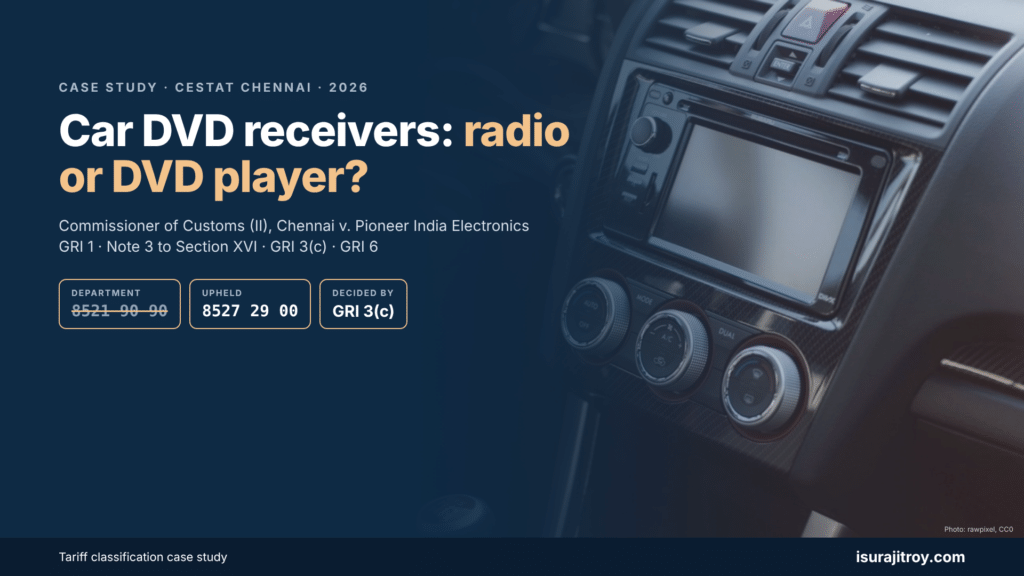
Short answer. A car head unit that combines an AM/FM radio receiver and a DVD player in one housing is a composite machine under Note 3 to Section XVI. It is classified by its principal function. If the principal function cannot be established, the General Explanatory Note to Section XVI sends the goods to GRI 3(c), and heading 85.27 (radio receivers) wins over heading 85.21 (video reproducing apparatus) because it comes last in numerical order. On October 14, 2026, CESTAT Chennai applied exactly that route and dismissed the Department’s appeal against Pioneer India Electronics.
The case is a good lesson in how Section Notes, Explanatory Notes and the GRIs fit together, and in what counts as evidence of a “principal function”. The Department’s only proof was the importer’s own advertising. It lost because advertising can support a finding about how a machine works, but it can’t replace one.
Case: Commissioner of Customs (II), Chennai v. Pioneer India Electronics Pvt. Ltd., CESTAT Chennai, Regional Bench, Court No. I, Customs Appeal No. 41972 of 2015, Final Order No. 41093/2026, decided October 14, 2026. Full text on Indian Kanoon.
At a glance
| Point | Detail |
| Goods | “DVH 3490UB/XNID AM/FM Radio with DVD Player for Car”, imported from Thailand (one bill of entry, No. 7136633 of October 21, 2014) |
| Importer’s classification | CTI 8527 29 00, with the India–ASEAN concession under Notification No. 46/2011-Customs (Sl. No. 1390(I)) |
| Department’s classification | CTI 8521 90 90, “Other DVD players”; concession denied |
| Competing headings | 85.27 (radio-broadcast reception apparatus) and 85.21 (video recording or reproducing apparatus) |
| Deciding provisions | GRI 1; Note 3 to Section XVI; General Explanatory Note to Section XVI, Part (VI); GRI 3(c) |
| Who won | The importer, at the Commissioner (Appeals) in 2015 and again at CESTAT in 2026 |
| Why the Department lost | It relied only on the product’s website and catalogue; no examination, cost analysis or expert opinion on the principal function |
| Point the order leaves open | The subheading inside 85.27: 8527.21 (“Combined with sound recording or reproducing apparatus”) or 8527.29 (“Other”) |
Why this case matters for classifiers
Electronics importers deal with combined devices every day. A car head unit can be a radio, a CD or DVD player, a USB media player, a Bluetooth hands-free kit and sometimes a display, all in one 1-DIN or 2-DIN box. Each of those functions points to a different heading in Chapter 85. The tariff does not have a heading for “car infotainment unit”.
Section XVI handles this with Note 3, which tells you to classify a multi-function or composite machine as the machine that performs its principal function. That sounds simple until two functions look equally important. The Pioneer order shows the full path, including the step most people forget: when the principal function can’t be found, the Explanatory Notes send you to GRI 3(c), not to whatever heading the officer prefers.
It also shows a common mistake in practice. The assessing group looked at how the product was marketed and decided it was a DVD player. Three appellate levels and eleven years later, that approach failed.
The goods
The bill of entry described the goods as an AM/FM radio with a DVD player for cars. The order records these facts, mostly from the importer’s side and not contested by the Department:
- The unit receives AM/FM radio broadcasts. The original adjudicating authority did not dispute that.
- It runs only on 12 V DC from a vehicle battery and is built to fit a dashboard. It conforms to ISO 7736, the standard size for car audio head units.
- A technical opinion placed before the Commissioner (Appeals) said the unit is built around a tuner-amplifier board, whose circuits receive and process radio signals. The DVD mechanism is a module connected to that board. USB and Bluetooth are further features.
- The manufacturer’s website called the product a “DVD receiver”.
The order does not say whether the unit has its own display. EN 85.21 describes video reproducing apparatus as apparatus that reproduces images and sound “directly on a television receiver”, so a DVD mechanism without a screen needs an external monitor to show video. The Tribunal noted that nothing on record showed the goods displayed video or were always installed with a monitor.
Timeline
- October 21, 2014: Bill of Entry No. 7136633 filed; goods self-assessed under CTI 8527 29 00 with the ASEAN concession.
- First check: the proper officer drew a sample and called for the catalogue. The assessing group reassessed the goods under CTI 8521 90 90. Duty was paid under protest.
- February 26, 2015: Order-in-Original No. 3591/2014 upheld the reassessment.
- May 29, 2015: Order-in-Appeal C.Cus.II No. 484/2015 set it aside and directed classification under CTI 8527 29 00.
- 2015: the Department appealed to CESTAT (Customs Appeal No. 41972 of 2015); the importer filed cross objections.
- May 25, 2026: hearing.
- October 14, 2026: Revenue’s appeal dismissed (Final Order No. 41093/2026).
The import took place in 2014, under HS 2012. The texts quoted below are from HS 2022. The headings and subheadings discussed should be checked against the edition in force on the date of import before relying on the exact wording.
The legal provisions
The GRIs that apply
GRI 1: “The titles of Sections, Chapters and sub‑Chapters are provided for ease of reference only; for legal purposes, classification shall be determined according to the terms of the headings and any relative Section or Chapter Notes and, provided such headings or Notes do not otherwise require, according to the following provisions.”
The Explanatory Notes to GRI 1 say the terms of the headings and the Section and Chapter Notes are “paramount” and are the first consideration (EN (V)(a) to GRI 1). A trade name, a marketing label or a product category used by sellers is none of those things.
GRI 3 (opening words): “When by application of Rule 2 (b) or for any other reason, goods are prima facie, classifiable under two or more headings, classification shall be effected as follows:”
GRI 3(c): “When goods cannot be classified by reference to 3 (a) or 3 (b), they shall be classified under the heading which occurs last in numerical order among those which equally merit consideration.”
Three Explanatory Notes to GRI 3 matter here. EN (I) to GRI 3 says the three methods run strictly in order. EN (II) to GRI 3 says Rule 3 takes effect only where the headings or Notes do not otherwise require. EN (XII) to GRI 3 restates the “last in numerical order” rule.
GRI 6: “For legal purposes, the classification of goods in the subheadings of a heading shall be determined according to the terms of those subheadings and any related Subheading Notes and, mutatis mutandis, to the above Rules, on the understanding that only subheadings at the same level are comparable. For the purposes of this Rule the relative Section and Chapter Notes also apply, unless the context otherwise requires.”
The competing headings
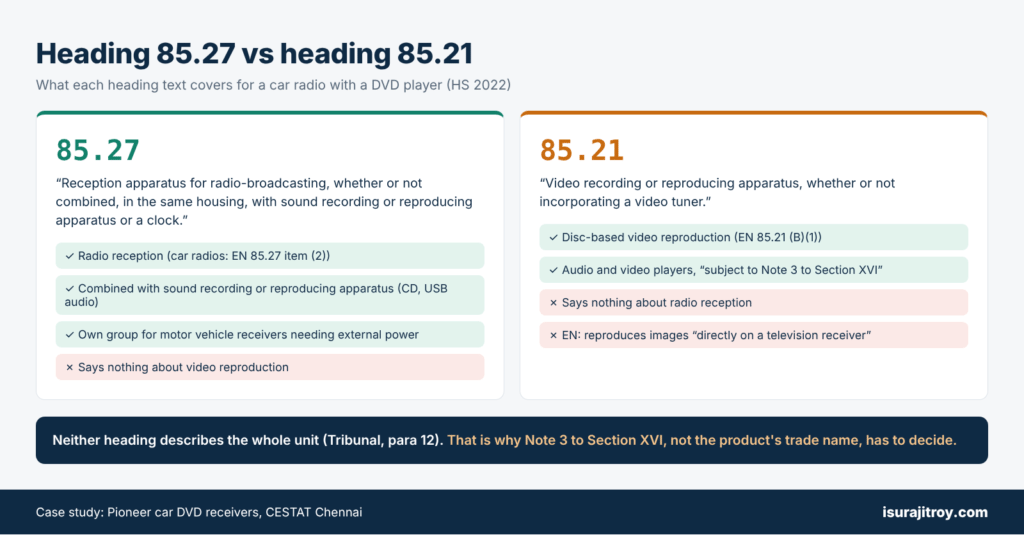
Heading 85.27: “Reception apparatus for radio-broadcasting, whether or not combined, in the same housing, with sound recording or reproducing apparatus or a clock.”
| Level | Subheading | Text |
| One-dash | (group) | – Radio-broadcast receivers capable of operating without an external source of power : |
| Two-dash | 8527.12 | — Pocket-size radio cassette-players |
| Two-dash | 8527.13 | — Other apparatus combined with sound recording or reproducing apparatus |
| Two-dash | 8527.19 | — Other |
| One-dash | (group) | – Radio-broadcast receivers not capable of operating without an external source of power, of a kind used in motor vehicles : |
| Two-dash | 8527.21 | — Combined with sound recording or reproducing apparatus |
| Two-dash | 8527.29 | — Other |
| One-dash | (group) | – Other : |
| Two-dash | 8527.91 | — Combined with sound recording or reproducing apparatus |
| Two-dash | 8527.92 | — Not combined with sound recording or reproducing apparatus but combined with a clock |
| Two-dash | 8527.99 | — Other |
Heading 85.21: “Video recording or reproducing apparatus, whether or not incorporating a video tuner.” It has two subheadings: 8521.10 (“- Magnetic tape-type”) and 8521.90 (“- Other”).
Read the two heading texts side by side. Heading 85.27 lets a radio be combined with sound recording or reproducing apparatus. It says nothing about video. Heading 85.21 covers video reproduction and says nothing about radio reception. Neither heading, on its own terms, describes a radio and a DVD player in one box. The Tribunal said so in paragraph 12, and rejected the importer’s argument that heading 85.27 covers the combination by its own wording.
The Section Notes
Note 3 to Section XVI: “Unless the context otherwise requires, composite machines consisting of two or more machines fitted together to form a whole and other machines designed for the purpose of performing two or more complementary or alternative functions are to be classified as if consisting only of that component or as being that machine which performs the principal function.”
Note 4 to Section XVI: “Where a machine (including a combination of machines) consists of individual components (whether separate or interconnected by piping, by transmission devices, by electric cables or by other devices) intended to contribute together to a clearly defined function covered by one of the headings in Chapter 84 or Chapter 85, then the whole falls to be classified in the heading appropriate to that function.”
Note 5 to Section XVI confirms that “machine” in these Notes includes “any machine, machinery, plant, equipment, apparatus or appliance cited in the headings of Chapter 84 or 85”. A radio receiver and a DVD player are both “machines” for Note 3.
The Explanatory Notes
These are the WCO’s official interpretation (HS Explanatory Notes, 7th edition, 2022). They are paraphrased here with short quotations.
- General Explanatory Note to Section XVI, Part (VI), “Multi-function machines and composite machines”. Multi-function machines are generally classified by their principal function. Where the principal function can’t be determined, and the context doesn’t otherwise require, the EN says “it is necessary to apply General Interpretative Rule 3 (c)”. Composite machines of different kinds fitted together to form a whole are also classified by the principal function. Machines count as “fitted together to form a whole” when they are, among other things, mounted “in a common housing”.
- General Explanatory Note to Section XVI, Part (VII), “Functional units”. This covers Note 4: separate components that together perform one clearly defined function.
- EN to heading 85.21, Part (B)(1). Disc-based reproducing apparatus belongs in heading 85.21, and apparatus that reproduces both video and audio recordings is classified there “subject to Note 3 to Section XVI”. The EN also says these apparatus are “designed only to reproduce images and sound directly on a television receiver”.
- EN to heading 85.21, exclusion (c). Reception apparatus for television and video monitors go to heading 85.28.
- EN to heading 85.27. The heading includes car radio receivers (item (2)). Item (5) covers hi-fi systems put up in sets for retail sale, with a radio receiver in combination with a CD player and other units in separate housings, where “the radio receiver gives the system its essential character”.
How each party applied the rules
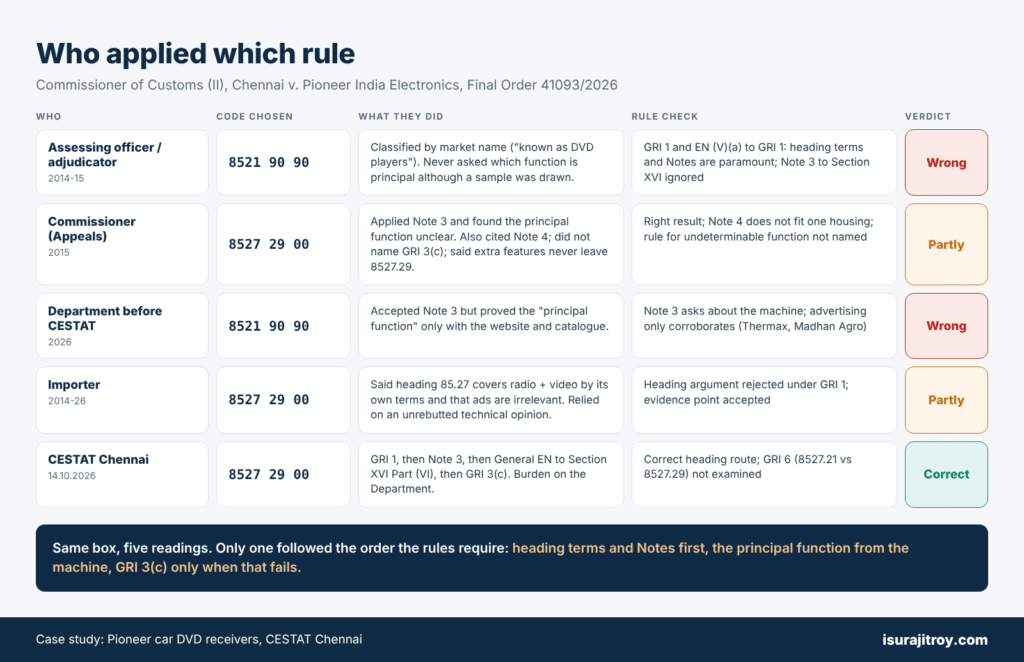
This is where the case teaches the most. Four parties dealt with the same box, and only one followed the GRIs in order.
The assessing officer and the adjudicating authority
The assessing group drew a sample and called for the catalogue. It then decided the goods were DVD players with AM/FM receivers and reassessed them under CTI 8521 90 90. According to the Commissioner (Appeals), the adjudicating authority did not dispute that the goods could receive radio broadcasts. It excluded them from heading 85.27 only because the market knew them as DVD players.
That is classification by trade name. GRI 1 makes the heading terms and the Notes decisive, and EN (V)(a) to GRI 1 calls them “paramount”. Once the officer accepted that the unit both receives radio and reproduces DVDs, Note 3 to Section XVI applied, and the question became which function is principal. The officer never asked it. The Tribunal said a reassessment that withdraws a trade agreement concession “ought not to rest on promotional description alone”.
The Commissioner (Appeals)
The Commissioner (Appeals) got further. He read heading 85.27 and the EN, found the goods to be composite machines and applied Note 3. He then found it hard to say which function was principal: the marketing suggested the DVD player, but in use the radio might dominate. Since CTI 8521 90 90 covers DVD players without a radio, classifying there would mean ignoring the radio altogether. He chose CTI 8527 29 00.
The outcome was right, but three things in his reasoning were not.
- He applied Notes 3 and 4 to Section XVI together. Note 4 is for functional units made of separate components that together perform one clearly defined function. A radio and a DVD player in one housing are a composite machine under Note 3. Part (VI) of the General EN to Section XVI covers this exact case: machines “mounted … in a common housing” are fitted together to form a whole.
- He did not name the rule that resolves an undeterminable principal function. The Tribunal supplied it: the General EN to Section XVI, Part (VI), read with GRI 3(c).
- He said any additional feature alongside radio reception would not take goods out of subheading 8527.29. The Tribunal rejected that as a general rule. If an added feature is shown to perform the principal function, Note 3 can take the goods out of heading 85.27 altogether.
The Department on appeal
Before CESTAT, the Department accepted that Note 3 applied. Its case was that the principal function was video reproduction, and its proof was the importer’s website and catalogue, which marketed the product as a DVD player. It also argued that buyers want passengers, including children, to watch DVDs while traveling. It relied on an earlier Order-in-Appeal for Epson projectors, where the importer’s literature had counted.
The legal point was correct: heading 85.27 does not, by its terms, cover a radio combined with video apparatus. The evidence did not match it. Note 3 makes the principal function of the machine decisive, and that is a question about the machine. The Department had drawn a sample and never examined it.
The importer
The importer argued that advertising is irrelevant to classification, that heading 85.27 covers the combination by its own terms, and that the technical opinion showed the radio was the core of the unit. The Tribunal accepted the third point, rejected the second, and said the first was stated too broadly. In its view, a manufacturer’s literature can corroborate a conclusion drawn from the goods, as in Thermax.
How the Tribunal decided
The Tribunal framed three issues and answered them in order.
Issue 1: does Note 3 to Section XVI govern? Yes. Under GRI 1, heading 85.27 contemplates combination with sound apparatus only and heading 85.21 says nothing of radio. The goods therefore unite in one housing two machines described in two different headings of Chapter 85. EN 85.21 (B) itself says disc-based apparatus is classified there “subject to Note 3 to Section XVI”. Both sides and the Commissioner (Appeals) treated the goods as composite machines, and nothing in the context of either heading required otherwise.
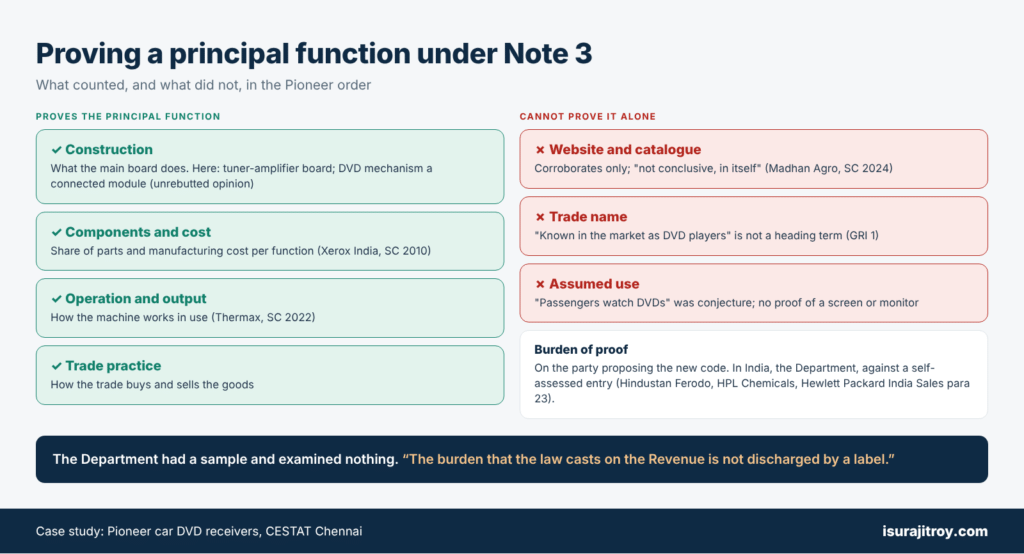
Issue 2: did the Department prove that video reproduction is the principal function? No. The Tribunal relied on two Supreme Court cases to show what that proof looks like:
- In Xerox India Ltd. v. Commissioner of Customs, Mumbai (2010), the Court found the principal function of multi-function machines by looking at the share of parts, components and manufacturing cost allocated to printing.
- In Thermax Ltd. v. Commissioner of Central Excise, Pune I (2022), the Court looked at how the machine operated and what it produced. It then found that conclusion borne out by how the product was perceived in the market, including the manufacturer’s own website.
Advertising can corroborate a finding, but it cannot replace one. The Tribunal cited Madhan Agro Industries (Supreme Court, 2024), where an advertisement showing a film actress with flowing hair was “not conclusive, in itself” to classify coconut oil as hair oil. On burden of proof it relied on Hindustan Ferodo, HPL Chemicals and Hewlett Packard India Sales (Supreme Court, 2023, paragraph 23), applied to a self-assessed import. The Department had no examination report, no cost or component comparison, no expert opinion and no trade evidence. The importer’s technical opinion stood unrebutted. In the Tribunal’s words, the burden “is not discharged by a label”.
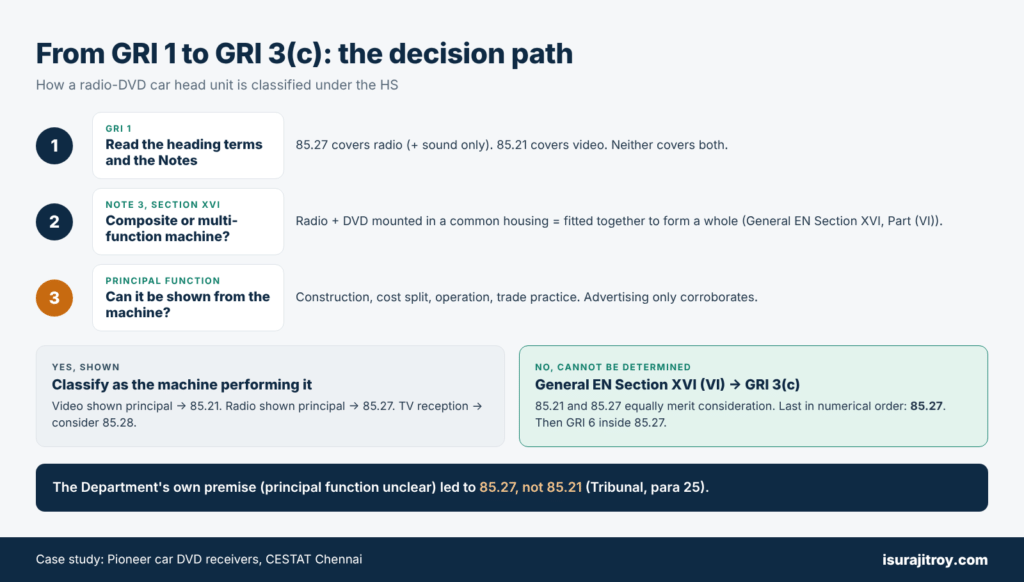
Issue 3: where do the goods fall? The Department’s appeal leaned on the Commissioner (Appeals)’ finding that the principal function was hard to determine. The Tribunal said that finding, if accepted, does not lead to heading 85.21. Under the General EN to Section XVI, an undeterminable principal function leads to GRI 3(c). Headings 85.21 and 85.27 “equally merit consideration”, and 85.27 comes last. On the Department’s own premise, heading 85.27 governs.
The Tribunal reached the same result on burden of proof: where the Department fails to establish its classification, the self-assessed classification stands. The ASEAN concession, denied only as a consequence of the reclassification, followed.
Walking the GRIs step by step
Here is the full analysis a classifier should write for a radio-DVD head unit, in the order the rules require.
Step 1: facts. Functions (radio reception, disc playback of audio and video, USB, Bluetooth), whether there is a display, power supply (12 V DC only), mounting (dashboard, ISO 7736 size) and construction (which board does the core processing). Get the bill of materials and a cost split if you can. These are the facts Xerox and Thermax used.
Step 2: GRI 1, heading texts. Candidate headings are 85.27 (radio reception, combined with sound apparatus) and 85.21 (video reproduction). If the unit has a built-in screen that can receive television, heading 85.28 also comes in, since it covers reception apparatus for television “whether or not incorporating radio-broadcast receivers or sound or video recording or reproducing apparatus”. Neither 85.27 nor 85.21 describes the whole unit.
Step 3: GRI 1, Section Notes. Note 3 to Section XVI applies to composite machines and multi-function machines. Part (VI) of the General EN to Section XVI treats machines in a common housing as fitted together to form a whole. Note 4 does not apply: this is one housing, not a set of separate components working together.
Step 4: the principal function test. Under Note 3, find the function that is principal. Evidence that counts: construction (what the main board does), share of components and cost, how the machine operates, and how the trade buys and sells it. Marketing material can corroborate those findings but cannot stand alone. If one function is shown to be principal, classify there and stop.
Step 5: if the principal function can’t be determined. Part (VI) of the General EN to Section XVI says to apply GRI 3(c). Why not GRI 3(a) or 3(b) first? Under GRI 3(a), each heading describes only part of the goods, so EN (V) to GRI 3 treats them as equally specific. GRI 3(b) asks for essential character, and for Section XVI machines Note 3’s principal function test already plays that role. It has failed on these facts. That is why the EN goes straight to 3(c). Of 85.21 and 85.27, heading 85.27 comes last.
Step 6: GRI 6, subheadings. See the next section. The order does not do this step.
Step 7: the national line and the concession. Choose the Indian eight-digit line under the six-digit subheading, then check the rate and the trade agreement concession for that line.
The step the order skipped: GRI 6 inside heading 85.27
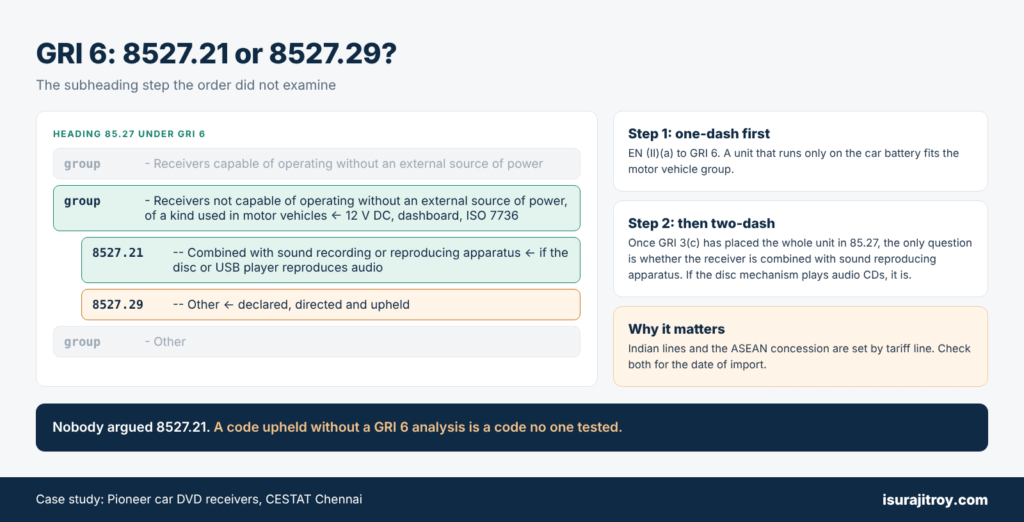
Once the goods are in heading 85.27, GRI 6 decides the subheading. One-dash subheadings are compared first (EN (II)(a) to GRI 6):
- receivers capable of operating without an external source of power;
- receivers not capable of operating without an external source of power, of a kind used in motor vehicles;
- other.
A unit that runs only on 12 V DC from a car battery and fits a dashboard belongs in the second group. The Tribunal’s own findings support that.
Inside that group, the two-dash choice is between 8527.21, “Combined with sound recording or reproducing apparatus”, and 8527.29, “Other”. The importer declared 8527 29 00, the Commissioner (Appeals) directed 8527 29 00, and the Tribunal upheld it. Nobody explained why a unit with a disc mechanism and a USB player is not “combined with sound recording or reproducing apparatus”.
A DVD mechanism in a car head unit normally also plays audio CDs, and a USB port normally plays audio files. If this unit does either, it reproduces sound, and 8527.21 is the stronger reading. The fact that the same mechanism also reproduces video does not stop it from being sound reproducing apparatus at subheading level. Once GRI 3(c) has placed the whole unit in heading 85.27, the video function no longer decides anything. The only question left is whether the receiver is combined with sound reproducing apparatus.
The Department never raised this, so the Tribunal did not decide it. It matters for two reasons. India’s eight-digit lines and the concession under Notification No. 46/2011-Customs are set by tariff line, so the line under 8527.21 may carry a different rate or concession from the line under 8527.29. And an importer that relies on this order for 8527 29 00 on a similar product may be relying on a code no one tested. Check the national lines and the concession entries for the dates of import.
Testing both sides
The case for the Department
- A DVD player is a video device. Heading 85.27 lets a radio combine only with sound apparatus, and the Tribunal agreed. If video reproduction is the reason people buy the unit, Note 3 sends it to 85.21.
- The manufacturer sold the product as a DVD unit, and Thermax allows market perception to count.
- The importer’s technical opinion was commissioned by the importer.
The case for the importer
- The Department examined nothing, although it had a sample. Under Note 3, the burden was on the Department to show the proposed function is principal.
- The only technical evidence said the unit is built around a tuner-amplifier with the DVD mechanism as a module. Without a screen, the unit can’t show video by itself.
- Even if the principal function is uncertain, GRI 3(c) leads to 85.27, the importer’s heading.
Points the record leaves open
- Whether the unit has a display or a video output, and whether it was sold with a monitor.
- Whether it plays audio CDs and USB audio files, which bears on 8527.21 against 8527.29.
- The component and cost split between the radio and DVD sections.
- The duty difference, which the order does not state.
Lessons for importers and classifiers
- When a device combines functions from different headings in Section XVI, start with Note 3 to Section XVI, not the product’s name or the marketing.
- Prove the principal function with the machine: construction, main board, bill of materials, cost split, how it operates. Keep that file before the bill of entry is filed.
- Treat advertising as corroboration only. Thermax lets it support a finding; Madhan Agro says it can’t make one alone.
- If the principal function really can’t be determined, follow Part (VI) of the General EN to Section XVI to GRI 3(c). The last heading in numerical order among those that equally merit consideration wins.
- Don’t confuse Note 3 (one machine, several functions, or machines in one housing) with Note 4 (separate components working together toward one function).
- Finish with GRI 6. For a car unit, the one-dash group “not capable of operating without an external source of power, of a kind used in motor vehicles” comes first, then the two-dash choice between 8527.21 and 8527.29.
- If you are the officer, record findings on the sample. A reassessment that withdraws a concession needs evidence about the goods, not about the brochure.
- For a product line you import regularly, consider an advance ruling. This dispute took eleven years to settle.
Questions people also ask
What is the HS code for a car radio with a DVD player? If the unit is a radio receiver that needs the car’s power supply, and its principal function is radio reception or can’t be determined, it falls in heading 85.27, in the motor vehicle group (8527.21 or 8527.29). If video reproduction is shown to be the principal function, it goes to heading 85.21. A unit with television reception goes to heading 85.28. The answer depends on the product facts.
What does Note 3 to Section XVI do? It classifies composite machines and multi-function machines as if they were only the component or machine that performs the principal function.
What happens if the principal function can’t be identified? Part (VI) of the General Explanatory Note to Section XVI says to apply GRI 3(c): classify under the heading that occurs last in numerical order among those that equally merit consideration.
Can a product’s advertising decide its classification? No. Under GRI 1, the heading terms and the Notes decide. Indian courts allow marketing material as corroboration of findings about the goods (Thermax), but not as the only basis (Madhan Agro, Meghdoot Gramodyog).
Who must prove the principal function in a dispute? The party proposing the different classification. In India, when the Department rejects a self-assessed classification, the burden is on the Department (Hindustan Ferodo, HPL Chemicals, Hewlett Packard India Sales).
Similar questions on this site
For other avoidable errors, see the top 10 common trade compliance mistakes. To test your GRI reasoning, try the GRI self-assessment. For more on headings in Chapters 84, 85 and 90, see classifying electronics: how to choose between Chapters 84, 85 and 90.
Disclaimer: This case study is an educational analysis of a published Tribunal order. It is not a binding ruling or legal advice. HS references are to the WCO HS 2022 nomenclature; the import in this case (2014) was governed by HS 2012, and the text in force on the date of import applies. HS codes are harmonized only to six digits. The eight-digit items quoted here belong to India’s Customs Tariff and are quoted as the order states them; check them, and any concession under Notification No. 46/2011-Customs, against the tariff in force on the date of import. Explanatory Notes are the WCO’s official interpretation and are paraphrased here with short quotations. For a specific shipment, get an advance ruling or advice from a qualified professional.
Image credits
- Car dashboard head unit photo (poster): “Car interior photo”, rawpixel, CC0 1.0: https://www.rawpixel.com/image/5906059/car-interior-photo-free-public-domain-cc0-image
- Car radio display photo (thumbnail): “Car audio”, rawpixel, CC0 1.0: https://www.rawpixel.com/image/8812220/car-audio
- Infographics: created by the author.
Sources
- Commissioner of Customs (II), Chennai v. Pioneer India Electronics Pvt. Ltd., CESTAT Chennai, Final Order No. 41093/2026, October 14, 2026: https://indiankanoon.org/doc/164655526/
- WCO, Harmonized System Nomenclature, 2022 edition: headings 85.21, 85.27 and 85.28; Notes 3, 4 and 5 to Section XVI
- WCO, General Rules for the Interpretation of the Harmonized System, with Explanatory Notes to GRI 1 (V)(a); GRI 3 (I), (II), (V) and (XII); GRI 6 (II)(a)
- WCO, Explanatory Notes to the Harmonized System (7th edition, 2022): General Explanatory Note to Section XVI, Parts (VI) and (VII); Explanatory Notes to headings 85.21 and 85.27
- Supreme Court of India, as cited in the order: Xerox India Ltd. v. Commissioner of Customs, Mumbai (2010) 14 SCC 430; Thermax Ltd. v. Commissioner of Central Excise, Pune I, 2022 (382) ELT 442 (SC); Commissioner of Central Excise, Salem v. Madhan Agro Industries (India) Pvt. Ltd., 2024 INSC 1002; Commissioner of Customs (Import) v. Welkin Foods, 2026 INSC 19; Hewlett Packard India Sales Pvt. Ltd. v. Commissioner of Customs (Import), Nhava Sheva, 2023 (383) ELT 241 (SC); Collector of Central Excise, Shillong v. Wood Craft Products Ltd. (1995) 3 SCC 454
- Notification No. 46/2011-Customs dated June 1, 2011 (India–ASEAN Trade in Goods Agreement)