
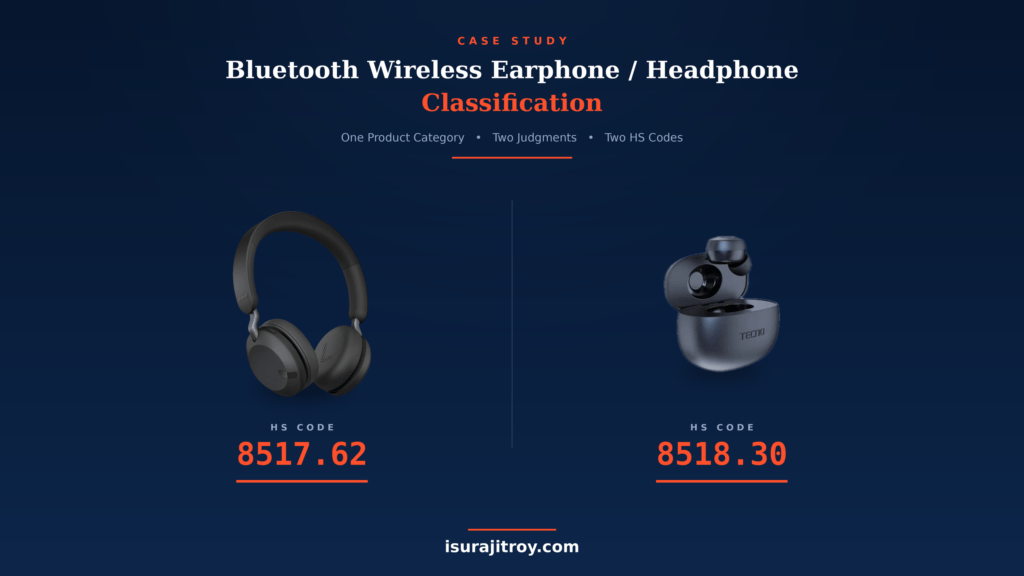
Bluetooth earphones and headsets sit on the boundary between heading 85.17 (apparatus for communication in a wireless network) and heading 85.18 (headphones and earphones). In 2026 two benches of India’s Customs, Excise and Service Tax Appellate Tribunal (CESTAT) split on them. CESTAT Chennai placed telephony-rich JABRA headsets in 8517.62 (Redington Ltd.); CESTAT New Delhi placed music-first earbuds in 8518.30 (G-Mobile Devices Pvt. Ltd.). In both cases the code followed the bench’s finding on the device’s principal function.
| Product | Bluetooth wireless earphones / headphones / earbuds / neckbands |
| Competing 6-digit subheadings | 8517.62 (communication apparatus) vs 8518.30 (headphones and earphones) |
| Authority basis | WCO Harmonized System (2022); GRIs and their Explanatory Notes; Section XVI Note 3; ENs to headings 85.17 and 85.18 |
| Scope note | Analysis is held to the 6-digit harmonised level. The Indian 8-digit tariff items (8517 62 90 / 8518 30 00) are national subheadings outside the WCO instrument. |
This study compares the two decisions, which reached opposite conclusions on the same product class. It is reasoned classification analysis based on the WCO instruments. It is not a binding ruling.
Executive summary
Both appeals turned on a single question: is a Bluetooth earphone or headset, as presented, an apparatus for communication on a wireless network (85.17), or a sound-reproduction article named by the tariff (85.18)? The two benches answered it differently. The difference is instructive because it sits exactly where General Interpretative Rule (GIR) method meets the principal-function finding.
| Dimension | Redington Ltd. (CESTAT Chennai) | G-Mobile Devices Pvt. Ltd. (CESTAT New Delhi) |
| Citation | Customs Appeal No. 40421 of 2024 | Customs Appeal No. 50651 of 2025 |
| Decided | 26.05.2026 | 29.04.2026 |
| Goods | JABRA Elite series (telephony-rich: voice dialing, call alerts, Siri/Assistant, HD voice) | Tecno Buds 1, Tecno H2, Oraimo OEB (music-first consumer earbuds) |
| Result (6-digit) | 8517.62 | 8518.30 |
| Driving authority | CBIC Circular 36/2013 treated as binding; Note 3 Sec XVI; GIR 2(b)/3(b) | SC Welkin Foods (2026); GIR 1 primacy; eo nomine; GIR 3(a) |
| Principal function found | Wireless communication (transceiver, active part of a network) | Audio reproduction (Bluetooth merely the wireless audio channel) |
| Outcome | Appeal allowed in full; reclassification to 8518.30 set aside | Appeal allowed in part: classification upheld at 8518.30, but extended-period demand and s.114A penalty set aside |
The bottom line: the code follows the principal-function finding, and the product label does not decide it. Where the device’s telephony or communication role dominates, 85.17 is defensible. Where it is essentially a wireless speaker for the ear, 85.18 prevails.
The goods and the dispute
Both importers brought in wireless earphones and headphones and claimed Indian tariff item 8517 62 90 to access the 10% concessional Basic Customs Duty under Sl. No. 20 of Notification 57/2017-Cus. In each case the Department sought 8518 30 00 at 15%.
- The physical article is the same family: an acoustic transducer (speaker), a microphone, a rechargeable battery, controls, and a short-range Bluetooth radio link in one shell.
- The functional dispute: a Bluetooth link both receives an audio stream and, during a call, transmits the user’s voice back. The device therefore arguably “receives, converts and transmits” data, which is the language of subheading 8517.62. It is also, by name, an “earphone”, the language of 8518.30.
- Presentation matters. These are finished consumer articles, not parts and not unassembled kits, so GIR 2(a) and the Section XVI Note 2 “parts” machinery are not engaged (G-Mobile expressly so held).
The two competing headings
| 6-digit | Heading / subheading text (paraphrased; verbatim where short) | Explanatory Note anchor |
| 8517.62 | One-dash: “Other apparatus for transmission or reception of voice, images or other data, including apparatus for communication in a wired or wireless network.” Two-dash 8517.62: “Machines for the reception, conversion and transmission or regeneration of voice, images or other data, including switching and routing apparatus.” | EN to 85.17 covers apparatus transmitting/receiving sound, images or data between points by electric current or electromagnetic waves; Subheading EN 8517.62 notes it “includes cordless handsets or base units, when presented separately.” |
| 8518.30 | “Headphones and earphones, whether or not combined with a microphone, and sets consisting of a microphone and one or more loudspeakers.” | EN to 85.18(C): headphones/earphones are electroacoustic receivers producing low-intensity sound; the heading covers them whether or not combined with a microphone, for telephony or telegraphy, and for plugging into radio/TV receivers, sound-reproducing apparatus or ADP machines. EN 85.18 opening: the heading covers them “regardless of the particular purpose for which such apparatus may be designed.” |
Two textual signals are easy to miss, and both bear directly on the dispute:
- Heading 85.18 expressly contemplates telephony use. EN 85.18(C) sweeps in earphones and headphones combined with a microphone “for telephony”, and the opening of the EN disclaims any purpose limitation. So the mere fact that a device can handle a call does not, by itself, take it out of 85.18.
- The “receiver” of a telephone set can itself be a headphone and microphone. EN to 85.17(I) describes a telephone set’s receiver as, in some cases, “a combined headphone and microphone, designed to be worn on the user’s head.” This is what makes a true telephony headset (a transceiver paired to a phone) a candidate for 85.17.
Both headings tolerate a microphone and a call function, so neither “does it have a microphone?” nor “can it take a call?” settles the question. The dividing line is which function is principal.
The legal framework
1. GIR 1: headings and Notes are paramount
GIR 1 provides that Section, Chapter and sub-Chapter titles are for ease of reference only; classification is determined by the terms of the headings and any relative Section or Chapter Notes. Its Explanatory Note says the titles “have no legal bearing on classification”, and many goods are classified on GIR 1 alone without recourse to later Rules (see this practical guide to applying the GRIs in order). Both 85.17 and 85.18 are in Chapter 85 / Section XVI, so the Section XVI Notes apply at GIR 1.
2. Section XVI Note 3: principal function
“Unless the context otherwise requires, composite machines consisting of two or more machines fitted together to form a whole and other machines designed for the purpose of performing two or more complementary or alternative functions are to be classified as if … being that machine which performs the principal function.”
The General EN to Section XVI, Part (VI), confirms that multi-function and composite machines are classified according to the principal function. Only where the principal function cannot be determined (and the context does not otherwise require) does one fall to GIR 3(c). Both benches addressed this hinge, though G-Mobile held it was not engaged because the device has one function. A Bluetooth earphone arguably performs two complementary functions (sound output, and wireless transmission and reception), so the code follows whichever predominates.
3. GIR 2(b): combinations and the reference to Rule 3
GIR 2(b) extends a heading for a material or substance to mixtures and combinations of it, and directs that goods of more than one material or substance be classified under Rule 3. Its EN cautions (para XII) that the Rule does not widen a heading to cover goods that no longer answer its description. Redington used GIR 2(b) as a route to “essential character”. Strictly, 2(b) is about materials; for a multi-function machine the more apt provision is Note 3 to Section XVI read with GIR 1.
4. GIR 3: goods prima facie in two or more headings (strict order a, b, c)
The EN to GIR 3 fixes the order of priority: (a) most specific description; (b) essential character; (c) last in numerical order. Rule 3(b) operates only if 3(a) fails, and 3(c) only if both fail.
- 3(a): a description by name is more specific than a description by class (EN 3(a), para IV(a)). “Headphones and earphones” (85.18) names the article; “other apparatus … including apparatus for communication” (85.17) describes a class and is residual in form. This is the textual core of the G-Mobile result.
- 3(b): essential character “may be determined by the nature of the material or component, its bulk, quantity, weight or value, or by the role of a constituent … in relation to the use of the goods” (EN 3(b), para VIII). It applies only to mixtures, composite goods and retail sets. The Circular and Redington invoked this.
- 3(c): last in numerical order among equally meritorious headings. Here that would itself favour 8518 over 8517.
5. GIR 6: subheadings
GIR 6 applies Rules 1–5 mutatis mutandis at subheading level, and only subheadings at the same level are comparable (one-dash against one-dash, then two-dash against two-dash). Once the heading is fixed:
- Within 85.17, the good sits under the one-dash “other apparatus for transmission/reception…”, then the two-dash 8517.62 “machines for reception, conversion and transmission…”.
- Within 85.18, the good is named directly at the one-dash 8518.30.
Case 1: Redington Ltd. (CESTAT Chennai, 8517.62)
Facts. JABRA Elite-series Bluetooth devices with pronounced telephony features: answer/end/reject call, voice dialing, last-number redial, call-vibration alert, Siri/Google Assistant activation, HD voice, NFC, DSP. Period 28.08.2021–30.04.2022. The Commissioner had reclassified the goods to 8518 30 00 and confirmed a demand of Rs. 2,71,95,456 (BCD + SWS + IGST), while dropping penalty under s.112(a)/s.117 and declining confiscation under s.111(m).
The bench reasoned as follows.
- Relying on Minda D-Ten, it held that a Bluetooth device receives RF analog signals, converts them to digital and transmits them back. It acts as a transceiver: it “receives, converts and transmits” voice and data, which is the test for 8517.62.
- It treated the device as an active part of a wireless network, distinct from a mere headphone that carries only audio signals.
- It applied Note 3 to Section XVI (principal function) and GIR 2(b)/3(b) essential character, and gave CBIC Circular 36/2013 binding effect. That Circular concludes that Bluetooth wireless headsets for mobile phones are classified under 8517.62 “by application of GRI 1 (Note 3 to Section XVI), 3(b) and 6.”
The GIR path, as decided:
GIR 1 (terms of 85.17 + Note 3 Sec XVI: principal function) → device is a transceiver / active network element → communication is the principal function → reinforced by GIR 2(b)/3(b) essential character + Circular 36/2013 → 8517.62.
Holding. The reclassification to 8518.30 was set aside and the appeal allowed in full with consequential relief. The Rs. 2.72 crore demand fell away, and the Rs. 2,00,00,000 pre-deposit becomes refundable. No penalty arose, since it had already been dropped below.
Case 2: G-Mobile Devices Pvt. Ltd. (CESTAT New Delhi, 8518.30)
Facts. Tecno Buds 1, Tecno H2 and Oraimo OEB consumer earbuds, headphones and neckbands, marketed on sound quality and pairable with phones, tablets, laptops, smart TVs and car audio. Period Feb 2020–Jan 2022. The show cause notice was issued under s.28(4) (extended period), with interest, a s.114A penalty and s.111(m) confiscation. The Commissioner classified the goods under 8518 30 00 and invoked the extended period.
The bench reasoned as follows.
- The primary function is audio playback. Call handling activates only on phone pairing, the brochures foreground sound quality, and the devices also serve TVs and laptops, where they are purely sound-output devices. Voice transmission and telephony are secondary.
- Note 3 to Section XVI does not apply. The device was treated as having essentially one function (acoustic reproduction), so there was no second function to resolve.
- GIR 1 and eo nomine. Following the Supreme Court in Welkin Foods (2026), GIR 1 gives primacy to heading terms and Notes, and GIRs 1–4 apply sequentially; once GIR 1 resolves the matter, the analysis stops. Heading 85.18 names the article eo nomine, a use limitation cannot be read into an eo nomine entry, and Bluetooth is “a means, not the function.”
- GIR 3(a) as a fallback. Even on a tie, 8518.30 names the goods specifically, while 8517 62 90 is a residual “other”, and the specific entry prevails.
- Circular 36/2013 was distinguished as confined to mono-aural headsets designed solely or principally for mobile telephony (on how much turns on that wording, see the case study on “solely” versus “principally” use in tariff classification).
- Precedents were distinguished: Amazon Wholesale (Echo devices require internet/cloud, which is true data communication), Minda D-Ten (a module whose sole function was reception, conversion and transmission) and L.G. Electronics (a smartwatch that was a computing and data device; compare the smartwatch classification divergence across jurisdictions).
- Goods are classified at the time of import on their objective characteristics. Actual end-use with a phone cannot drive classification.
The GIR path, as decided:
GIR 1 (terms of 85.18; eo nomine “headphones and earphones, whether or not combined with a microphone”) → primary function is audio reproduction; Bluetooth is only the wireless audio channel → Note 3 Sec XVI not engaged (single function) → [fallback GIR 3(a): named article beats residual “other”] → resolved at GIR 1; GIR 2/3 not required → 8518.30.
Holding (allowed in part):
- Classification was upheld at 8518.30; the importer lost on the merits.
- The extended period under s.28(4) could not be invoked, because a bona fide classification dispute is not suppression with intent to evade. The demand survives only for the normal period (s.28(1)) and was remitted for quantification, with interest to be re-determined.
- The s.114A penalty was set aside, since it stood on the same footing as the extended period.
- No rupee figures are stated in the judgment.
Side-by-side comparison
| Issue | Redington (8517.62) | G-Mobile (8518.30) |
| Characterisation of Bluetooth | Active network transceiver | Wireless audio delivery channel |
| Principal function | Wireless communication | Audio reproduction |
| Note 3 to Section XVI | Applied (multi-function → communication) | Not engaged (single function) |
| Governing GIR limb | GIR 1 + Note 3; GIR 2(b)/3(b) essential character | GIR 1 eo nomine; fallback GIR 3(a) most specific |
| Circular 36/2013 | Binding clarification, followed | Distinguished (mono-aural telephony headsets only) |
| Minda D-Ten | Followed | Distinguished |
| Main precedent | Circular 36/2013; Minda D-Ten | SC Welkin Foods (2026) |
| Product facts | Telephony-rich (voice dialing, assistant, HD voice) | Music-first, multi-device |
| Result | Appeal fully allowed | Appeal allowed in part |
Why the two benches diverged
The split has three causes:
- The product facts differ. Redington’s JABRA devices carried deep telephony functionality, which made a “communication” principal function plausible. G-Mobile’s earbuds were marketed for music across many non-telephony devices, which made “audio reproduction” the natural principal function. On this reading the two outcomes can be reconciled on their facts.
- The method differs. Redington routed through the Circular and Note 3, then added GIR 2(b)/3(b) essential character. G-Mobile insisted on strict sequential GIRs, anchored in Welkin Foods, and stopped at GIR 1 on eo nomine grounds, mentioning GIR 3(a) only as a fallback.
- The case law before each bench differed. G-Mobile (29 April) applied the new Supreme Court ruling in Welkin Foods; Redington (26 May, Chennai) did not cite Welkin Foods or G-Mobile. This is a classic inter-bench divergence of the kind a High Court or a larger bench is usually asked to resolve. In July 2026 Taxscan reported that CESTAT Mumbai, in an appeal by Imagine Marketing Ltd on the same question, left the classification of Bluetooth earphones to await a Larger Bench (Taxscan report).
A disciplined GIR walkthrough (6-digit)
Applying the Rules in strict order to a representative Bluetooth earphone with microphone, presented finished and ready for retail:
Step 1: GIR 1. Read the heading terms with the Section XVI Notes. On its face the good answers to both 85.18 (it is an “earphone … combined with a microphone”) and 85.17 (it “receives … and transmits … data” over a wireless link). EN 85.18 confirms the heading is not purpose-limited and even covers earphones “for telephony.” So GIR 1 alone does not exclude either heading, unless Section XVI Note 3 resolves it.
Step 2: Section XVI Note 3 (principal function). Treat the device as a machine performing two complementary functions (sound output, and wireless reception and transmission) and classify it by principal function:
- If the article is, in substance, a telephony or communication headset (designed and marketed for two-way voice or data on a network, with telephony as its reason for existing), the principal function is communication: 85.17, then 8517.62. (Redington pattern.)
- If the article is, in substance, a wireless listening device (audio reproduction is its reason for existing, and calling is an incidental convenience that only activates on phone pairing), the principal function is audio: 85.18, then 8518.30. (G-Mobile pattern.)
If Note 3 resolves it, classification is complete at GIR 1 and you do not go down to GIR 3.
Step 3: GIR 3 (only if Note 3 cannot fix the principal function).
- 3(a): “headphones and earphones” (85.18) is a description by name; “other apparatus … for communication” (85.17) is a description by class and is residual. Under EN 3(a), the named description is more specific, which gives 85.18.
- 3(b): only if 3(a) fails. Weigh essential character by the role of the constituent in relation to use (EN 3(b) para VIII).
- 3(c): only if both fail. Last in numerical order would itself give 85.18.
Step 4: GIR 6. Go down to the 6-digit subheading: 8517.62 (two-dash, machines for reception, conversion and transmission) or 8518.30 (one-dash, headphones and earphones), comparing only subheadings at the same level.
Observation on method. Where Note 3 fixes the principal function, the cleanest path is GIR 1 read with Note 3, and there is no need to invoke GIR 3(b). Reaching for 3(b) when a heading already names the article, or when Note 3 already resolves the function, over-cites the path. The substantive divergence between the two judgments is therefore narrower than it looks: both turn on the principal-function finding, which is a question of the product’s objective characteristics at the time of import.
Practical takeaways
- Identify the principal function first, on the objective characteristics at import. Marketing slogans and the way a particular customer uses the device do not decide it. Per Welkin Foods, actual use does not control unless the heading invites a use test.
- Bluetooth connectivity alone is not decisive. Both headings tolerate a microphone and even telephony use. A radio chip does not turn a listening device into a network machine, and a genuine telephony transceiver is not demoted to a speaker just because it sits in the ear.
- Distinguish a transceiver from a sink. Devices that receive, convert and transmit voice or data as an active network element tend towards 8517.62; devices that essentially receive an audio stream and render it as sound tend towards 8518.30. (Indian customs has also litigated heading 85.18 over loudspeakers; see the case study on Philips multimedia speaker systems.)
- For multi-function machines, Note 3 to Section XVI (read with GIR 1) is the right tool. Keep GIR 2(b) for combinations of materials or substances.
- Keep eo nomine discipline. Where a heading names the article (85.18 “headphones and earphones”), do not read in a use limitation, and do not jump to GIR 3(b) when GIR 1 or 3(a) already resolves it.
- A classification dispute is not evasion. A genuine, defensible classification position generally defeats the extended period of limitation and the matching penalty (G-Mobile), even where the importer loses on the merits.
- Document the design intent. In the Redington line, catalogues showing that the device is built and sold as a telephony/communication headset supported 8517.62; the absence of such evidence hurt the importer in G-Mobile.
Authorities cited
- GIR 1, 2(b), 3(a)/(b)/(c) and 6, and their Explanatory Notes (WCO HS 2022).
- Note 3 to Section XVI (principal function of composite and multi-function machines); General EN to Section XVI, Part (VI).
- EN to heading 85.17 (apparatus for transmission/reception of voice, images, data; a telephone-set receiver may be a combined headphone and microphone); Subheading EN 8517.62 (cordless handsets/base units when presented separately).
- EN to heading 85.18(C) (headphones and earphones are electroacoustic receivers; covered whether or not combined with a microphone, for telephony, and regardless of the particular purpose for which designed).
- CBIC Circular No. 36/2013-Cus (05.09.2013), clarifying Bluetooth wireless headsets for mobile phones under 8517.62.
- The two CESTAT decisions: Redington Ltd., CESTAT Chennai, Customs Appeal No. 40421 of 2024 (TaxGuru report), and G-Mobile Devices Pvt. Ltd., CESTAT New Delhi, Customs Appeal No. 50651 of 2025 (LiveLaw report).
- CESTAT and court decisions referred to in the judgments: Minda D-Ten; L.G. Electronics; Delhi High Court in Amazon Wholesale India; Supreme Court in Welkin Foods (2026) and Simplex Mills (2005).
Caveats and scope
- Six-digit level. This analysis resolves to 8517.62 or 8518.30. The Indian eight-digit tariff items (8517 62 90 / 8518 30 00, and the later national subdivisions of 8518 30) are national subheadings beyond the WCO instrument; for the full national code, consult the applicable national tariff schedule.
- Persuasive, not binding. These are Indian CESTAT decisions applying the Indian Customs Tariff and India’s GIR, which mirror the WCO HS to 6 digits. They are reasoned practice, not WCO classification rulings, and only customs authorities issue binding rulings.
- The outcome depends on the facts. The correct 6-digit code depends on the specific device’s design and principal function as presented at import. Telephony-centric communication headsets and music-first listening earbuds can legitimately diverge between 85.17 and 85.18.
- The divergence is unresolved. Until a higher forum reconciles the two lines, importers of borderline devices face genuine classification risk. The conservative course is to map each SKU’s principal function to the heading and document the basis.