
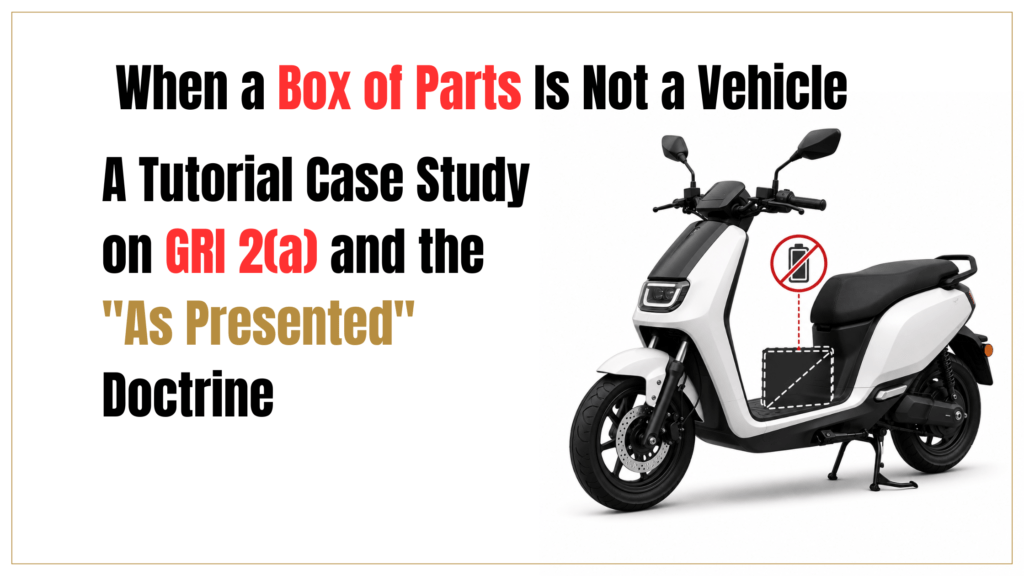
Greaves Electric Mobility Pvt. Ltd. & Ors. v. Commissioner of Customs, Chennai-II
CESTAT Chennai, Final Order Nos. 40569–40572/2026 | Decided 04.05.2026 Members: Mr. Vasa Seshagiri Rao (Technical) and Mr. P. Dinesha (Judicial)
How to Read This Case Study
This is a teaching case, not just a digest. It uses one real dispute to walk through the single most litigated rule in the entire General Rules for the Interpretation of the Harmonized System: GRI 2(a). By the end you should be able to do three things on your own: (1) recognise when GRI 2(a) is even in play; (2) run the two-pillar test — “essential character” and “as presented” — the way a WCO-trained classifier does; and (3) read the Explanatory Notes to Rule 2(a) closely enough to know which note helps which side of an argument.
The dispute is worth ₹56.43 crore in duty alone. But the lesson is worth more than the number, because the principle decided here governs every CKD/SKD import you will ever classify.
Edition note. All Nomenclature references in this study are to the WCO Harmonized System, Seventh Edition (HS 2022). The 8-digit codes used by the Indian customs authority (e.g., 8711 6020, 8714 10 10) are national subdivisions below the harmonised 6-digit ceiling and are flagged as such throughout.
The Story in One Paragraph
A manufacturer of electric two-wheelers imported the components of its e-scooters from China — motors, controllers, converters, frames, wiring harnesses, body panels, fasteners — and cleared each consignment as parts under their own tariff headings (mainly heading 87.14, parts of motorcycles). The Revenue, acting on intelligence from the Directorate of Revenue Intelligence, said this was a dodge: the imports were really complete e-scooters in Completely Knocked Down (CKD) condition, and should be reclassified as whole vehicles under heading 87.11, attracting far higher duty. The Revenue’s entire legal engine for that reclassification was GRI 2(a). The Tribunal held that the engine never started — because the goods, as presented in each consignment, did not have the essential character of a complete electric vehicle, the battery being absent. The importer won on every issue.
The Factual Matrix
The appellant, Greaves Electric Mobility Pvt. Ltd. (GEMPL, formerly Ampere Vehicles Pvt. Ltd. / AVPL), assembles e-scooters in Coimbatore. Over the disputed period 20.03.2018 to 31.12.2021, it filed 405 Bills of Entry, importing components across Chapters 39, 40, 48, 73, 83, 84, 85, 87 and 90.
The Revenue’s investigation assembled a circumstantial picture that, on its face, looked damning:
- Proforma invoices and Bills of Lading repeatedly described the goods as “Electric Bike CKD” or “Full CKD Kit,” and some Bills of Lading even quoted heading 8711 60.
- Purchase orders covered the parts needed to assemble specific named models (Elite, Magnus, Zeal, Reo, V.48).
- The Bills of Entry, by contrast, declared the same goods as “parts and components of electric scooters” under heading 87.14.
- The freight forwarder admitted, in a statement under Section 108, that the description was changed from the Bill of Lading wording to “parts” on the importer’s instruction.
- Assembly in India was simple — “screwdriver technology,” roughly five minutes per scooter, no reworking of the imported components.
- Consignments arriving under a single Import General Manifest (IGM) were split into multiple Bills of Entry; of 405 Bills of Entry, 190 were linked to common IGMs.
On that footing the Commissioner confirmed a differential duty demand of ₹56,43,93,553 under Section 28(4), a redemption fine of ₹16 crore under Section 125, a penalty of ₹56,43,93,553 under Section 114A on the company, and penalties on three co-appellants (two employees and the logistics agent, Seven Seas Global Express Logistics).
There was, however, one fact the Revenue could not escape, and it is the fact the whole case turns on: the battery pack was never imported with the consignments. Batteries were imported separately (from Phylion and Xupai) or procured locally. From 2021 onward, frames, motors and body panels were also increasingly sourced domestically.
The Classification Battlefield: 87.11 versus 87.14
Two headings were in contention. At the 6-digit harmonised level the contest is 8711.60 against 8714.10.
Heading 87.11 — the Revenue’s destination.
“Motorcycles (including mopeds) and cycles fitted with an auxiliary motor, with or without side-cars; side-cars.”
Subheading 8711.60 – With electric motor for propulsion.
The Explanatory Note to 87.11 is explicit that electric two-wheelers belong here: motorcycles propelled by one or more electric motors are “Electric Motorcycles,” and they “incorporate an electric accumulator pack supplying power to the electric motors.” Read that phrase carefully — the EN itself ties the identity of the goods to the accumulator pack (battery). We return to this.
Heading 87.14 — the importer’s declaration.
“Parts and accessories of vehicles of headings 87.11 to 87.13.”
Subheading 8714.10 – Of motorcycles (including mopeds).
A frame, a controller, a wiring harness — each is, on a plain reading, a part of a motorcycle and falls squarely in 87.14 by the terms of the heading. Nobody disputed that the individual components, taken individually, were correctly classifiable as parts. The dispute was whether GRI 2(a) could aggregate and promote those parts into a finished vehicle.
Why this is a GRI 2(a) question and not a GRI 1 question. Under GRI 1, classification is determined first by the terms of the headings and the relative Section/Chapter Notes. A motor, presented as a motor, is described by heading 87.14 (parts). Heading 87.11 (the vehicle) does not, by its own terms, describe a loose motor. So GRI 1 alone classifies these goods as parts. The only route to 87.11 is the extending mechanism of GRI 2(a), which is precisely why the Revenue’s case lived or died on Rule 2(a).
GRI Refresher — How Rule 2(a) Actually Works
This is the tutorial core. Read it slowly; the rest of the case is just the rule applied to facts.
1. The text of Rule 2(a)
Rule 2(a): “Any reference in a heading to an article shall be taken to include a reference to that article incomplete or unfinished, provided that, as presented, the incomplete or unfinished article has the essential character of the complete or finished article. It shall also be taken to include a reference to that article complete or finished (or falling to be classified as complete or finished by virtue of this rule), presented unassembled or disassembled.”
Notice the rule has two distinct parts joined by “It shall also”:
- First part — incomplete or unfinished articles. A heading for a finished article also catches that article when it is incomplete or unfinished, if as presented it has the essential character of the finished article.
- Second part — unassembled or disassembled articles. A heading for a finished article also catches that article when it is presented in pieces (a flat-pack), to be put together by simple assembly.
A CKD import potentially engages both parts at once: it is arguably incomplete (the first part) and it is certainly unassembled (the second part). To win, the Revenue had to satisfy both pillars below.
2. The two pillars
Every GRI 2(a) reclassification stands on two legs. Knock out either one and the rule collapses.
Pillar A — Essential character. The incomplete/unassembled goods must, as a bundle, possess the essential character of the finished article. Essential character is a finding, not a slogan: per the Rule 3(b) Explanatory Note (VIII), it may be determined by nature, bulk, quantity, weight, value, or “the role of a constituent material in relation to the use of the goods.” That last factor — role in use — is the one that decided this case.
Pillar B — As presented. The test is applied to the goods as they are presented at the moment of importation, in the consignment before the assessing officer. Not as they will be after assembly. Not as they exist when notionally combined with other consignments. The two words “as presented” appear in the rule text itself and recur throughout the Explanatory Notes.
3. The first-part Explanatory Notes — (I) to (IV)
(I) The first part of Rule 2(a) extends the scope of any heading which refers to a particular article to cover not only the complete article but also that article incomplete or unfinished, provided that, as presented, it has the essential character of the complete or finished article.
This is the operative note. It binds the two pillars together in a single sentence: essential character + as presented. Everything the Tribunal did flows from this note.
(II) [Blanks and semi-manufactures.] The rule applies to “blanks” — articles already having the approximate shape of the finished part — but not to semi-manufactures such as bars, discs and tubes that lack the essential shape of the finished article.
Not relevant here: e-scooter components are neither blanks nor undifferentiated semi-manufactures. Set it aside.
(III) In view of the scope of the headings of Sections I to VI, this part of the Rule does not normally apply to goods of those Sections.
This is a carve-out, and it does not bite, because e-scooters are Section XVII (Chapter 87), far outside Sections I–VI. So Rule 2(a) is at least available for these goods. Note (III) tells us the door is open; it says nothing about whether we should walk through it.
(IV) Several cases covered by the Rule are cited in the General Explanatory Notes to Sections or Chapters (e.g., Section XVI, and Chapters 61, 62, 86, 87 and 90).
This is the note the Revenue liked, because it directs you to the Chapter 87 General Explanatory Note, which contains the famous illustration:
“An incomplete or unfinished vehicle… is classified as the corresponding complete or finished vehicle provided it has the essential character of the latter… as for example: (A) A motor vehicle, not yet fitted with the wheels or tyres and battery. (B) A motor vehicle not equipped with its engine or with its interior fittings. (C) A bicycle without saddle and tyres.”
Read literally, illustration (A) says a vehicle without a battery can still be the vehicle. The Revenue built its case on that single clause. Hold that thought — §7.4 explains why it failed.
4. The second-part Explanatory Notes — (V) to (IX)
(V) The second part provides that complete or finished articles presented unassembled or disassembled are classified in the same heading as the assembled article — usually for reasons of packing, handling or transport.
The phrase to highlight is “presented unassembled” — presented, singular, in one consignment.
(VI) This Rule also applies to incomplete or unfinished articles presented unassembled or disassembled provided that they are to be treated as complete or finished articles by virtue of the first part of this Rule.
This is the gate-keeper note, and it is lethal to the Revenue. Note (VI) makes the second part (unassembled) conditional on the first part (essential character). In other words: you cannot use the “it’s just unassembled” argument unless the bundle already has essential character. If Pillar A fails, the second part is never reached.
(VII) “Articles presented unassembled or disassembled” means articles whose components are to be assembled by fixing devices (screws, nuts, bolts), riveting or welding, provided only assembly operations are involved. The complexity of the assembly method is irrelevant. The components shall not be subjected to any further working operation. Excess components are classified separately.
This is the “screwdriver technology” note. The Revenue invoked it to say: the assembly is simple, therefore the kit is still a vehicle. But note the conditional structure — (VII) only matters if you are already inside the second part, which (VI) gates on the first part. (See §7.5.)
(VIII) Cases covered by this Rule are cited in the General ENs to Sections/Chapters (e.g., Section XVI, and Chapters 44, 86, 87 and 89).
(IX) In view of the scope of Sections I to VI, this part of the Rule does not normally apply to goods of those Sections.
(VIII) is the second-part twin of (IV); (IX) is the second-part twin of (III). Neither changes the analysis.
5. The gateway in the Rule 1 Explanatory Note
There is one more note, and it is decisive for the “multiple consignments” point. The Explanatory Note to Rule 1, provision (V)(b), introduces Rule 2 with this example:
“(2) goods presented unassembled or disassembled (e.g., a bicycle, unassembled or disassembled, all components being presented together)…”
The WCO’s own gateway illustration of an unassembled article presupposes that all components are presented together. A bicycle in one box. Not a wheel in March, a frame in June and a saddle in September across three separate import declarations. This phrase, “all components being presented together,” is the textual root of the “as presented” doctrine the Supreme Court later crystallised in Sony India.
The Department’s Theory of the Case
The Revenue’s argument, distilled, ran like this:
- The commercial documents prove the importer intended to bring in complete e-scooters in CKD form.
- The Chapter 87 General EN, illustration (A), says a vehicle without a battery can still be a vehicle — so the missing battery does not matter.
- The assembly was trivial (“screwdriver technology”), so EN (VII) is satisfied.
- The splitting of one IGM into multiple Bills of Entry was a deliberate device to evade Rule 2(a); the imports should therefore be “viewed holistically,” aggregating components across consignments to reconstruct complete kits.
- CBIC Circular dated 27.02.1997 supports treating essential-component imports as complete articles.
It is a coherent narrative. Its weakness is that every limb assumes the conclusion — that there was a complete kit — rather than proving it consignment by consignment.
The Appellant’s Defence
The importer’s counsel did not argue that the parts were never destined for assembly. They argued something narrower and far more powerful: whatever the intention, GRI 2(a) is tested on the goods as presented, and what was presented never amounted to a vehicle.
The defence rested on four pillars of authority:
- The battery point — the battery is the sole source of propulsion in an EV; it was never in the consignments; without it there is no essential character of an electric vehicle (Twinkle Tradecom, since affirmed by the Supreme Court).
- The “as presented” point — Sony India (SC) forbids classifying on intended assembly or post-import activity.
- The aggregation point — Battre Electric Mobility holds that multiple Bills of Entry cannot be clubbed; each must be independently assessed; the Customs Act contains no provision to combine separate Bills of Entry for classification.
- The limitation point — successive Show Cause Notices on the same facts negate any allegation of suppression (Nizam Sugar Factory).
The Tribunal’s GRI Analysis, Step by Step
This is how the Bench actually reasoned. Follow the sequence — it is a model of GRI discipline.
1. Pillar B first: the “as presented” doctrine
The Tribunal began not with intention or documents but with the rule’s own language: classification under Rule 2(a) is determined on the goods “as presented” at the time of import. It quoted the principle from the Supreme Court in Sony India Ltd.: the test is whether the incomplete article, as presented, has the essential character of the finished article, and the rule “cannot be applied on the basis of post-importation assembly or use.” Where goods arrive in separate consignments over time, “they cannot be clubbed together to treat them as a complete article. Each consignment must be assessed independently.”
That single holding does most of the work. The Revenue’s case was built on aggregation across time; Sony India prohibits exactly that.
2. Multiple Bills of Entry cannot be aggregated
The Tribunal then confronted the Revenue’s “view it holistically” submission head-on. It examined the actual Bills-of-Entry data for 2018–2021 and found the imports “highly fragmented.” Critically:
- Even consignments under the same IGM did not contain a complete set of components.
- A single IGM was routinely split into multiple Bills of Entry, “none of which individually or collectively contain a complete set of essential components.”
- There was no consignment-wise correlation — no analysis showing how many complete vehicles could be assembled from any given import, and no matching of batteries to vehicles at all.
The Revenue had relied on Samay Electronics, where split consignments were aggregated. The Tribunal distinguished it cleanly: in Samay the components were imported in correlated quantities capable of forming complete kits. Here they were not. And in any event, a Tribunal ruling (Samay) cannot override a Supreme Court judgment (Sony India) that forbids aggregation. Following Battre Electric Mobility, the Bench held there is no statutory mechanism to combine goods imported under more than one Bill of Entry to decide classification.
Tutorial point. This is the procedural heart of the win. Even if every part of an e-scooter eventually entered India, the classifier may only look at one Bill of Entry at a time. GRI 2(a) is a rule about what is in the box now, not what will be in the warehouse next quarter.
3. Pillar A: essential character and the battery
Having dealt with presentation, the Tribunal turned to essential character — and here it made the doctrinally important move. It held that “essential character” cannot be equated with mere functional completeness (Universal Commercial Corporation), but must be determined by reference to the component that imparts the product’s primary function.
For an electric vehicle, that component is the battery:
“In the case of electric vehicles, the battery is not merely a component but constitutes the primary source of propulsion, analogous to the engine in an internal combustion engine vehicle.”
This is the role-in-use limb of essential character (Rule 3(b) EN (VIII)) applied to Rule 2(a). The battery is to an EV what the engine is to a petrol scooter. The Bench found support in the statutory scheme itself — Entry 531A of Notification 50/2017-Cus expressly lists the battery pack as one of the essential components of an EV CKD kit — and in a line of CESTAT authority: Twinkle Tradecom (Kolkata), Vani Electric Vehicle, and Jade Korea Spine Life. Decisively, Twinkle Tradecom had since been affirmed by the Supreme Court (the Department’s appeal dismissed on delay and on merits).
Because the battery — the propulsion source — was admittedly never imported with the consignments, the imported goods could not, as presented, possess the essential character of a complete electric vehicle. Pillar A failed.
4. Distinguishing the Chapter 87 EN illustration
Now to the Revenue’s best card: Chapter 87 General EN illustration (A), “a motor vehicle, not yet fitted with the wheels or tyres and battery.” On its face this clause says a battery-less vehicle is still a vehicle. Why didn’t it govern?
The Tribunal’s answer is a small masterpiece of EN reading. The illustrations in the Chapter 87 General EN were drafted in the conceptual world of the internal-combustion-engine vehicle, where the engine is the prime mover and the battery is an ancillary starter component. In that world, a car missing its 12-volt battery is obviously still a car — the engine, the thing that makes it a car, is present. Transplant that illustration onto an electric vehicle and it inverts: the battery is the prime mover’s energy source; remove it and you have removed the very thing that makes the goods an electric vehicle. The EN illustration was therefore distinguishable, not binding, on the facts of an EV.
Tutorial point. An Explanatory Note illustration is an aid to interpretation, not a statute. When a new technology (here, EVs) shifts which component carries the “role in use,” the classifier must re-map the essential-character analysis rather than apply a legacy illustration mechanically. This is one of the most transferable lessons in the judgment.
5. The “screwdriver technology” limb — deliberately left undecided
The Revenue had a second-part argument too: EN (VII) says complexity of assembly is irrelevant, so even trivial “screwdriver” assembly yields a vehicle. The appellant countered that its post-import activity went beyond mere assembly. The Tribunal declined to decide this question — and that refusal is itself a teaching point. Because EN (VI) gates the second part (unassembled) on the first part (essential character), and the first part had already failed, the second-part assembly question never arose. As the Bench put it, “No finding is required to be given on this as the essential test has failed for invoking… Rule 2(a).”
Tutorial point. The two parts of Rule 2(a) are sequential, not parallel. If the bundle lacks essential character, you never reach the “is the assembly simple enough” question. Arguing assembly complexity before settling essential character is putting the cart before the horse.
6. Circulars cannot override the rule
Finally, the Revenue leaned on the 1997 CBIC Circular and the 2022 GST Circular (which said an EV keeps its classification even without a fitted battery). The Tribunal held that Board circulars bind the Department but cannot override statutory provisions or Supreme Court precedent (Ratan Melting & Wire Industries). A circular that presumes completeness despite the absence of a critical component cannot be relied on to defeat the “as presented” rule laid down in Sony India. (Separately, the importer noted that the GST Circular’s reasoning sat uneasily with classifying the very same goods as parts — but the Tribunal disposed of the point on the binding-precedent ground.)
The Explanatory-Note Scorecard
A compact reference you can lift into training material. “Supports” = advances the Revenue’s reclassification to 87.11; “Denies” = favours the importer’s parts classification.
| EN to Rule 2(a) | What it says | Effect in this case |
| (I) First part: incomplete article caught “provided, as presented, it has the essential character” | Binds the two pillars | Denies — decisive; essential character absent as presented (battery missing) |
| (II) Blanks vs semi-manufactures | Defines “blank” | Not applicable — components are neither |
| (III) Sections I–VI carve-out (first part) | Limits scope | Neutral — Chapter 87 is outside I–VI, so rule is merely available |
| (IV) Cites Chapter 87 General EN | Signposts the vehicle illustration | Supports, but the illustration was distinguished (IC-engine vs EV) |
| (V) Second part: unassembled article classified as assembled “when goods are so presented” | “Presented” = together | Denies — split Bills of Entry are not “so presented” |
| (VI) Second part conditional on first part | Gate-keeper | Denies — first part failed, so second part never reached |
| (VII) Simple assembly; complexity irrelevant; no further working | “Screwdriver” note | Supports in theory, but rendered moot by (VI) |
| (VIII) Cites Chapter 87 (second part) | Signposts | Supports, same fate as (IV) |
| (IX) Sections I–VI carve-out (second part) | Limits scope | Neutral |
| Rule 1 EN (V)(b) Bicycle “all components presented together” | Gateway to Rule 2 | Denies — root of the “single consignment” requirement |
Reading the scorecard: the only notes that genuinely helped the Revenue were (IV)/(VIII) — the Chapter 87 signpost — and the illustration they point to was neutralised by the EV-versus-IC-engine distinction. The notes that sank the case were (I), (VI) and (V), all converging on the same two words: as presented.
Beyond Classification — Limitation, Confiscation and Penalties
The classification finding decided the case, but the Tribunal addressed the consequential issues too, and each contains a discrete lesson.
1. Extended period of limitation — barred
The Revenue invoked the extended period (Section 28(4)) alleging suppression. The Tribunal rejected it for a clean reason of fact: the Department had already issued earlier Show Cause Notices on substantially the same facts and period (one on the normal period, one invoking the extended period), so it plainly knew the nature of the imports and the classification adopted. Per Nizam Sugar Factory, once the Department possesses the relevant facts, it cannot keep invoking the extended period on the same facts by alleging suppression. The imports were all on duly filed and assessed Bills of Entry; a bona fide classification dispute is not suppression (Densons Pultretaknik, Northern Plastics).
Tutorial point. Misclassification ≠ misdeclaration. Adopting a classification the Department later disputes is not, without more, wilful suppression. This distinction routinely decides whether the demand survives at three or five years.
2. Redemption fine — set aside
The goods had long been cleared and were not available for confiscation. Per Finesse Creation (affirmed by the Supreme Court) and Weston Components, redemption fine under Section 125 can only arise when the goods are physically available for redemption. No goods, no fine. The ₹16 crore redemption fine fell on this ground alone, independent of the merits.
3. Penalties — collapse with the demand
Section 114A penalty is attracted only where there is fraud, suppression or wilful misstatement. Once the dispute is characterised as a bona fide interpretational difference over Rule 2(a), the foundation for penalty evaporates. The penalties under Sections 112, 114A and 114AA — on the company and on all co-appellants — were set aside in toto. Once the demand fails on merits and limitation, all consequential actions necessarily fail.
Why the Appellant Won — The Synthesis
Strip away the 64 pages and the win reduces to a single chain of reasoning:
- The only route to 87.11 was GRI 2(a) — GRI 1 classifies loose parts as parts (87.14).
- GRI 2(a) is tested “as presented” — at the moment of import, consignment by consignment (Sony India; Rule 1 EN (V)(b); EN (I) and (V)).
- You cannot aggregate separate Bills of Entry to manufacture a complete kit (Sony India; Battre) — and the data showed no single consignment, nor even a single IGM, contained a complete set.
- Essential character is decided by the propulsion component — for an EV, the battery (Twinkle Tradecom, aff’d by SC; Rule 3(b) EN (VIII), role-in-use).
- The battery was never imported with the kits — so no consignment, as presented, had the essential character of an electric vehicle.
- Therefore Pillar A fails; EN (VI) blocks the second part; Rule 2(a) cannot be invoked — and the parts stay classified as parts.
- Everything downstream collapses — extended period (no suppression), redemption fine (goods unavailable), penalties (no fraud).
The importer did not win on sympathy or on a technicality of drafting. It won because the Revenue tried to run GRI 2(a) on intention and aggregation, and the rule is built to defeat exactly that — it asks only what is in the box, and what was in the box was never a vehicle.
Practitioner Takeaways
- GRI 2(a) is a snapshot, not a movie. Classify the consignment in front of you, frozen at the moment of import. Intention, purchase orders, and what arrives next month are irrelevant to the rule.
- One Bill of Entry, one assessment. There is no statutory power to club separate Bills of Entry — not even under a single IGM — to build a complete article. If the Revenue must aggregate to reach a heading, the heading is wrong.
- Identify the propulsion/prime-mover component before assessing essential character. For EVs that is the battery; for IC vehicles, the engine. Essential character lives in the component that delivers the product’s core function (role-in-use), not in a headcount of parts present.
- Treat EN illustrations as technology-dated. The Chapter 87 “vehicle without a battery” example was written for IC-engine vehicles. Do not transplant a legacy illustration onto a technology whose functional centre of gravity has shifted.
- Mind the gate between the two parts of Rule 2(a). EN (VI) makes the “unassembled” limb conditional on the “essential character” limb. Settle essential character first; the assembly-complexity (“screwdriver”) debate is downstream and often moot.
- Misclassification is not suppression. A bona fide, consistently declared classification — assessed by the Department — does not support the extended period or Section 114A, especially where earlier notices show prior knowledge.
- No goods, no redemption fine. Once goods are cleared and unavailable, Section 125 redemption fine cannot stand, whatever the merits.
The Classifier’s GRI 2(a) Checklist
Run this sequence on any CKD/SKD or incomplete-goods question:
- Is GRI 1 sufficient? Do the heading terms and Section/Chapter Notes already classify the goods (e.g., as parts)? If yes, stop — do not invoke Rule 2(a).
- What exactly is in this consignment? List the components present in the single Bill of Entry. Resist the urge to look at sister consignments.
- Which component carries the essential character (role-in-use)? Is that component present? For propulsion goods, is the prime mover / energy source present?
- As presented, does the bundle have the essential character of the finished article? If no → Rule 2(a) fails; classify components on their own terms. If yes → proceed.
- (Only if essential character is satisfied) Is the assembly limited to fixing/riveting/welding with no further working (EN (VII))? Are there excess components to split out?
- Descend to the 6-digit subheading under GRI 6 — and flag any 8/10-digit national code as outside the harmonised ceiling.
Final Classification Stated
HS Code (upheld): 8714.10 — “Parts and accessories of vehicles of headings 87.11 to 87.13 — Of motorcycles (including mopeds)” (and the other imported components under their own respective headings).
HS Code (rejected): 8711.60 — “Motorcycles… — With electric motor for propulsion.”
The 8-digit Indian tariff items (8711 6020 / 8714 10) are national subdivisions below the WCO 6-digit level and require confirmation against the applicable national schedule.
Supporting authority relied on in this study: General Rules for the Interpretation of the Harmonized System, Rule 1 and Rule 2(a), with Explanatory Notes (I)–(IX); Rule 1 Explanatory Note (V)(b); Rule 3(b) Explanatory Note (VIII); Explanatory Notes to headings 87.11 and 87.14 and the General Explanatory Note to Chapter 87 (HS 2022). Judicial authorities: Sony India Ltd. (SC), Twinkle Tradecom Pvt. Ltd. (CESTAT Kolkata, aff’d SC), Battre Electric Mobility Pvt. Ltd. (CESTAT New Delhi), Universal Commercial Corporation (SC), Bharat Heavy Electricals Ltd. (SC), Nizam Sugar Factory (SC), Densons Pultretaknik (SC), Northern Plastics Ltd. (SC), Ratan Melting & Wire Industries (SC), Finesse Creation Inc. (SC), Weston Components Ltd. (SC).
This article is reasoned classification analysis for educational and professional reference. It is not a binding tariff ruling; binding rulings issue only from the competent customs authority.