
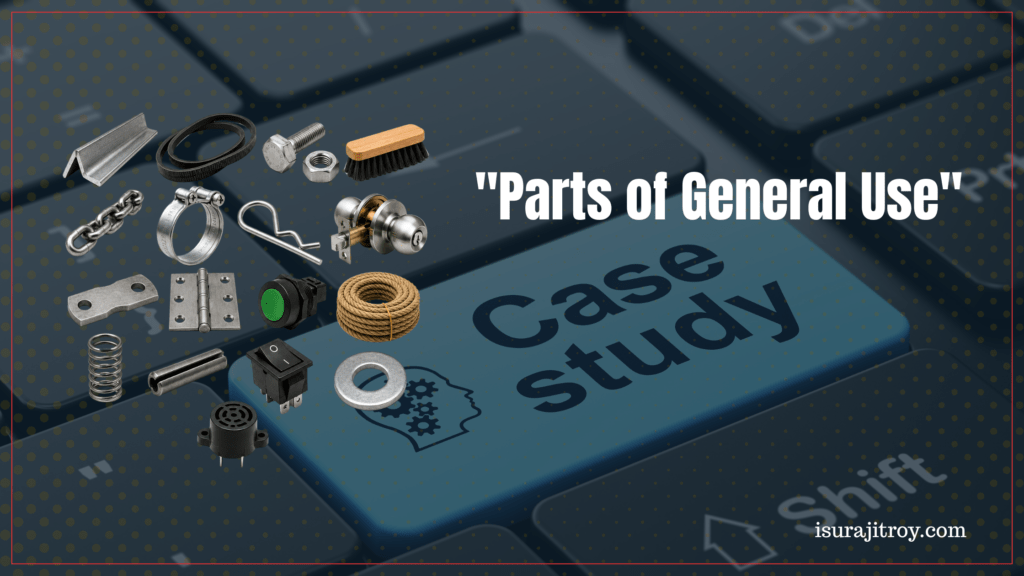
Built around Johnson Lifts Pvt. Ltd. v. Commissioner of Customs, Chennai-II (CESTAT Chennai, Final Order No. 40054/2026, 9 January 2026)
“Parts of general use” is a closed list defined in Note 2 to Section XV of the Harmonized System: base-metal articles of headings 73.07, 73.12, 73.15, 73.17 and 73.18 (and similar articles of other base metal), springs of base metal, and the locks, fittings, clasps, sign-plates, frames and mirrors of headings 83.01, 83.02, 83.06, 83.08 and 83.10. Goods on that list stay in their own headings even when they are made for one particular machine or vehicle, because Section XVI Note 1(g), Section XVII Note 2(b) and similar Notes exclude them from the parts headings. In Johnson Lifts, the rule sent lift door locks to heading 83.01, yet the Department lost on ten other items because it never proved, with evidence, that they were parts of general use.
Why this concept deserves a dedicated study
“Parts of general use” is a frequent source of classification disputes. Also cut bold to a handful of key sentences. It sits exactly where two intuitions collide:
- “This bolt was made specifically for a lift, so it must be a lift part.” (the importer’s instinct)
- “A bolt is a bolt, classified as a bolt wherever it goes.” (the design of the Nomenclature)
The Harmonized System resolves this collision deliberately, and against the first instinct. A defined class of ordinary fasteners, springs, chains and fittings is taken out of the “parts” logic entirely and tied to its own base-metal heading regardless of the machine it is destined for. The Johnson Lifts judgment is a good teaching case because the Department tried to apply this rule to ten different items and lost on every one. The rule is strong; the Department lost because the rule has conditions that must be proved. The case therefore shows both what the rule is and what it takes to trigger it.
What “parts of general use” means
The governing definition: Note 2 to Section XV
The expression is not a loose description. It is a closed, exhaustively defined term fixed by Note 2 to Section XV, and it has the same meaning everywhere in the Nomenclature. The Note defines “parts of general use” (abbreviated PGU below) as:
(a) Articles of heading 73.07 (tube or pipe fittings), 73.12 (stranded wire, ropes, cables), 73.15 (chain), 73.17 (nails, tacks, etc.) or 73.18 (screws, bolts, nuts, washers, etc.), and similar articles of other base metal, other than articles specially designed for use exclusively in medical, surgical, dental or veterinary implants (heading 90.21);
(b) Springs and leaves for springs, of base metal, other than clock or watch springs (heading 91.14); and
(c) Articles of headings 83.01 (locks), 83.02 (mountings, fittings, hinges, castors), 83.08 (clasps, buckles, eyelets) and 83.10 (sign-plates, name-plates), and frames and mirrors of base metal of heading 83.06.
Two features of this Note give it its force:
- It is a definition and not a heading. It does not classify anything by itself; it labels a class of goods so that other Notes throughout the Nomenclature can refer to that class with a single phrase.
- It reaches across the whole Nomenclature. The opening words “Throughout the Nomenclature” mean the same list applies in Section XVI (machinery), Section XVII (vehicles), Chapter 90 (instruments) and everywhere else.
The consequence: the part loses its destination
The decisive sentence is in the General Explanatory Note to Section XV, under “Parts of Articles”:
“… parts of general use (as defined in Note 2 to this Section) presented separately are not considered as parts of articles, but are classified in the headings of this Section appropriate to them. This would apply, for example, in the case of bolts specialised for central heating radiators or springs specialised for motor cars. The bolts would be classified in heading 73.18 (as bolts) and not in heading 73.22 (as parts of central heating radiators). The springs would be classified in heading 73.20 (as springs) and not in heading 87.08 (as parts of motor vehicles).”
This is the heart of the concept. Specialisation does not rescue the item. A bolt machined to the exact tolerance of one radiator model is still a bolt of 73.18. A leaf spring built for one car is still a spring of 73.20. For these defined goods the destination (the radiator, the car, the lift) is legally irrelevant. The HS removes the “for use with X” reasoning from this narrow class so that common hardware is classified the same way everywhere.
How the exclusion is wired into each Section
The definition would do nothing without exclusionary Notes that use it. They appear in every Section that deals with parts:
| Where | Exclusion mechanism |
| Section XVI (machinery) | Note 1(g): the Section “does not cover … parts of general use, as defined in Note 2 to Section XV, of base metal (Section XV), or similar goods of plastics (Chapter 39).” |
| Section XVII (vehicles, aircraft, vessels) | Note 2(b): parts and accessories that are “parts of general use” are excluded from the parts headings. The EN lists cable, chain, nails, bolts, nuts, washers, cotters, springs and coachwork locks and hinges by name. |
| Chapters 73–76, 78–81 | Note 2 to Section XV itself: “In Chapters 73 to 76 and 78 to 81 (but not in heading 73.15) references to parts of goods do not include references to parts of general use.” |
| Chapter 82 (tools) | Chapter Note 2: “parts of general use as defined in Note 2 to Section XV are in all cases excluded from this Chapter.” |
| Chapter 83 (miscellaneous articles of base metal) | Chapter Note 1: articles of 73.12, 73.15, 73.17, 73.18 or 73.20 “are not to be taken as parts of articles of this Chapter.” |
The pattern is consistent. Wherever a “parts” heading exists, parts of general use are carved out of it and sent back to their own base-metal heading.
The deliberate exceptions show the rule is intentional
The HS builds in two narrow exceptions, which confirm that the rule is a conscious design choice:
- Medical and surgical implants. Articles otherwise within 73.18 and the other listed headings that are specially designed for use exclusively in medical, surgical, dental or veterinary implants fall outside the definition and go to heading 90.21. The Nomenclature grants this only for a context where it explicitly chose to.
- Heading 73.15. The parenthetical “(but not in heading 73.15)” keeps chain’s own “parts” logic in one place, which shows the drafters tuned the rule heading by heading.
When the HS wants a specialised part to follow its machine, it says so. Where it is silent, the general rule governs and the part stays with its own heading.
The case: facts and the disputed items
The importer and the goods
Johnson Lifts Pvt. Ltd. runs turnkey lift and escalator installation projects. It imported seventeen categories of components and declared every one under CTH 8431, specifically Indian tariff item 8431 31 00 (WCO subheading 8431.31, “Of lifts, skip hoists or escalators”), which sits under heading 84.31, “Parts suitable for use solely or principally with the machinery of headings 84.25 to 84.30.”
The Department’s reclassification
After an audit, the Department issued a show cause notice reclassifying each item into its own heading and demanding Rs. 1,24,08,419 (about Rs. 1.24 crore) in differential duty, plus a Rs. 3 crore redemption fine and about Rs. 1.35 crore in penalties, invoking the extended period of limitation.
The items, and the “parts of general use” logic that should in principle govern several of them:
| Item | Dept’s heading | WCO 6-digit | Falls within PGU definition? |
| Angle Steel | 7308 90 90 | 7308.90 | No: 73.08 is not in the Note 2 list |
| Belt | 4010 39 99 | 4010.39 | No: rubber belt, excluded by Note 1(a), not 1(g) |
| Bolt & Nut | 7318 15 / 7318 16 | 7318.15 / 7318.16 | Yes: 73.18 is listed |
| Brush | 9603 50 00 | 9603.50 | No: excluded by Note 1(o), not PGU |
| Chain | 7315 12 90 | 7315.12 | Yes: 73.15 is listed |
| Clamp | 8205 70 00 | 8205.70 | No: Chapter 82 article (Note 1(k)) |
| Clip | 7326 90 99 | 7326.90 | Arguable: 73.26 is not in the list |
| Door Lock | 8301 40 90 | 8301.40 | Yes: 83.01 is listed (see the door-lock section below) |
| Fish Plate | 7326 90 99 | 7326.90 | Arguable: 73.26 is not listed |
| Hinge | 8302 10 90 | 8302.10 | Yes: 83.02 is listed |
| Push Button | 8536 50 90 | 8536.50 | No: electrical apparatus |
| Rope | 7312 10 90 | 7312.10 | Yes: 73.12 is listed |
| Springs | 7320 20 00 | 7320.20 | Yes: springs are listed (limb (b)) |
| Springs Pin | 7320 90 20 | 7320.90 | Yes: springs (limb (b)) |
| Switch | 8536 50 90 | 8536.50 | No: electrical apparatus |
| Washer | 7318 22 00 | 7318.22 | Yes: 73.18 is listed |
| Buzzer | 8531 10 90 | 8531.10 | No: electrical apparatus |
The table is a useful exercise in itself. The Department’s “parts of general use” theory was correct in form for the items of 73.12, 73.15, 73.18, 73.20, 83.01 and 83.02, but it over-reached for angle steel (7308) and for the clip and fish plate (7326), which are not on the Note 2 list at all. The label “parts of general use” was being used loosely to mean “ordinary hardware”, when it is in fact a closed list.
Why the Department lost despite a plausible rule
This is the part that surprises newcomers: the “parts of general use” exclusion is mandatory and cannot be defeated by end use, yet the importer still won. The explanation lies entirely in proof and procedure. The strength of the rule was never in question.
1. The exclusion is real, but whether it applies is a question of fact that needs evidence
Note 1(g) applies only if the goods are in fact parts of general use within Note 2 to Section XV. That is a factual characterisation the Department must establish. To put a bolt in 73.18 as a part of general use, Revenue must show that the article answers the description of a bolt of 73.18, and not merely that it is called a bolt on an invoice.
The Tribunal held that the burden lay on Revenue, and that Revenue had produced no evidence contradicting the importer’s declarations and supplier documents to show that the angle steel, bolts, nuts, chain, clip, fish plate, rope, springs, springs pin and washers were ordinary general-use hardware and not purpose-built lift components. The importer, for its part, put on record uncontroverted evidence that the angle steels were uniquely numbered and pre-drilled and that the bolts and nuts were special types unusable elsewhere. The burden of proof rests on Revenue when it disturbs a declared classification, and that burden was not discharged.
Teaching point. Once the goods are shown to be PGU, the rule cannot be beaten, but showing it is the Department’s job. An importer cannot use “it’s specialised” to escape a proven bolt of 73.18, and the Department cannot win merely by asserting that the item is a bolt of 73.18. The same definition binds both sides.
2. The grounds were raised outside the show cause notice
The only basis stated in the show cause notice (SCN) was GRI 1 plus the EN to 84.31 (the caution that “many parts do not fall in this heading … e.g. suspension springs (heading 73.20)”). The specific Section XVI Note 1 exclusions (1(g), 1(a), 1(o) and 1(k)) and Note 2(a) were not invoked in the SCN. They first appeared in the adjudication order. Supplying fresh legal grounds in the final order, without giving the noticee a chance to answer them, violates natural justice. The SCN is the foundation of the case and the adjudicating authority cannot go beyond it.
3. Residuary headings were preferred over specific entries
The Department placed most items in “others” residuary subheadings. That runs against the settled rule that a specific entry is preferred to a residuary one: a specific entry is not to be denied to an article that has a reasonable claim to it.
4. The importer’s heading does allow use as a criterion
Heading 84.31 reads “Parts suitable for use solely or principally with the machinery of headings 84.25 to 84.30.” That wording builds use into the classification test. Relying on the Supreme Court’s January 2026 decision in Welkin Foods (2026 INSC 19), the aluminium mushroom shelving case, the Tribunal held that use is a legitimate criterion because the heading text invites it. So for any item not caught by a Note 1 exclusion, the importer’s exclusive lift and escalator business and the tailor-made nature of the goods satisfied the “solely or principally” standard at GRI 1. (For how tribunals read those two words, see the case study on “solely” versus “principally” use in tariff classification.)
This is the interaction to remember: the PGU exclusion (Note 1(g)) and the use-based heading (84.31) pull in opposite directions, and the exclusion wins where it applies. A proven part of general use goes to its own heading even though 84.31 would otherwise have taken it on grounds of use. The importer prevailed only because the exclusion was never proven to apply.
The door-lock counter-example: the rule applied
Door locks are the most instructive item in the case, because here the importer lost, and lost clearly. The contrast shows exactly how the exclusion works when it is properly engaged.
Two independent routes pointed the door locks to heading 83.01 (subheading 8301.40, “Other locks”):
- Parts of general use. Locks of 83.01 are expressly listed in Note 2(c) to Section XV. A lock is therefore a part of general use, excluded from Section XVI by Note 1(g) even if used solely in lifts. This is the radiator-bolt and car-spring logic of the General EN.
- A specific EN exclusion. The Explanatory Note to heading 84.31 expressly excludes “locks for passenger and goods lifts, etc. (heading 8301),” and the EN to 83.01 expressly covers locks “for lifts.” This exclusion was raised in the SCN.
The Tribunal upheld the reclassification of the door locks to 83.01, for the normal period of limitation and for imports within the adjudicating authority’s jurisdiction, because the importer offered no reason why the specific exclusion should not apply. The same “used solely in lifts” argument that saved the unproven items could not save the door locks, because locks are squarely within the PGU definition and the EN exclusion for lift locks was specifically pleaded. Applied correctly, the rule does not favour the importer or the Department; it follows the text.
Teaching point. The door locks show the PGU rule working as designed: an article on the Note 2 list goes to its own heading whatever its lift-only destiny. The other items escaped because the Department never did the work of placing them on the list with evidence. The rule itself is the same for all of them.
A decision procedure for “parts of general use”
Use this sequence whenever a base-metal or plastic part is presented “for” a machine, vehicle or instrument:
Step 1: identify the candidate heading of the part itself. Is the article, on its own terms, a tube or pipe fitting (73.07), stranded wire, rope or cable (73.12), chain (73.15), a nail or tack (73.17), a screw, bolt, nut or washer (73.18), a spring (73.20), a lock (83.01), a mounting, fitting, hinge or castor (83.02), a clasp or buckle (83.08), a sign-plate (83.10), or a frame or mirror of 83.06, or a similar article of another base metal?
- Yes: go to Step 2.
- No: it is not a part of general use. Classify it as a part of its machine, vehicle or instrument under the normal parts rules (for example Section XVI Note 2; Section XVII Note 3, as in the ILJIN case on motor vehicle parts of heading 87.08; or Note 2(b) to Chapter 90 for instrument parts). This is where angle steel (7308) and the clip and fish plate (7326) sat: outside the PGU list, so in form the exclusion never applied to them.
Step 2: apply the definition in Note 2 to Section XV literally. The list is closed and exhaustive. Confirm, with evidence (literature, samples, a test report), that the item answers the heading description as a matter of fact. The name on an invoice is not enough.
Step 3: check the two carve-outs. Is it specially designed for exclusive use in a medical, surgical, dental or veterinary implant (heading 90.21)? Is it a clock or watch spring (heading 91.14)? If so, it falls outside the PGU definition.
Step 4: apply the exclusion and ignore the destination. If it is a part of general use, classify it in its own base-metal heading. Specialisation for one machine is legally irrelevant (radiator bolt: 73.18; car spring: 73.20; lift lock: 83.01). The “for use with X” reasoning does not apply to these goods.
Step 5: decide who must prove what. If the Department is displacing a declared classification, it must show with evidence that the goods are PGU. If the importer claims a use-based heading (such as 84.31) for an item that is not PGU, the importer must show that the goods meet the “solely or principally” standard from their objective characteristics.
Five misconceptions this case corrects
- “My part was custom-made for one machine, so it follows that machine.” False for the defined class. A bolt built to one radiator’s specification is still a bolt of 73.18. Custom design does not take an article off the PGU list.
- “‘Parts of general use’ just means ordinary or generic hardware.” False. It is a closed list of specific headings (73.07, 73.12, 73.15, 73.17, 73.18, springs, and 83.01, 83.02, 83.06, 83.08, 83.10), not a general impression. Angle steel of 73.08 and clips of 73.26 are not on the list, and calling them “general use” is an error of law.
- “The exclusion is weak: Johnson Lifts beat it ten times.” False. The exclusion is mandatory and cannot be beaten once proven. The Department lost on evidence and procedure. The door locks show the rule winning as soon as it is properly engaged.
- “End use is never relevant in classification.” Too absolute. Use is relevant where the heading text invites it (the “solely or principally” of 84.31). But a Section or Chapter Note exclusion, such as the PGU exclusion, overrides a use-based heading. Under GRI 1, the Notes come before the use argument.
- “A specialised lift lock used only in lifts must be a lift part.” False. Locks are PGU under Note 2(c), and the EN to 84.31 itself sends lift locks to 83.01. The destination loses to the defined exclusion.
Authorities relied on
| Source | Point it establishes |
| Note 2 to Section XV | The closed definition of “parts of general use.” |
| General EN to Section XV, “Parts of Articles” | Specialised bolts and springs stay in 73.18 and 73.20, not in the machine’s parts heading. |
| Section XVI, Note 1(g) | The machinery Section does not cover PGU of base metal. |
| Section XVI, General EN (exclusions) | Lists wire, chains, bolts, screws, springs (73.12, 73.15, 73.18, 73.20), locks (83.01) and fittings (83.02) as excluded PGU. |
| Section XVII, Note 2 and EN | The matching exclusion for vehicles, naming bolts, nuts, washers, springs, and coachwork hinges and locks. |
| Chapter 82, Note 2; Chapter 83, Note 1 | PGU excluded from the parts provisions of the tools chapter and of the miscellaneous base-metal chapter. |
| EN to heading 84.31 | “Many parts do not fall here … e.g. suspension springs (73.20)”; also excludes “locks for passenger and goods lifts (83.01).” |
| EN to heading 83.01 | Expressly covers locks for lift doors, including electrically operated lift-door locks. |
| EN to heading 73.20 | Springs of all types, irrespective of use, fall here (other than clock or watch springs of 91.14). |
| GRI 1 | Headings and relative Section and Chapter Notes are paramount; the Notes govern. |
| GRI 6 | Subheading comparison at the same level (for example, resolving 8301.40). |
The lesson for classifiers
The “parts of general use” rule keeps the commonest hardware (bolts, nuts, washers, springs, chains, ropes, locks, hinges) classified the same way whatever machine it ends up serving. It is mandatory, it is defined by a closed list, and end-use arguments do not defeat it.
Johnson Lifts shows both sides of that rule. The Department failed to exclude ten items because it never proved, on evidence and within its own notice, that they were parts of general use, and because heading 84.31 lawfully admits a use-based test. The door locks were correctly sent to 83.01 because the EN exclusion for lift locks was pleaded in the notice and the importer gave no answer to it. For the classifier, that means two things: know the closed list, and treat the exclusion as something to be proved with evidence.
Prepared as an educational reference. The analysis is based on the WCO Harmonized System, Seventh Edition (2022), and its Explanatory Notes. National tariff items shown (8-digit) are illustrative breakdowns to be confirmed against the applicable national schedule; the HS is harmonized only to the 6-digit subheading level. This study is not a binding ruling.