
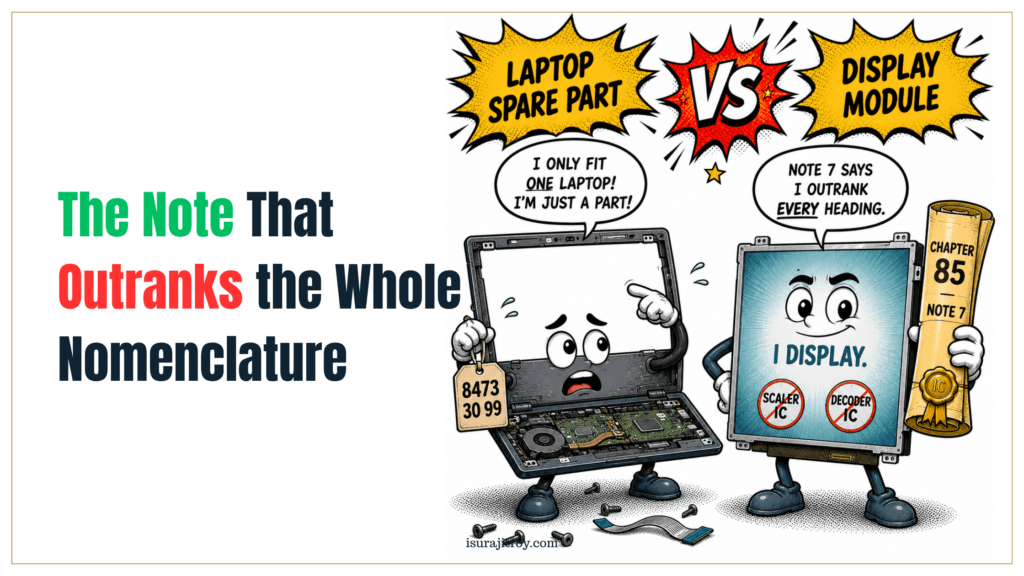
Chapter 85 Note 7, the precedence clause, and why a laptop replacement screen is not a laptop part
Case: N.R. Computech v. Commissioner of Customs, Air Cargo Complex (Export), New Delhi Forum: CESTAT, New Delhi — Principal Bench, Court No. I Appeal: Customs Appeal No. 50135 of 2024 Decided: 19 August 2026 Coram: Dr. Rachna Gupta (Officiating President), Hemambika R. Priya (Technical) Outcome: Appeal dismissed. Heading 85.24 upheld; differential duty and penalties confirmed.
The question, and why the answer was never really in doubt
An importer brought in one hundred bare laptop replacement screens, declared them as parts of automatic data processing machines under Heading 84.73 at nil basic customs duty, and argued that goods usable only inside a specific range of notebook models must be classified with those notebooks. The department said the goods were flat panel display modules of Heading 85.24 at 15%.
The importer’s argument has intuitive appeal. The panels fit nothing but laptops. They are sold to dealers who fit them into laptops. They are, in every commercial sense, laptop spares.
It made no difference. Heading 85.24 carries something very unusual in the Nomenclature: a precedence clause in its governing Chapter Note. Chapter 85, Note 7 closes with a sentence that ends the argument before it starts:
“For the classification of flat panel display modules defined in this Note, heading 85.24 shall take precedence over any other heading in the Nomenclature.”
That is not a definition, a description, or a tie-breaker. It is an override. Once goods answer the Note 7 definition, no other heading may be considered — not a parts heading, not a more specific commodity heading, not a heading that would win on any GRI 3 analysis. There is nothing left to weigh.
This case is worth studying less for its outcome, which was inevitable, than for three things it teaches: how precedence clauses work, how a parts argument dies at GRI 1, and how an importer’s own volunteered fact can complete the department’s case.
The goods
| Attribute | Detail |
| Description as filed | “Laptop, LCD Panel” — 100 pieces, two models |
| Technology | Liquid crystal display cell with LED backlight (not fluorescent) |
| Video-converting components | None — no scaler IC, no decoder IC, no application processor (importer’s own admission) |
| Compatibility | Specific laptop models across several brands only |
| Presentation | Bare panels, imported loose, not integrated into any apparatus |
| Intended use | Resale to dealers for replacement of faulty laptop screens |
| Declared heading | 84.73 (CTI 8473 3099, nil BCD) |
| Contended heading | 85.24 (CTI 8524 1100, revised to 8524 1900; 15% BCD) |
| Held | Heading 85.24 |
Two facts in that table do all the work, and it is worth naming them now: the panels are presented separately, and they contain no video-converting components. Everything else — brand compatibility, intended end use, the LED-versus-fluorescent backlight question — is classification noise.
Chapter 85, Note 7: anatomy of a precedence clause
Note 7. For the purposes of heading 85.24, “flat panel display modules” refer to devices or apparatus for the display of information, equipped at a minimum with a display screen, which are designed to be incorporated into articles of other headings prior to use. Display screens for flat panel display modules include, but are not limited to, those which are flat, curved, flexible, foldable or stretchable in form. Flat panel display modules may incorporate additional elements, including those necessary for receiving video signals and the allocation of those signals to pixels on the display. However, heading 85.24 does not include display modules which are equipped with components for converting video signals (e.g., a scaler IC, decoder IC or application processer) or have otherwise assumed the character of goods of other headings.
For the classification of flat panel display modules defined in this Note, heading 85.24 shall take precedence over any other heading in the Nomenclature.
The Note has four moving parts.
The inclusive definition. A device for the display of information, equipped at a minimum with a display screen, designed to be incorporated into articles of other headings prior to use. Read that clause carefully: being designed for incorporation into something else is not a reason to classify the goods with that something else. It is a qualifying condition for 85.24. The Note takes the very feature the importer relied on — this panel only exists to go inside a laptop — and makes it the entry ticket to the heading the importer was resisting.
The permissive middle. Modules “may incorporate additional elements, including those necessary for receiving video signals and the allocation of those signals to pixels”. Drivers, timing controllers, backlight units, connectors, chassis — all permitted. Adding electronics does not push a module out of 85.24.
The single exclusion. Modules “equipped with components for converting video signals (e.g., a scaler IC, decoder IC or application processer)” are outside. This is the boundary between a display module and a display device. A scaler takes an arbitrary input format and converts it for the panel; once the article can do that, it has stopped being a component and started being a monitor, a television, or a screen assembly of some other heading.
The precedence clause. For goods meeting the definition, 85.24 outranks everything.
That last sentence puts Note 7 in a very small class. The Nomenclature contains only a handful of such overrides — Chapter 84 Note 10 for additive manufacturing machines at 84.85, and Chapter 84 Note 11(D) for the semiconductor manufacturing equipment of 84.86 are the closest analogues. Where one applies, the classifier’s job is reduced to a single question: does the article meet the definition? If yes, stop.
Why the parts argument was dead on arrival
The importer’s case rested on the proposition that a component usable solely with laptops must follow the laptop. That is ordinarily a respectable argument — it is the logic of Section XVI Note 2(b). But it fails here twice over, and it is worth seeing that it would have failed even without Note 7.
Section XVI Note 2 sets the parts cascade:
2(a) Parts which are goods included in any of the headings of Chapter 84 or 85 (other than headings 84.09, 84.31, 84.48, 84.66, 84.73, 84.87, 85.03, 85.22, 85.29, 85.38 and 85.48) are in all cases to be classified in their respective headings;
2(b) Other parts, if suitable for use solely or principally with a particular kind of machine … are to be classified with the machines of that kind or in heading … 84.73 … as appropriate.
The structure is strictly sequential. Note 2(a) is tested first, and its list of parenthesised exclusions is a list of parts baskets — headings that exist only to collect parts. Heading 84.73 is in that list. So the analysis runs:
- Is the article itself a good of a heading of Chapter 84 or 85, other than one of the listed parts baskets? A flat panel display module is a good of Heading 85.24. Yes.
- Note 2(a) therefore applies, and applies “in all cases” — words that leave no room for a competing sole-use argument.
- Note 2(b), the sole-or-principal-use rule that would have taken the panel to 84.73, is never reached. It governs only “other parts”, meaning parts that failed the 2(a) test.
The Nomenclature confirms the point from another direction. Note 2(b) contains a special instruction that parts suitable for use solely or principally with the goods of heading 85.24 are to be classified in heading 85.29. The drafters plainly contemplated 85.24 goods as articles in their own right, with their own parts stream. A heading that has its own parts basket is not itself a part.
So the parts route closes under Section XVI Note 2(a). Note 7’s precedence clause then closes it again, more emphatically. The Tribunal reached the right result but rested it mainly on Note 7 and on the settled proposition that an eo nomine description defeats end-use reasoning. The Section XVI Note 2(a) analysis — arguably the cleaner path — goes unmentioned in the order.
The functional-unit argument fails too. The importer invoked Section XVI Notes 4 and 5. Note 4 applies where individual components, separate or interconnected, are intended to contribute together to a clearly defined function — and it operates on the components as presented together. A hundred loose replacement screens in a courier consignment are not components of anything; there is no machine present for them to contribute to. Note 4 has no application to a spare presented alone.
The admission that completed the department’s case
The single most instructive moment in the record is the importer’s letter stating that the goods “were not equipped with the components for converting video signals, example scalar IC, decoder IC or application processor.”
That statement was made to support the argument that these were bare, unsophisticated spares — mere parts, not finished apparatus. Read against Note 7, it does the opposite. The only thing in Note 7 capable of removing a display module from Heading 85.24 is the presence of video-converting components. By certifying their absence, the importer certified that the sole available exit from 85.24 was closed.
The general lesson is worth stating plainly. Before volunteering a technical fact about goods, check what work that fact does in the governing Note. “Simple” and “unfinished” are commercial adjectives; the Nomenclature may treat the same facts as qualifying criteria. Here, sophistication would have been the importer’s friend — a panel with a scaler IC would have left 85.24 (usually landing in 85.17, 85.28 or 85.29 per the Explanatory Note exclusions). Simplicity kept it in.
“Presented separately” is a classification fact, not a commercial one
The Explanatory Note to 85.24 states the principle directly:
“However, flat panel display modules that are not integrated into other apparatus and presented separately are classified in this heading rather than the heading in which the finished products with flat panel display modules are classified.
Flat panel display modules that have been integrated into other apparatus are to be classified in the heading appropriate to the apparatus as a whole.”
This is a clean binary and it turns on physical state at importation, nothing else.
- Panel inside a laptop at the time of import → classify the laptop (84.71).
- Panel loose at the time of import → classify the panel (85.24), regardless of what it is destined for.
The Tribunal captured this when it observed that the imported goods were not integrated into the computer and were capable of being presented separately, and for that reason alone fell outside the scope of a part or accessory of the computer. The same physical article, sourced from the same factory, sold to the same customer, therefore has two different classifications depending only on whether it arrives fitted or unfitted. That is not an anomaly to be argued around. It is how the HS is designed to work, and Note 7’s opening words — “designed to be incorporated into articles of other headings prior to use” — anticipate exactly this.
The EN also supplies a helpful list of what 85.24 does not cover, all of which are cases where a module has been built into something:
| Excluded | Destination |
| Modules with video-converting components | Usually 85.17, 85.28, 85.29 |
| Visual signalling apparatus (indicator panels) incorporating modules | 85.31 |
| Measuring or checking apparatus incorporating modules | Generally Chapter 90 |
| Musical instruments incorporating modules | Chapter 92 |
| Chapter 95 goods incorporating modules (consoles, toys, sport requisites) | Chapter 95 |
Every entry on that list describes an article that has absorbed the module. None describes a bare panel.
The subheading: neither side got it right
Here the order stops short. Having settled the heading, it never descends properly under GRI 6, and both contended six-digit positions are wrong.
Heading 85.24 splits at one-dash level on the presence of drivers or control circuits — not on display technology:
| Code | Text |
| — | – Without drivers or control circuits: |
| 8524.11 | – – Of liquid crystals |
| 8524.12 | – – Of organic light-emitting diodes (OLED) |
| 8524.19 | – – Other |
| — | – Other: |
| 8524.91 | – – Of liquid crystals |
| 8524.92 | – – Of organic light-emitting diodes (OLED) |
| 8524.99 | – – Other |
Under GRI 6, only subheadings at the same level are comparable, and the one-dash contest must be resolved before descending. The Explanatory Note defines the two series:
“(1) Flat panel display modules without drivers or control circuits, which are generally referred to as ‘cells’. In the case of LCD cells, liquid crystals are placed between two sheets or plates of glass or plastics such as TFT substrates and colour filter substrates … Those cells do not contain electrical parts such as drivers or control circuits, whether or not fitted with electrical connections or attached with polarizing plates.
(2) Flat panel display modules with drivers or control circuits: Drivers or control units are added to ‘cells’ of item (1). The modules may contain drivers that receive video signals or other data … and switch individual pixels of displays (generally consisting of driver IC and PCB that connects video signals to driver IC) or control circuits of power supply for display modules or timing control. They might combine with backlight units (for LCDs) or frames (chassis).”
A laptop replacement screen is a drop-in module. It carries gate and source driver ICs bonded to the glass, timing control, an eDP or LVDS connector, an integrated LED backlight and a metal chassis. That is item (2) on every limb. It belongs in the second series, at 8524.91 — Other: of liquid crystals.
Where each contended code went wrong
8524.11 (the department’s opening position) is the code for a bare cell — glass, liquid crystal, polarizers, no drivers. A panel that plugs into a motherboard and lights up is not a cell. The department chose a subheading that describes an intermediate product it had never examined.
8524.19 (the revised position) was adopted because the panels use LED backlight rather than fluorescent backlight. This does not follow. An LED backlight illuminates a liquid crystal cell; the image is still formed by liquid crystals. The residual “Other” at the two-dash level is for display technologies that are neither liquid crystal nor OLED — for example micro-LED or plasma. Changing the lamp behind the cell does not change the cell. The EN puts it beyond argument: item (2) expressly contemplates LCD modules that “might combine with backlight units (for LCDs)”. A backlight is a normal constituent of an LCD module, not a change of technology.
The Tribunal half-noticed the problem, remarking that any classification based on the technical distinction between LCD and LED panels is of no relevance at the point of import. That observation is correct — but it was made while affirming an order built on precisely that distinction, and the bench never asked the question GRI 6 actually required: drivers or no drivers?
Practical consequence. In a jurisdiction where duty rates differ across the two series, this is not academic. Even where the rate is identical, a wrong six-digit code propagates into every downstream declaration, FTA certificate and statistical return.
The GRI path, in one view
GRI 1 — heading terms + relative Section and Chapter Notes
│
├─ Chapter 85, Note 7 tested first (definitional gate + precedence clause)
│ ├─ Device for display of information, min. a display screen ……. YES
│ ├─ Designed to be incorporated into articles of other headings
│ │ prior to use …………………………………………. YES
│ ├─ Equipped with video-converting components (scaler / decoder /
│ │ application processor)? ……………………………….. NO
│ │ └─ (importer’s own admission)
│ └─ Has it assumed the character of goods of another heading? ….. NO
│ └─ presented loose, not integrated into any apparatus
│
├─ Definition satisfied → Note 7 precedence clause engages
│ “heading 85.24 shall take precedence over any other heading
│ in the Nomenclature”
│
├─ Independent confirmation via Section XVI Note 2(a):
│ the article is itself a good of a heading of Ch. 85 (85.24), and
│ 84.73 is one of the excluded parts baskets → 2(a) applies “in all
│ cases”; Note 2(b) sole-use rule is never reached
│
└─ Heading 85.24 — resolved at GRI 1
└─ GRI 6, one-dash: drivers or control circuits present? YES
└─ two-dash: of liquid crystals → 8524.91
GRI 2, 3, 4, 5 — NEVER REACHED
Where the order is loose
The outcome is right. Four passages should not be relied on.
GRI 3 is invoked after GRI 1 has already decided. The order records that GRI 1 stands satisfied, that GRI 2 does not apply, and then proceeds to apply GRI 3 anyway. That sequence is self-contradictory. GRI 3 exists solely to resolve a tie between headings under which goods are prima facie classifiable. Where a Chapter Note grants one heading precedence over every other heading in the Nomenclature, there is no tie and no prima facie duality. The order itself quotes authority for sequential application of the Rules two paragraphs earlier, then departs from it.
The last-in-numerical-order rule is attributed to the wrong sub-rule. The order states that “Rule 3(b) says that the heading which occurs last in the numerical order among those which equally merit consideration” applies. That is GRI 3(c). GRI 3(b) is the essential-character rule. The misattribution would matter a great deal in a case that genuinely turned on GRI 3.
An Explanatory Note is described as a Chapter Note. The passage the order introduces as “the Chapter Note ii of CTH 8524” is in fact from the WCO Explanatory Note to heading 85.24. The distinction is not pedantic: Chapter Notes are legally binding text within the Nomenclature; Explanatory Notes are official interpretative guidance of persuasive authority. Conflating them weakens an otherwise sound reliance on both.
A transposition in the operative finding. The order records GRI 1 as satisfied “in favour of 8425”. No such heading is in issue; 85.24 is meant.
None of these affects the result, which is dictated by Note 7. All of them matter if the order is cited as authority on the mechanics of the Rules.
Practitioner takeaways
1. Search for precedence clauses before anything else. A short list of Chapter Notes grant a heading priority over the entire Nomenclature — Chapter 85 Note 7 (85.24), Chapter 84 Note 10 (84.85), Chapter 84 Note 11(D) (84.86). Where one applies, no competing-heading analysis is permitted. Check for them at the top of the file, not after building a GRI 3 argument.
2. Sole-use is not a trump card. Section XVI Note 2(a) is tested before Note 2(b). If the article is itself a good of a Chapter 84 or 85 heading other than a listed parts basket, it goes to that heading “in all cases”, however dedicated its application. Sole-or-principal-use reasoning only reaches goods that are not themselves nomenclature articles.
3. Physical state at importation governs, not destination. A module fitted into apparatus is classified as the apparatus; the same module presented loose is classified as a module. Nothing about the buyer, the invoice description or the intended repair changes this.
4. Audit what your own technical statements prove. The exclusion from 85.24 turns on the presence of video-converting components. An importer arguing “these are simple, unsophisticated spares” is confirming they meet the Note. Model every volunteered fact against the governing Note before it goes into a letter or a statement.
5. Do not stop at the heading. This order settles 85.24 and leaves the subheading unresolved between two positions that are both wrong. Under GRI 6, heading 85.24 splits first on drivers or control circuits, only then on technology. Answer the one-dash question before touching the two-dash.
6. Backlight technology is not display technology. LED-backlit LCD is LCD. The two-dash split between “of liquid crystals” and “other” concerns the mechanism that forms the image, not the light source behind it. This misconception is common enough in the trade to be worth a standing note in any electronics classification manual.
7. An eo nomine heading defeats a general parts heading. Where the Nomenclature names the article, a heading covering “parts and accessories of” something else cannot be preferred. This is orthodox GRI 1 reasoning and needs no recourse to GRI 3(a) specificity analysis.
Caveats
- This analysis is anchored to the WCO Harmonized System, Seventh Edition (2022), at the six-digit level. Eight-digit figures in the order (8473 3099, 8524 1100, 8524 1900) are national subdivisions, illustrative only, and vary by jurisdiction.
- The 8524.91 conclusion depends on the panels carrying drivers or control circuits. If a consignment genuinely consists of bare cells — glass sandwich, polarizers, flex tails, no driver ICs, no backlight unit — then the first series applies and the code is 8524.11. The specification sheet decides it; check for bonded driver ICs, a timing controller and an integrated backlight before declaring.
- Had the panels carried a scaler IC, decoder IC or application processor, Note 7 would have excluded them from 85.24 altogether, and the EN routes such modules generally to 85.17, 85.28 or 85.29 depending on the character assumed. That is a different analysis, not a variation of this one.
- Heading 85.24 was introduced in the Seventh Edition (2022). Consignments cleared under earlier editions were governed by a materially different scheme in which display panels were more readily treated as parts, and pre-2022 precedents on laptop panels should be read with that in mind.
- Parts of goods of Heading 85.24 — as distinct from the modules themselves — are directed by Section XVI Note 2(b) to Heading 85.29.
- This is reasoned classification advice grounded in the WCO instruments. It is not a binding tariff ruling; only a customs administration can issue one.