
Chapter 34 Note 3, the conjunction “and”, and why low-mole alcohol ethoxylates land in Heading 38.24
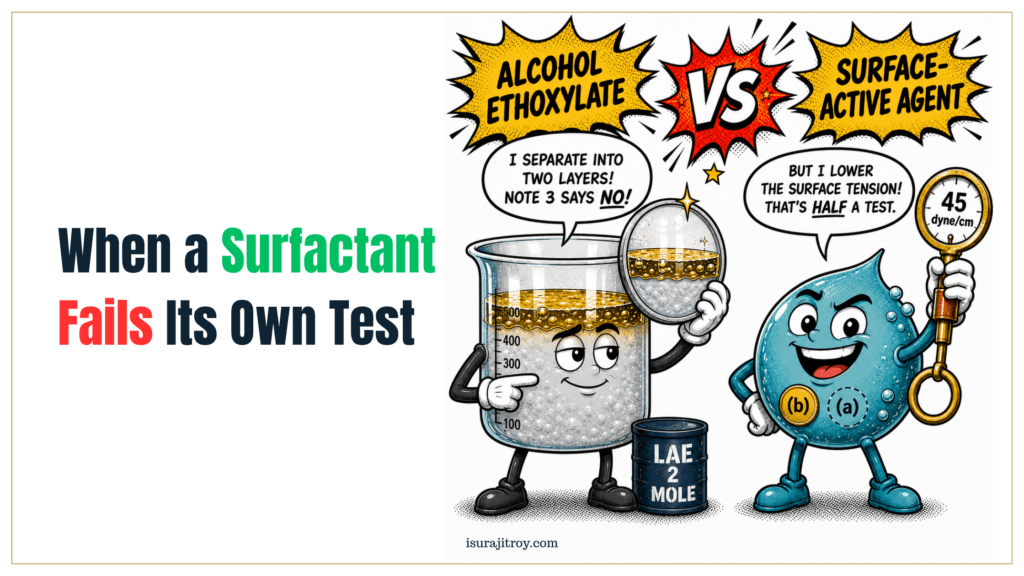
Lauryl alcohol ethoxylates with only one or two moles of ethylene oxide reduce the surface tension of water, but in water they separate into two layers. CESTAT Mumbai held that this separation means they fail limb (a) of Note 3 to Chapter 34, so they are not “organic surface-active agents” of Heading 34.02. Revenue’s appeal against Godrej Industries was dismissed and the declared Heading 38.24 stood; at the six-digit level the goods fall in 3824.99. Because a Chapter Note shut 34.02 at GRI 1, GRI 3 was never reached.
| Case | Commissioner of Customs, Nhava Sheva-I v. Godrej Industries Ltd |
| Forum | CESTAT, Mumbai, Regional Bench, Court No. 1 |
| Final Order | A/86060/2026, pronounced 21 August 2026 |
| Coram | S.K. Mohanty (Judicial), M.M. Parthiban (Technical) |
| Outcome | Revenue’s appeal dismissed. Heading 38.24 sustained. |
Why this case matters beyond its own facts
Most classification disputes are arguments about description: does this look more like X or more like Y? This one was an argument about grammar in a legal Note, and it turned on the word “and”.
A small number of headings in the Harmonized System have their scope set by a definitional Chapter Note that works as an entry gate, and not by the heading text. Heading 34.02 is one of them. A product can be a surfactant in every commercial, technical and laboratory sense and still be shut out of Heading 34.02 because it fails one limb of a two-limb statutory test. That is what happened here.
The lesson for classifiers carries over to other chapters. Where a Note defines a term used in a heading, the definition is a threshold. It is not one description to be weighed against others. You either clear it or you do not, and if you do not, GRI 3 never opens. The same pattern appears in the “Slammers” fruit snack case, where a three-part definition in Note 3 to Chapter 21 decided the heading, and the wider family of “for the purposes of” definitions is set out in critical phrase patterns in the Harmonized System.
The goods
| Attribute | Detail |
| Trade descriptions | Dehydol LS1 TH (1 mole alcohol ethoxylate 1214); Dehydol LS2 TH (2 mole alcohol ethoxylate 1214); Lauryl Alcohol Ethoxylate 2 Mole (LAE 2 Mole) |
| Chemistry | Lauryl alcohol (C12) / C12–C14 fatty alcohol reacted with 1 or 2 moles of ethylene oxide |
| Molecular architecture | Hydrophobic C12–C14 alkyl tail + short polyoxyethylene (1–2 EO) head |
| Ionic character | Non-ionic |
| CAS RN | 9002-92-0 |
| Chemical definition | Not a separate chemically defined compound; a homologue distribution |
| Presentation | Bulk, industrial use |
| Declared heading | 38.24 (India CTI 3824 9090 / 3824 9990) |
| Contended heading | 34.02 (India CTI 3402 1300, non-ionic) |
| Duty consequence | 0% BCD under the declared entry (claimed under Notification No. 46/2011-Customs) vs 5% under the contended entry |
The degree of ethoxylation decides the case. The polyoxyethylene chain is what makes a non-ionic surfactant water-soluble: the more EO units, the more hydrophilic the molecule. At 1 or 2 moles, the hydrophile is barely present. The Tribunal recorded the technical position plainly: an ethoxylate with only two ethylene oxide groups will have virtually no water solubility and is instead oil-soluble, whereas one with twenty such groups is readily water-soluble.
Chemically, then, the goods are a surfactant with almost no water solubility. A product that is surface-active and also water-insoluble is exactly the case the HS drafters anticipated and provided for.
The two rival headings
Heading 34.02
“Organic surface-active agents (other than soap); surface-active preparations, washing preparations (including auxiliary washing preparations) and cleaning preparations, whether or not containing soap, other than those of heading 34.01.”
Subheading structure (HS 2022):
| Code | Text |
| – Anionic organic surface-active agents, whether or not put up for retail sale: | |
| 3402.31 | – – Linear alkylbenzene sulphonic acids and their salts |
| 3402.39 | – – Other |
| – Other organic surface-active agents, whether or not put up for retail sale: | |
| 3402.41 | – – Cationic |
| 3402.42 | – – Non-ionic |
| 3402.49 | – – Other |
| 3402.50 | – Preparations put up for retail sale |
| 3402.90 | – Other |
Heading 38.24
“Prepared binders for foundry moulds or cores; chemical products and preparations of the chemical or allied industries (including those consisting of mixtures of natural products), not elsewhere specified or included.”
Terminal subheading: 3824.99, “- Other: – – Other”.
Heading 38.24 is a residual heading. It is reached by elimination, never by attraction. Its “not elsewhere specified or included” clause means it can only be tested after every specific candidate has been closed. The anti-rust preparations case study shows the same residual logic for another group of Chapter 38 products.
The gate: Chapter 34, Note 3
Note 3. For the purposes of heading 34.02, “organic surface-active agents” are products which when mixed with water at a concentration of 0.5 % at 20 °C and left to stand for one hour at the same temperature: (a) give a transparent or translucent liquid or stable emulsion without separation of insoluble matter; and (b) reduce the surface tension of water to 4.5 x 10⁻² N/m (45 dyne/cm) or less.
Three features of this Note deserve attention.
First, it is a definition. The words “for the purposes of heading 34.02” make it one. Under GRI 1, classification is determined by the terms of the headings and any relative Section or Chapter Notes, so a Note that defines the operative term of a heading fixes the heading’s outer boundary. Trade parlance, commercial understanding and the general impression that a product “is a surfactant” cannot soften it.
Second, the two limbs are conjunctive. They are separated by a semicolon and joined by “and”, and both must be satisfied. The text permits no other reading.
Third, limb (a) is itself internally conjunctive, and this was where the parties actually fought. Revenue argued that limb (a) offers three alternatives (transparent liquid, or translucent liquid, or stable emulsion without separation of insoluble matter) and that any one of them is enough. On that reading, a translucent liquid qualifies whether or not insoluble matter separates out.
That reading fails for two reasons.
Grammatically, “without separation of insoluble matter” closes the whole limb and attaches to every alternative in the series, the first two as well as the last. The appearance element (transparent, translucent or emulsion) and the stability element (no separation of insoluble matter) are two aspects of the single property the Note is testing: the water solubility of the product.
Purposively, Revenue’s reading would empty limb (a) of content. Almost any liquid dispersed in water at 0.5 % will look translucent for at least a moment. If translucency alone were enough, limb (a) would exclude nothing, and the drafters would have written a limb that does no work. Notes are not drafted to be inert.
The Explanatory Notes settle the reading
The EN to Heading 34.02, Part (I), restates the Note and then tightens it:
“The organic surface-active agents of this heading are chemical compounds, not chemically defined, which contain one or more hydrophilic or hydrophobic functional groups in such a proportion that, when mixed with water at a concentration of 0.5 % at 20 °C and left to stand for one hour at the same temperature, they give a transparent or translucent liquid or stable emulsion without separation of insoluble matter (see Note 3 (a) to this Chapter).”
The EN reproduces limb (a) as a single unbroken clause. No punctuation isolates “without separation of insoluble matter” as a qualifier of the emulsion alone.
The EN then supplies working criteria that Revenue’s reading cannot survive:
“For the purposes of this heading, an emulsion should not be considered as having a stable character if, after being left to stand for one hour at 20 °C, (1) solid particles are visible to the naked eye, (2) it has separated into visually distinguishable phases or (3) it has separated into a transparent part and a translucent part, visible to the naked eye.”
Criterion (2), separation into visually distinguishable phases, describes word for word what the laboratories observed. The EN also confirms that the Note’s second limb works as an exclusion on its own terms: products not capable of reducing the surface tension of distilled water to 45 dyne/cm or less at 0.5 % and 20 °C are not regarded as surface-active agents and are excluded from the heading.
The EN then names the destination. Among the exclusions at the end of the Note to 34.02:
“(e) Water-insoluble naphthenates, petroleum sulphonates and other water-insoluble surface-active products and preparations. They fall in heading 38.24, provided they are not included in a more specific heading.”
This exclusion is deliberate. The HS runs two tracks for surfactants: water-soluble surfactants to 34.02, water-insoluble surfactants to 38.24. “Water-insoluble surface-active product” is a recognised category of the Nomenclature, and these goods are not an anomaly within it.
The exclusion also has its own proviso: “provided they are not included in a more specific heading”. That proviso requires an elimination cascade before 38.24 can be settled. The section on the elimination cascade below runs it.
The evidence: what the reports observed versus what they concluded
One line in the departmental test report decided the case: the sample in water “gives translucent liquid with separation in two layers”.
| Source | Reported result |
| Departmental laboratory, 22.03.2018 | OSAA positive; non-ionic; alcohol and ethoxylate positive; translucent liquid with separation in two layers |
| Departmental laboratory, 07.06.2018 | Same findings |
| Independent laboratory, 03.03.2017 | Translucent solution with layer |
| Independent laboratory, 10.02.2017 | Translucent liquid with separation of insoluble matter in upper layer |
Every report, departmental and private, recorded the same physical observation.
The classification point here is easy to miss. Revenue relied on the report’s conclusion: “presence of organic surface-active agent: positive; nature: non-ionic”. The Tribunal relied on the report’s observation: separation into two layers.
When a laboratory writes “OSAA positive”, it is applying a working chemical definition of surface activity. It is not certifying compliance with Chapter 34 Note 3. “Organic surface-active agent” in the tariff is a term of art with a statutory meaning, and only the observed physical behaviour can be measured against it. When a test report’s conclusion and its observation point different ways, the observation is the evidence and the conclusion is opinion. The Tribunal was right to hold that the conclusory label could not displace the recorded observation.
The layer on top is the proof: an insoluble fraction separating out is, by definition, separation of insoluble matter. Limb (a) fails. Limb (b) was not what decided the case (the importer said the goods reduce surface tension below 45 dyne/cm), and half a test is not a heading.
The elimination cascade to 38.24
Heading 38.24 cannot be reached by assertion. The EN exclusion that routes goods to 38.24 is expressly conditional on their not being covered by a more specific heading. Four candidates must be closed.
Chapter 29 (organic chemicals): closed. Chapter 29 is confined, subject to listed exceptions, to separate chemically defined organic compounds. Heading 29.09 would otherwise be the natural home for ether-alcohols, and its text does extend to certain products “whether or not chemically defined”, but that parenthesis attaches to ketone peroxides, the only Chapter 29 exception listed for heading 29.09 in the General EN to the Chapter. A commercial alcohol ethoxylate is a distribution of homologues with a range of EO numbers and a C12–C14 alkyl distribution. It is not chemically defined, so Chapter 29 is out. The n-hexane case study shows the opposite situation, where a product that is a defined compound was held to belong in Chapter 29.
Chapter 39, Heading 39.07 (other polyethers): closed. Polyoxyethylene chains are polyethers, and poly(oxyethylene) (polyethylene glycol) is named in the EN to 39.07. But Note 3(c) to Chapter 39 limits these headings to synthetic polymers “with an average of at least 5 monomer units”. One or two EO units do not come close. The Chapter 39 General EN states the corollary when discussing prepolymers: the term does not cover finished products such as poly(oxyethylene) (polyethylene glycol) with very low molecular weight (heading 38.24). On the HS’s own reasoning, low-mole ethoxylates are 38.24 goods.
Heading 38.23 (industrial fatty alcohols): closed. The goods are the ethoxylate of a fatty alcohol, which is a different product from the fatty alcohol. The EN to 38.23 states the relationship: fatty alcohols are mainly used for the preparation of derivatives whose salts are the organic surface-active agents of Heading 34.02. The starting material and the derivative are different goods.
Heading 34.01: closed. The goods are not soap, not in bar, cake or moulded form, and not a liquid or cream skin-washing preparation put up for retail sale.
With every specific heading closed, Heading 38.24 applies as the residual heading of Chapter 38, on its own terms: chemical products and preparations of the chemical or allied industries, not elsewhere specified or included.
GRI 6 descent within 38.24
| Level | Test | Result |
| One-dash | Prepared binders (3824.10)? Metal carbides (3824.30)? Cement additives (3824.40)? Mortars (3824.50)? Sorbitol (3824.60)? | No |
| One-dash | Goods specified in Subheading Note 3 (3824.81–3824.89)? | No. The goods contain no listed substance. Watch for a trap here: these subheadings cover mixtures containing oxirane (ethylene oxide). Ethoxylates are made by reacting with ethylene oxide; the record does not show free ethylene oxide as a constituent of the goods as presented. Subheading 3824.81 does not apply. |
| One-dash | – Other | Yes |
| Two-dash | 3824.91, 3824.92 (named phosphonates)? | No |
| Two-dash | 3824.99 – – Other | Yes |
Final classification: 3824.99.
The GRI path, in one view
GRI 1: heading terms + relative Chapter Notes
│
├─ Heading 34.02 tested
│ └─ Chapter 34, Note 3 (definitional gate)
│ ├─ Limb (b): surface tension ≤ 45 dyne/cm ………. SATISFIED
│ └─ Limb (a): transparent/translucent/stable emulsion
│ WITHOUT separation of insoluble matter .. FAILED
│ (two layers observed at 0.5 %, 20 °C, 1 hr)
│ └─ Conditions are cumulative → 34.02 CLOSED at GRI 1
│
├─ EN 34.02 exclusion (e) → water-insoluble surface-active
│ products fall in 38.24, if no more specific heading
│
├─ Elimination cascade
│ ├─ Ch. 29: not chemically defined …………….. CLOSED
│ ├─ 39.07: Ch. 39 Note 3(c), <5 monomer units ….. CLOSED
│ ├─ 38.23: ethoxylate ≠ fatty alcohol …………. CLOSED
│ └─ 34.01: not soap, not retail skin wash ……… CLOSED
│
└─ Heading 38.24 applies (residual)
└─ GRI 6 → – Other → – – Other → 3824.99
GRI 2, 3, 4, 5: NEVER REACHED
The most telling part of this diagram is what is missing. There is no essential-character analysis, no “most specific description” contest and no last-in-numerical-order tie-break. Because a Chapter Note excluded the goods from 34.02, they were never prima facie classifiable under two headings, and the precondition for GRI 3 never arose.
Where the reasoning is loose
The outcome is correct. Some passages in the reasoning are not, and a practitioner citing this order should know where its weak points are.
The BIS detour. The order states that, to classify a product as an organic surface-active agent, both the conditions of Chapter Note 3 and the requirements of a national standards-body definition must be met. That is doctrinally wrong. Where the tariff supplies its own definition, no external technical standard is laid on top of it, and the order itself accepts this two paragraphs earlier when it holds that a statutory definition displaces trade parlance entirely. The error does no harm here, because Note 3 alone decides the matter and the standards-body definition pointed the same way. It would do harm in a case where the two diverged.
Foreign administration opinions. The order records that the overseas suppliers had obtained clarifications from a foreign customs administration confirming classification under 3824.90/3824.99. The Tribunal correctly treated these as persuasive only. Another administration’s classification opinions bind no one, come without the evidential record, and cannot replace the Note analysis. The reasoning is no stronger for their inclusion and would be no weaker without them.
Subsequent assessment practice. The respondent argued that all later imports were being finally assessed under Heading 38.24 and that provisional entries had been finalised there. That is an argument about equity and consistency. It says nothing about classification: uniform administrative practice does not make a classification correct, it only makes an incorrect one uniform.
Unstated eliminations. The order concludes that all miscellaneous chemical products not classifiable in any other heading fall in 38.24. That is correct as a statement of the heading’s residual character, but the order never walks the elimination through Chapter 29 or Heading 39.07. The finding is right; the reasoning behind it is asserted and not shown. A future bench facing a higher-mole ethoxylate, where 39.07 comes into play, will get no help from this order.
Edition discipline: what the codes mean today
The imports spanned 2015 to 2020, and the tariff entries reproduced in the order reflect the pre-2022 structure of Heading 34.02. Heading 34.02 was restructured in HS 2022 (Seventh Edition), so anyone applying this decision to current imports must remap.
| Pre-2022 | HS 2022 | Description |
| 3402.11 | 3402.31 / 3402.39 | Anionic, now split between LAB sulphonic acids and their salts, and other |
| 3402.12 | 3402.41 | Cationic |
| 3402.13 | 3402.42 | Non-ionic, the subheading Revenue contended for |
| 3402.19 | 3402.49 | Other |
| 3402.20 / 3402.90 | 3402.50 / 3402.90 | Retail preparations / other |
Subheading 3402.13 no longer exists. The equivalent contention today would be 3402.42, and it would fail on the same Note 3 analysis: HS 2022 changed the subheading structure, and left unchanged the Chapter Note that governs the heading’s scope.
Heading 38.24’s residual terminal subheading remains 3824.99 in HS 2022.
The eight-digit figures in the order (3824 9090, 3824 9990, 3402 1300) are Indian tariff items (CTI) below the harmonized six-digit level. They belong to one national schedule and carry no international force. Importers elsewhere must map 3824.99 into their own national breakout.
Practitioner takeaways
1. Identify the definitional Notes before you begin. A handful of headings across the Nomenclature are gated by Notes that define their operative term: Chapter 34 Note 3 for 34.02, Chapter 34 Note 2 for “soap” in 34.01, Chapter 34 Note 5 for “artificial waxes” in 34.04, Chapter 39 Note 3 for the plastics headings. Where such a Note exists, it is the first question and often the last. Classify against the gate before you weigh descriptions of the goods.
2. Read conjunctions as written. “And” between limbs means cumulative. A qualifying phrase at the close of a series of alternatives presumptively attaches to the whole series. Splitting a Note into alternatives to reach a preferred heading is redrafting the Note.
3. Separate a test report’s observations from its conclusions. Laboratories apply general chemical definitions, not tariff definitions. Instruct testing against the exact wording of the Note (concentration, temperature, standing time and the specific visual criteria) and read the observation line before the summary line. Where a report says “positive” but records behaviour inconsistent with the Note, the recorded behaviour governs.
4. Specify the test conditions in your instruction to the lab. The Note’s parameters (0.5 %, 20 °C, one hour) are legal elements, and laboratory convention has no say over them. A report run at a different concentration or temperature proves nothing about the heading’s scope.
5. A residual heading must be earned. Never declare under 38.24 without running the elimination: Chapter 29 for chemical definition, Chapter 39 for polymer thresholds, and any specific commodity heading. The EN’s own routing language (“provided they are not included in a more specific heading”) makes the cascade mandatory.
6. Chemistry drives the gate. For non-ionic ethoxylates, the number of moles of ethylene oxide decides the classification. Low-mole grades are oil-soluble and fail Note 3(a); high-mole grades are water-soluble and clear it. The same trade name at different EO numbers can sit in different chapters, so classify the product specification, not the product family.
7. The heading contest may never arise. Where a Note excludes goods from one of two candidate headings, there is no prima facie dual classification and GRI 3 is unavailable. Arguments about specificity or essential character made in that position are misconceived from the start.
8. The burden follows the reclassification. Where an importer has self-assessed and the department seeks to displace the declared heading, the department must establish the alternative on the record. A test report that does not show the governing Note is satisfied does not discharge that burden, whatever its conclusion line says.
Caveats
- This analysis is anchored to the WCO Harmonized System, Seventh Edition (2022), at the six-digit level. National subdivisions beyond six digits are illustrative and vary by jurisdiction.
- The conclusion depends on the test result. A grade of the same product family that gives a transparent or translucent liquid without separation of insoluble matter at 0.5 %, 20 °C and one hour would satisfy Note 3(a) and, since limb (b) is met, would classify in 34.02 as a non-ionic agent of subheading 3402.42. The classification follows the specification, whatever the product is called.
- Higher-mole ethoxylates raise a question this case did not need to answer. At an average of five or more oxyethylene units, Note 3(c) to Chapter 39 comes into play and Heading 39.07 becomes a candidate. That contest would have to be resolved on its own terms.
- Where a preparation is formulated with the ethoxylate as one of several constituents, the analysis shifts: surface-active preparations fall in Part (II) of Heading 34.02, and the EN sends preparations in which the surface-active function is subsidiary to the main function elsewhere. This case concerned the agent as such, in bulk, and not a formulated preparation.
- This is reasoned classification analysis based on the WCO instruments. It is not a binding tariff ruling; only a customs administration can issue one.