
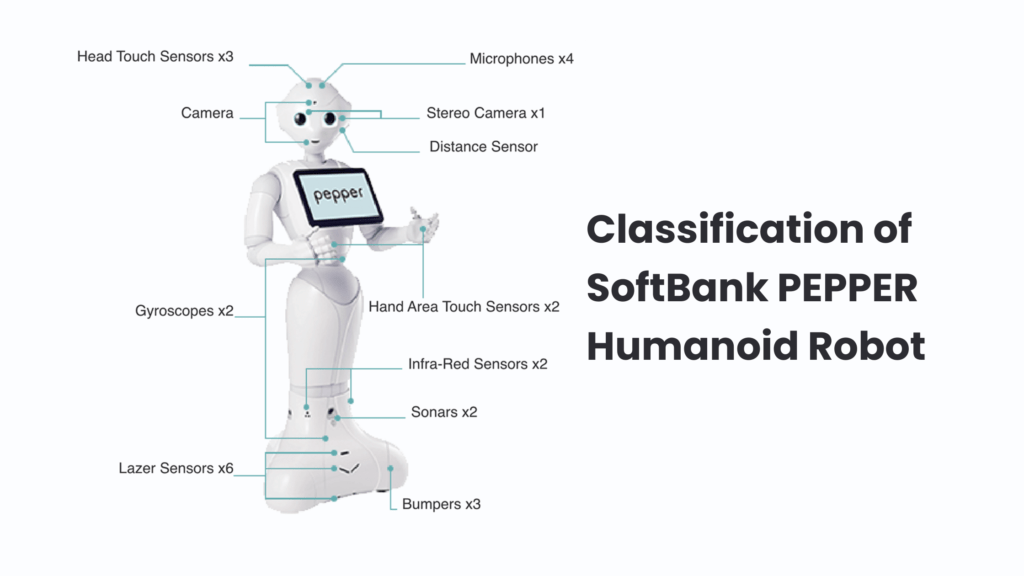
CBP classified SoftBank’s PEPPER humanoid robot in subheading 8479.89.94, HTSUS, as a machine with an individual function not specified elsewhere in Chapter 84 (HQ H301814, July 13, 2020). Three headings competed: 90.23 (demonstrational apparatus), 84.71 (automatic data processing machines) and 84.79. Heading 90.23 failed because PEPPER is suitable for uses other than demonstration, and Note 5(E) to Chapter 84 kept it out of heading 84.71 because it performs a specific function other than data processing.
A note on numbering: the ruling applied the HTSUS as it stood in 2020, when the automatic data processing provisions were Note 5 to Chapter 84. In the HS 2022 nomenclature the same provisions are Note 6, so Note 5(A) and Note 5(E) in this case study correspond to Note 6(A) and Note 6(E) today.
The SoftBank PEPPER is a wheeled humanoid robot about 120 cm tall, with a tablet display mounted on its chest. It moves autonomously and interacts with people through the tablet, artificial speech, voice analysis, facial expression recognition and vocabulary processing, which let it read human emotions and respond in conversation.
The robot has four major components: an electrical block unit, hip and knee motors, the chest tablet, and a rechargeable lithium-ion battery. Both the electrical block unit and the tablet contain internal computers with RAM and flash memory. Other components include electronic boards, two autofocus cameras, a 3D camera, loudspeakers, microphones, Android OS, various LEDs, several small motors, and laser, infrared, sonar and touch sensors.
PEPPER runs on an open platform and can be programmed in several programming languages. SoftBank ships it with two pre-installed applications: “Promotor” (customer engagement, promotional content management, data capture) and “Host” (greeting customers and visitors, answering FAQs). Users can also write new applications that change what the robot does. SoftBank expected about 50% of deployments to be commercial (Promotor or Host), 25% to be used for developing new applications, and 25% to be academic (computer science education in high schools).
Competing headings
Heading 90.23: “Instruments, apparatus and models, designed for demonstrational purposes (for example, in education or exhibitions), unsuitable for other uses.”
SoftBank argued that PEPPER is designed for demonstrational purposes: it is deployed at trade shows, at exhibitions and in schools to teach computer science and robotics. It cited CBP ruling HQ H201596 (RealCare Baby), where a humanoid simulation baby was classified in heading 90.23, and HQ H050116, where a humanoid robot designed to explain facts about robotics was found sufficiently “demonstrational.”
EN 90.23 covers a wide range of instruments, apparatus and models designed for demonstrational purposes (in schools, lecture rooms, exhibitions) and unsuitable for other uses. Its examples include cross-sectional models showing how something works inside, training dummies, military tank simulators, and small-scale demonstrational models of machines.
Heading 84.71: “Automatic data processing machines and units thereof; magnetic or optical readers, machines for transcribing data onto data media in coded form and machines for processing such data, not elsewhere specified or included.”
In the alternative, SoftBank argued that PEPPER is an automatic data processing (ADP) machine. The robot contains two internal computers with RAM and flash memory, runs proprietary software and Android OS, is freely programmable, stores its own programs and can access cloud-based software, which SoftBank said meets the criteria for ADP machines in Note 5(A) to Chapter 84.
Note 5(A) to Chapter 84 defines automatic data processing machines as machines capable of: (i) storing the processing program and the data immediately necessary for its execution; (ii) being freely programmed by the user; (iii) performing arithmetical computations specified by the user; and (iv) executing, without human intervention, a processing program that requires logical decisions during the processing run.
Heading 84.79: “Machines and mechanical appliances having individual functions, not specified or included elsewhere in this Chapter.”
The case for heading 84.79, which CBP adopted, is that PEPPER is a machine with the individual function of mimicking human speech and expressions and interacting with humans by voice and movement, a function no more specific heading in Chapter 84 or elsewhere in the Nomenclature covers. SoftBank had argued that 84.79, as a residual provision, should not be reached at all.
EN 84.79 restricts the heading to machinery having individual functions which: (a) is not excluded from Chapter 84 by any Section or Chapter Note; (b) is not covered more specifically by a heading in any other Chapter; and (c) cannot be classified in any other particular heading of Chapter 84. The EN treats a mechanical device as having an “individual function” when its function can be performed distinctly from and independently of any other machine or appliance.
The conflict
This is a three-heading competition across two Sections of the HS (Section XVI and Section XVIII), complicated by Legal Notes that set the order of analysis and by the exclusion that separates Chapter 84 from Chapter 90.
The tension comes from PEPPER doing three things at once:
- It demonstrates and teaches (robotics education, trade show demonstrations), which points to 90.23.
- It processes data (internal computers, RAM, flash memory, free programmability, cloud access), which points to 84.71.
- It performs a mechanical function (human-like movement, mimicry of human speech, autonomous interaction), which points to 84.79.
GIR 1 cannot settle this by reading the heading texts alone, because PEPPER’s capabilities reach headings in different Sections. But before GIR 3 even comes into view, the Legal Notes have to be applied. Note 1(m) to Section XVI says that Section XVI does not cover articles of Chapter 90. Heading 90.23 must therefore be tested first: if PEPPER falls in Chapter 90, it is excluded from all of Section XVI, and headings 84.71 and 84.79 drop out. Only if heading 90.23 fails can the Chapter 84 headings be considered. The same kind of cross-Section note routing decides the Insight infrared video goggles case.
Inside Chapter 84 a second gate applies. Note 5(E) to Chapter 84 says that machines incorporating or working in conjunction with an ADP machine, and performing a specific function other than data processing, are classified in the headings for their respective functions and not in heading 84.71. This gives a sequence within the Chapter: if PEPPER performs a specific function beyond data processing, the Note excludes heading 84.71, and the residual heading 84.79 remains.
Analysis and resolution
Step 1: GIR 1 and heading 90.23, tested first because of Note 1(m) to Section XVI
Note 1(m) to Section XVI states: “This Section does not cover: … (m) Articles of Chapter 90.”
So if PEPPER properly falls in heading 90.23, it is automatically excluded from all of Chapter 84. The 90.23 analysis has to come first.
Heading 90.23 requires goods to be (1) designed for demonstrational purposes and (2) unsuitable for other uses.
The first test, design for demonstrational purposes, is arguably met. PEPPER can give demonstrations and has been used at trade shows and in schools. The examples in EN 90.23 have one thing in common: they can convey conceptual or practical knowledge. In HQ H050116 CBP found that a humanoid robot designed to explain facts about robotics was sufficiently “demonstrational”, and PEPPER can demonstrate robotics concepts in the same way.
The second test, unsuitability for other uses, is where heading 90.23 fails. PEPPER is not limited to demonstration. It ships with a “Host” application for greeting customers in any business setting and a “Promotor” application for managing promotional content and capturing customer data. It runs on an open platform that allows any number of custom applications. SoftBank itself expected only 25% of deployments to be academic; the other 75% are commercial or developmental.
The EN 90.23 examples (Wimshurst machines, anatomical models, tank simulators, scale models) can only be used for demonstration and have no other commercial function. PEPPER is different in kind: it is a general-purpose programmable robot, and demonstration is one of many things it can be used for.
EN 90.23 also excludes “articles designed for both recreational and demonstrational purposes” and sends them to Chapter 95. That exclusion is aimed at recreational goods, but the principle behind it is plain enough: heading 90.23 does not cover multi-purpose articles.
Result: heading 90.23 is eliminated. PEPPER cannot be classified as demonstrational apparatus because it is designed for, and suitable for, uses well beyond demonstration. The Note 1(m) exclusion does not come into play.
Step 2: GIR 1 and heading 84.71 under Note 5(A) and Note 5(E) to Chapter 84
With heading 90.23 eliminated, the Section XVI headings become available.
On the Note 5(A) test, PEPPER contains two internal computers with RAM and flash memory, can be freely programmed in several languages, performs arithmetical computations and runs programs that require logical decisions during processing. On its face, it appears to meet the ADP machine criteria. (CBP itself found the record insufficient to decide whether PEPPER’s proprietary software performs the kind of data processing Note 5(A) contemplates, and left that question aside.)
Note 5(E) then applies as a gate. It states that “machines incorporating or working in conjunction with an automatic data processing machine and performing a specific function other than data processing are to be classified in the headings appropriate to their respective functions or, failing that, in residual headings.”
PEPPER performs a specific function other than data processing: it is designed to interact with human beings by voice and movement. Its cameras, speakers, microphones, lights, motors and sensors work together to create an anthropomorphic robot that mimics human speech and expressions and talks with people. That interaction is what the robot is designed for. Data processing is how it does it.
Result: Note 5(E) to Chapter 84 excludes PEPPER from heading 84.71. The robot must go to the heading for its specific function (human interaction through speech and movement) or, failing that, to a residual heading. The same note, now numbered 6(E), is an independent ground, alongside the failure of the Note 6(A) programmability test, on which CBP kept a conferencing PC out of heading 84.71 in the HP Presence videoconferencing case.
Step 3: GIR 1 and the residual heading 84.79
Heading 84.79 is the residual heading of Chapter 84. It covers machines and mechanical appliances having individual functions, not specified or included elsewhere in the Chapter.
EN 84.79 sets three cumulative conditions:
- (a) Not excluded from Chapter 84 by any Section or Chapter Note. Met: heading 90.23 was eliminated, so Note 1(m) does not block it.
- (b) Not covered more specifically by a heading in any other Chapter. Met: no heading in another Chapter specifically covers humanoid interactive robots.
- (c) Not classifiable in any other heading of Chapter 84. Met: Note 5(E) excluded heading 84.71, and no other Chapter 84 heading covers this product.
The “individual function” test is also satisfied. PEPPER’s function (mimicking human speech and expressions, analysing emotions and talking with people as prompted) can be performed distinctly from and independently of any other machine or appliance. The robot is a self-contained device that performs this function on its own.
Heading 85.43 (electrical machines and apparatus having individual functions, not specified or included elsewhere in Chapter 85) is the other residual candidate. HQ H301814 does not discuss it. In my view it is excluded because PEPPER’s mechanical functions are not subsidiary to its electrical ones, which is the usual dividing line between Chapter 84 and Chapter 85 machines. PEPPER’s mechanical functions (wheeled movement, motor-driven limb movement, physical gesturing) are not subsidiary; they are central to how it interacts with people. Read together, EN 84.79 and EN 85.43 point to heading 84.79 when mechanical and electrical functions coexist and the mechanical function is not subsidiary. A similar 84 versus 85 boundary question comes up in the access controller face recognition case study.
Result: heading 84.79 covers PEPPER. The classification is resolved under GIR 1 in heading 84.79, subheading 8479.89.
Final classification
8479.89: Machines and mechanical appliances having individual functions, not specified or included elsewhere in this Chapter: Other machines and mechanical appliances: Other.
The result follows from GIR 1 and GIR 6, after a required sequence of eliminations: Note 1(m) to Section XVI (heading 90.23 tested first), Note 5(E) to Chapter 84 (heading 84.71 excluded) and the three-part residual heading test in EN 84.79.
Ruling: CBP Headquarters ruling HQ H301814 (July 13, 2020), issued in response to SoftBank’s request for internal advice: SoftBank PEPPER robot, subheading 8479.89.94, HTSUS.
Classification principles
- Note 1(m) to Section XVI sets the order: Chapter 90 headings are tested before Chapter 84 and 85 headings. If a product is prima facie classifiable both in Section XVI and in Chapter 90, the Chapter 90 heading has to be tested and eliminated before Section XVI headings can be considered. The order is fixed by the note; the classifier does not get to choose it. The UV flame scanner case shows a longer chain of the same kind.
- The words “unsuitable for other uses” in heading 90.23 set an absolute bar. A product that can be used for demonstrations but also has commercial, developmental or other uses is excluded from heading 90.23, however prominent the demonstrational use may be. Open-platform programmability is a strong factual indicator against heading 90.23.
- Note 5(E) to Chapter 84 (Note 6(E) in HS 2022) puts function ahead of processing power. When a machine incorporates an ADP machine but performs a specific function other than data processing, the note requires classification by that function. RAM, flash memory, programmability and cloud access do not make a device an ADP machine of heading 84.71 if they serve a function other than data processing.
- Heading 84.79 is residual, with a three-part cumulative test. A product must (a) not be excluded by Section or Chapter Notes, (b) not be more specifically covered in another Chapter, and (c) not be classifiable in any other Chapter 84 heading. All three have to be shown. The “individual function” requirement also asks that the device perform its function distinctly from and independently of any other machine.
- In my view, the boundary between 84.79 and 85.43 turns on whether the mechanical function is subsidiary to the electrical function. When a product has both and the mechanical function is central, heading 84.79 prevails. When the mechanical function is subsidiary, heading 85.43 applies. For humanoid robots with motor-driven movement, the mechanical function is central by design.
For the order in which the rules and notes are applied, see the practical guide to the GRIs.