
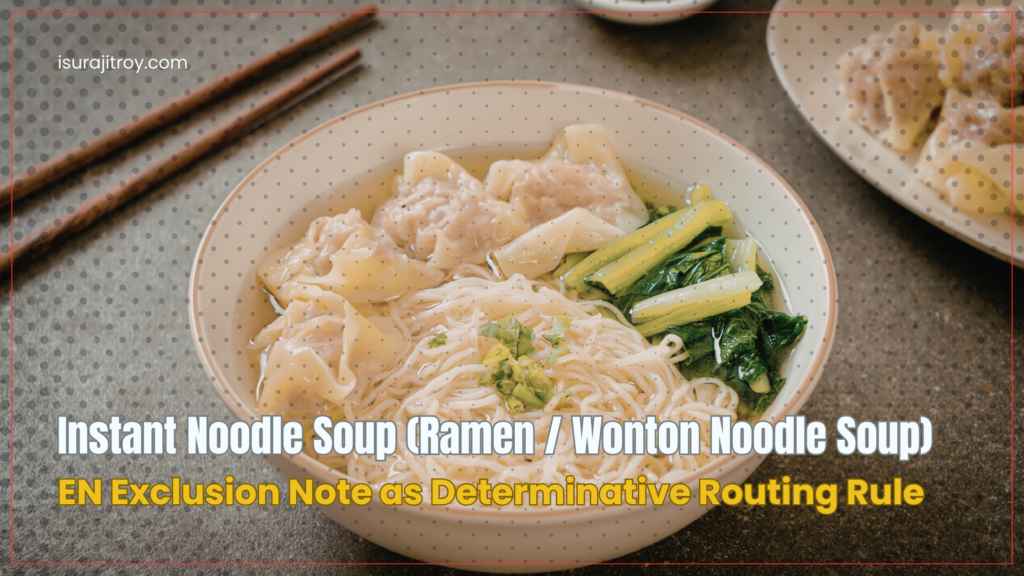
Instant noodle soup, sold as a block of dried noodles with a separate pouch of powdered soup base, is classified in heading 21.04 as a soup preparation, and not in heading 19.02 as pasta. CBP reached that result in HQ H304896 (February 6, 2020), classifying the products in subheading 2104.10.0020, HTSUS, and revoking three rulings going back to 1990 that had treated them as pasta. The deciding text is exclusion (b) in the Explanatory Note to heading 19.02, which sends “soups and broths and preparations therefor, containing pasta” to heading 21.04. The analysis below uses the HS 2022 nomenclature; the headings it relies on are unchanged from the edition CBP applied in 2020.
The goods are instant noodle soup products with two main components: a block of dried noodles (ramen or wonton) and a separate sealed pouch or packet of powdered soup base. They come in several flavours (Chicken, Shrimp, Spicy Beef, Spicy Vegetable). The package instructions tell the consumer to add boiling water to the dried noodles and soup base, or to boil water, cook the noodles for 2–3 minutes, take the pot off the heat and stir in the soup base. Some products are packed in a plastic bowl with a foil lid, so the consumer can prepare and eat the product from the container.
At importation the product is mostly dried noodles by weight. The soup base is the smaller component by weight, but it gives the product its flavour and turns it from a noodle dish into a soup.
Competing headings
Heading 19.02: “Pasta, whether or not cooked or stuffed (with meat or other substances) or otherwise prepared, such as spaghetti, macaroni, noodles, lasagne, gnocchi, ravioli, cannelloni; couscous, whether or not prepared.”
The case for 19.02 is that the product is mainly dried noodles, a form of pasta the heading names, and the noodles make up most of the product by weight. The soup base packet could be seen as making this pasta “packaged with sauce” (an exemplar noted in subheading 1902.19, HTSUS), with the soup base playing the part of a sauce or seasoning packet. On this view, adding a sealed soup base does not “prepare” the pasta enough to change its character.
EN 19.02 says pasta may be “otherwise prepared” and names noodles. The heading covers pasta packaged with other ingredients. Earlier CBP rulings (HQ 086309 of 1990, HQ 953104 of 1993 and NY N125119 of 2010), spread over more than 20 years, held that a soup base packet packed with dried noodles did not take the product out of heading 19.02.
Heading 21.04: “Soups and broths and preparations therefor; homogenised composite food preparations.”
The case for 21.04 is that the product is sold and marketed as soup (“Ramen Noodle Soup”, “Oriental Style Instant Noodle With Soup”). It needs only boiling water to become a finished soup: a flavoured broth with noodles in it. Mixed with water, the powdered soup base becomes soup stock. The soup base provides the flavour of the dish and turns the noodles into a soup preparation. The noodles are an ingredient of the soup, and not the other way round.
EN 21.04(A)(1) expressly includes “preparations for soups or broths requiring only the addition of water, milk, etc.” EN 21.04(A) says these products are “generally based on vegetable products (vegetables, flour, starches, tapioca, pasta, rice, plant extracts, etc.)…”, so pasta is listed as a base ingredient of soup preparations. The products here are put up as a powder (the soup base) with dried noodles, which matches the EN description.
The conflict
Both headings have a fair textual claim. Heading 19.02 names noodles, and the dried noodles are the larger component by weight. Heading 21.04 covers soup preparations, and the product, once prepared, is clearly a soup.
This is not a GIR 3 case, though. It is resolved under GIR 1, through an exclusion in the Explanatory Notes that works as a one-way routing rule.
EN 19.02, exclusion (b), states: “The heading does not cover: … (b) Soups and broths and preparations therefor, containing pasta (heading 21.04).”
In this case the exclusion decides the outcome. It removes soup preparations containing pasta from heading 19.02 and sends them to heading 21.04. It does not merely hint that such goods might be better placed elsewhere: it says heading 19.02 “does not cover” them and names the correct heading by number.
One qualification. The Explanatory Notes are interpretive guidance, not part of the legal text that GIR 1 refers to (the heading terms and the Section and Chapter Notes). H304896 itself calls them “not legally binding nor dispositive.” The exclusion carries weight here because it agrees with the terms of heading 21.04, which covers soup preparations, and CBP treated it as settling the question. How the ENs fit alongside the legal notes is explained in the legal anatomy of HS classification and in the role of EN notes in classification disputes.
So the classification turns on one factual question: is the product a soup preparation that contains pasta, or pasta that happens to be packed with a flavouring?
Analysis and resolution
Step 1: GIR 1, is the product a “soup preparation” of heading 21.04?
EN 21.04(A)(1) defines the category: “preparations for soups or broths requiring only the addition of water, milk, etc.” The product needs only boiling water to become a finished soup, a flavoured broth with noodles in it. That fits the EN description exactly.
The facts that support it:
- The products are sold as “Ramen Noodle Soup” and “Oriental Style Instant Noodle With Soup”. The manufacturer’s own labelling calls the product soup.
- Dictionary definitions describe the finished dish as soup. “Ramen” is defined as “quick-cooking egg noodles usually served in a broth with bits of meat and vegetables.” “Wonton” is defined as “a Chinese food made of dough that is filled with meat or vegetables and often served boiled in soup.”
- The powdered soup base, on its own, is classifiable in heading 21.04 as a soup preparation (CBP HQ 962908 classified dried soup stocks in 2104.10). Packing it with the noodles makes a preparation for soup, and not pasta with a flavouring.
- The consumer adds water to make a liquid food with stock, which is what defines a soup. The product is not drained and served dry like a pasta dish.
- Some products come in a bowl with a foil lid so the consumer can prepare and eat the soup from the container, and soups are typically served in bowls.
Step 2: GIR 1, does EN 19.02 exclusion (b) apply?
EN 19.02, exclusion (b): “The heading does not cover: … (b) Soups and broths and preparations therefor, containing pasta (heading 21.04).”
Once the product is shown to be a soup preparation containing pasta (the dried noodles), the exclusion takes it out of heading 19.02 and sends it to heading 21.04. No further GIR analysis is needed. Phrases such as “does not cover” are among the critical phrase patterns in the Harmonized System that decide cases on their own.
Step 3: Why the “pasta with sauce” counterargument fails
The earlier CBP rulings (HQ 953104, HQ 086309, NY N125119) treated the soup base like a sauce packet packed with pasta, relying on the “pasta packaged with sauce” exemplar noted in subheading 1902.19, HTSUS. HQ H304896 did not answer the sauce analogy directly; it relied on EN 19.02 exclusion (b) and on the soup base being, in CBP’s words, “the foundation of the dish”. The analogy also fails for these reasons:
- The soup base is a soup stock that becomes broth when water is added. A sauce is put on drained, cooked pasta; a soup stock makes the liquid the noodles sit in.
- The instructions do not tell the consumer to drain the noodles and add a sauce. They tell the consumer to add water to make soup.
- The finished dish is a liquid food (soup), and not a pasta dish served on a plate.
- EN 19.02 exclusion (b) is explicit and unconditional. If the product is a soup preparation containing pasta, it is excluded from heading 19.02 even if the pasta is the larger component by weight.
Step 4: The boundary case, when noodles with seasoning are pasta
NY N204353 (Indomie Instant Noodles Chicken Flavor) shows the other side of the line. There, dried noodles packed with a chili powder and seasoning packet were classified in heading 19.02. Those noodles could be prepared either as a dry noodle dish or “soup style”, the seasoning packet was not called a “soup base”, and the product was not marketed as soup. The seasoning flavoured pasta; it was not a preparation for soup.
Three questions decide it. Does the product include a component identified as “soup base”? Is it marketed and labelled as soup? Do the preparation instructions produce a liquid, broth-based dish? If the answer to all three is yes, heading 21.04 applies. If not, heading 19.02 remains available.
Final classification
2104.10.0020, HTSUS (HS subheading 2104.10): Soups and broths and preparations therefor; homogenised composite food preparations: Soups and broths and preparations therefor: Dried.
The result follows from GIR 1, through EN 19.02 exclusion (b), which removes soup preparations containing pasta from heading 19.02 and sends them to heading 21.04.
Ruling: CBP Headquarters ruling HQ H304896 (February 6, 2020): instant noodle soup, subheading 2104.10.0020, HTSUS. The ruling revoked three earlier rulings (NY N125119, HQ 953104, HQ 086309) that had classified these products as pasta in heading 19.02, a practice that began with HQ 086309 in 1990 and lasted nearly 30 years.
Instant noodle soup: the headings compared
| Heading | Why it is considered | Outcome |
| Heading 19.02 (pasta: noodles, spaghetti, macaroni, etc.) | Dried noodles are the larger component by weight; the heading names noodles; the product looks like “pasta packaged with sauce” | Rejected. EN 19.02 exclusion (b) states: “The heading does not cover soups and broths and preparations therefor, containing pasta (heading 21.04).” The exclusion routes the product out of this heading |
| Heading 19.02 (alternative argument: pasta “otherwise prepared”) | The noodles could be seen as pasta “otherwise prepared” by being packed with a flavouring or seasoning | Rejected. The soup base is a soup stock preparation that makes broth when water is added, not a seasoning or sauce; the finished product is a liquid soup, not a drained pasta dish |
| Heading 21.04 (soups and broths and preparations therefor) | The product includes a powdered soup base, needs only boiling water to become soup, and is marketed and labelled as “Noodle Soup” | Classified here under GIR 1. EN 21.04(A)(1) covers “preparations for soups requiring only the addition of water”; the EN lists pasta as a base ingredient of soup preparations; EN 19.02 exclusion (b) routes pasta-containing soup preparations here |
| Boundary case: heading 19.02 (noodles with seasoning, no soup base) | Dried noodles with a seasoning packet (not labelled “soup base”); prepared as a dry noodle dish or optionally “soup style” | Stays in 19.02. When the seasoning is not a soup base, the product is not marketed as soup, and the instructions do not produce only a broth-based dish, EN 19.02 exclusion (b) does not apply |
Classification principles
- An EN exclusion that names the destination heading works as a one-way routing rule. When an Explanatory Note says a heading “does not cover” a category of goods and gives the correct heading by number, the question can be settled under GIR 1 without GIR 3. EN 19.02 exclusion (b) is a clear example: soup preparations containing pasta are excluded from heading 19.02 and sent to heading 21.04. The EN is guidance, not law, so it decides cases like this one when the heading terms agree with it.
- For food preparations, the identity of the finished product can outweigh which component is heaviest. The dried noodles are most of the product’s weight at importation, but prepared as directed the product is a soup. The intended use and the identity of the finished product decide the classification, more than the weight of individual components at import.
- A soup base is a different thing from a sauce. Soup base makes the liquid broth the other ingredients sit in; a sauce is put on drained, cooked food. The difference decides the heading: pasta packed with sauce stays in heading 19.02, and pasta packed with soup base becomes a soup preparation of heading 21.04.
- Marketing, labelling and preparation instructions are strong evidence of what the product is when the heading texts describe end-use categories (soup or pasta). When a manufacturer labels its product “Noodle Soup”, supplies a “soup base” and tells the consumer to add water to make soup, those facts support classification as a soup preparation.
- Long-standing rulings can be wrong and can be revoked. CBP classified instant noodle soup as pasta for nearly 30 years (1990–2020) before correcting itself, A classification practice does not become correct by lasting a long time.
Related reading: the Slammers fruit snack pouch case is another heading 21.04 question, settled under GIR 1 by Note 3 to Chapter 21 without any GIR 3 analysis, and the practical guide to the GRIs explains why GIR 1 always comes first.