
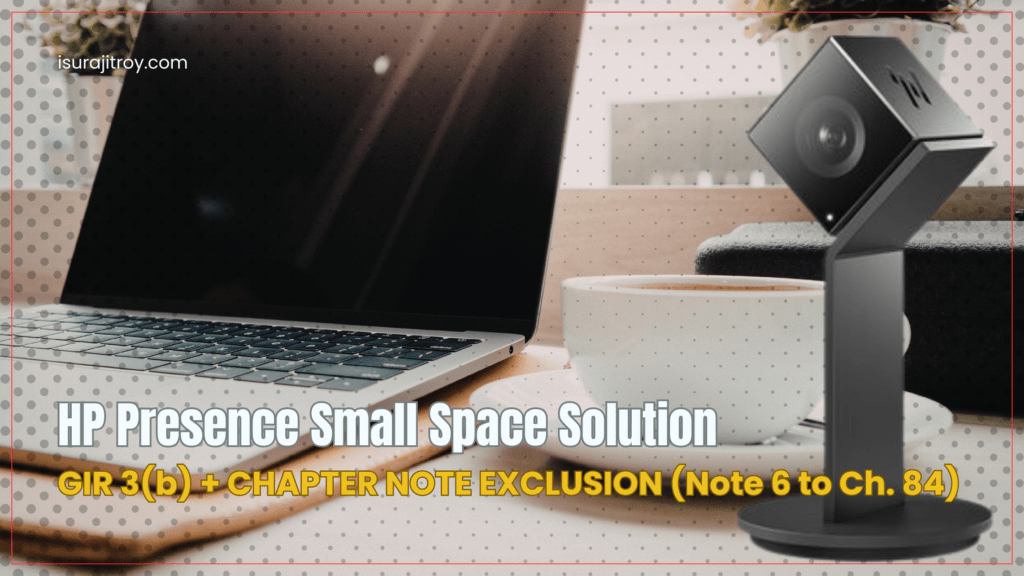
CBP classified the HP Presence Small Space Solution, a conference-room system built around a small conferencing PC, in subheading 8517.62.00, HTSUS, as apparatus for the transmission and reception of voice, images and data (HQ H326071, July 25, 2023). HP argued for heading 84.71 as an automatic data processing (ADP) system. That failed for two reasons: the Mini Conferencing PC is not “freely programmable” under Note 6(A) to Chapter 84, and Note 6(E) sends machines that perform a specific function other than data processing to the heading for that function. The two-piece configuration was classified by GIRs 1 and 6; the three-piece version with a camera also needed GIR 3(b), as a set. Note numbers follow the HS 2022 nomenclature.
The HP Presence Small Space Solution is a multi-component videoconferencing system for conference rooms. It is imported in two configurations:
Configuration 1, “Solution”: HP Presence Mini Conferencing PC and HP Presence Control (a touchscreen panel with microphones, speakers and sensors).
Configuration 2, “Solution Plus AI Camera”: HP Presence Mini Conferencing PC, HP Presence Control and Presence See 4K AI Camera (with speaker tracking and picture-in-picture modes).
The Mini Conferencing PC is a small-form-factor computing device that stores and runs an operating system. At importation it is preloaded with either a Microsoft Teams or a Zoom conferencing application, not both, and it cannot run the other application without connecting to an external laptop. It contains a CPU, RAM, flash memory and dedicated ports for the conferencing peripherals.
The HP Presence Control is a touchscreen panel with integrated Bang & Olufsen speakers, microphones, audio processing and mixing functions (volume control, noise filtering), temperature sensors, light sensors and passive infrared (PIR) sensors. It manages and adjusts audio, video and conferencing settings. It cannot work without a cable connection to the Mini Conferencing PC.
The See 4K AI Camera (Solution Plus only) has embedded microphones and captures 4K video with automatic framing, speaker tracking and temperature readings. It needs a cable connection to the Mini Conferencing PC to start or stop capture.
The components depend on one another. Each has a port layout that matches only the other units, and each carries firmware that works only with the other components. None can work as a standalone device. HP markets the system as: “Bring people together with this intuitive and easy-to-setup conferencing system.”
Competing headings
Heading 84.71: “Automatic data processing machines and units thereof; magnetic or optical readers, machines for transcribing data onto data media in coded form and machines for processing such data, not elsewhere specified or included.”
HP’s position was that the Mini Conferencing PC contains a CPU, RAM, flash memory and an operating system and runs applications, so it meets the ADP machine criteria of Note 6(A) to Chapter 84. The Control and the Camera are input and output units that connect to the CPU under Note 6(C). Together, on HP’s argument, they form an ADP system under Subheading Note 2 to Chapter 84: a central processing unit (the Mini Conferencing PC), input units (the Control touchscreen and the Camera) and an output unit (the Control’s display and speakers), classifiable in subheading 8471.49.
EN 84.71 says ADP systems may consist of a number of separate interconnected units, including at least a central processing unit, an input unit and an output unit. It also confirms that an ADP machine must be capable of being “freely programmed in accordance with the requirements of the user”, as Note 6(A)(ii) requires.
Heading 85.17: “Telephone sets, including smartphones and other telephones for cellular networks or for other wireless networks; other apparatus for the transmission or reception of voice, images or other data, including apparatus for communication in a wired or wireless network (such as a local or wide area network)…”
CBP’s position was that the system exists to carry remote video and audio communication between two or more parties. The Mini Conferencing PC is preloaded with conferencing software (Teams or Zoom) and has ports that serve only the conferencing peripherals. The Control handles audio processing, microphones and speakers, and call control. The Camera captures and transmits video for remote communication. Together the system is apparatus for the transmission and reception of voice, images and data over a network, which is what heading 85.17 describes. Subheading 8517.62 covers machines for the reception, conversion and transmission of voice, images or other data.
EN 85.17 covers apparatus for the transmission or reception of speech, sounds, images or other data between two points, including apparatus for communication in a wired or wireless network. The signal may be analogue or digital. Networks include telephony networks, local area networks and wide area networks.
The conflict
The Mini Conferencing PC has the hardware of an ADP machine (CPU, RAM, operating system, stored programs), while the system as a whole performs one specific function, videoconferencing, which heading 85.17 describes and heading 84.71 does not.
Three provisions of Note 6 to Chapter 84 bear on the conflict:
- Note 6(A)(ii), the “freely programmable” test: does the Mini Conferencing PC qualify as an ADP machine at all?
- Note 6(D)(ii), the exclusion of telecommunication apparatus: even if the ADP criteria were met, are the components excluded from heading 84.71 when presented separately?
- Note 6(E), the function-over-processing rule: a machine that incorporates or works with an ADP machine and performs a specific function other than data processing is classified by that function.
For the Solution Plus configuration, which adds the separate 4K AI Camera, a GIR 3(b) essential character analysis is also needed, because the three components form a set put up for retail sale.
Analysis and resolution
Step 1: GIR 1 and Note 6(A)(ii) to Chapter 84, is the Mini Conferencing PC “freely programmable”?
Note 6(A) to Chapter 84 defines ADP machines as machines capable of meeting four conditions at once, including (ii): “Being freely programmed in accordance with the requirements of the user.”
EN 84.71 adds: “machines which operate only on fixed programs, i.e., programs which cannot be modified by the user, are excluded even though the user may be able to choose from a number of such fixed programs.”
CBP relies on Optrex America Inc. v. United States, 427 F. Supp. 2d 1177 (Ct. Int’l Trade 2006), aff’d, 475 F.3d 1367 (Fed. Cir. 2007), for the meaning of “freely programmable”: a machine (i) for which applications can be written, (ii) that does not impose artificial limitations on those applications, and (iii) that will accept new applications allowing the user to manipulate data as the user considers necessary.
Applied to the Mini Conferencing PC: it is preloaded with either Teams or Zoom at importation, and it cannot run the other conferencing application without connecting to an external laptop. CBP treated that as a software block, an artificial limitation that stops the user from programming the device freely. Under the Optrex standard and CBP’s earlier rulings HQ H026665 (AIDA System: software blocks that prevented additional software meant the system was not freely programmable) and HQ 964682 (PlayStation 2: proprietary blocks that prevented a commercially available operating system meant it was not freely programmable), the Mini Conferencing PC fails the Note 6(A)(ii) test.
Result: the Mini Conferencing PC is not an ADP machine. Heading 84.71 is ruled out at the threshold, and the system cannot be an ADP system under Note 6(B) or 6(C), because there is no ADP machine at its core.
Step 2: GIR 1 and Note 6(E) to Chapter 84, the function-over-processing rule (an independent ground)
Even if the Note 6(A)(ii) point is set aside, Note 6(E) gives a separate ground for exclusion:
“Machines incorporating or working in conjunction with an automatic data processing machine and performing a specific function other than data processing are to be classified in the headings appropriate to their respective functions or, failing that, in residual headings.”
The HP Presence system performs a specific function other than data processing: videoconferencing and remote telecommunication. It carries video and audio calls between remote parties over a network. The Mini Conferencing PC runs dedicated conferencing software (Teams or Zoom). The Control manages audio processing, call placement and conferencing settings. The Camera captures and transmits video for remote communication. These are telecommunication functions.
EN 84.71 says the same: “the heading excludes machines, instruments or apparatus incorporating or working in conjunction with an automatic data processing machine and performing a specific function. Such machines, instruments or apparatus are classified in the headings appropriate to their respective functions.”
CBP has applied this principle in several comparable rulings: HQ 964973 (PC cameras for videoconferencing, excluded from 84.71 by the specific-function note and classified as television cameras), HQ W966951 (Digidesign Control 24, a control surface performing a recording and mixing function, excluded from 84.71) and HQ 967054 (HD digital video recorders with a CPU, excluded from 84.71 because they perform the video recording function of heading 85.21). The same note, numbered 5(E) before HS 2022, is what kept a humanoid robot out of heading 84.71 in the SoftBank PEPPER case.
Result: Note 6(E) on its own excludes the HP Presence system from heading 84.71 and directs it to the heading for its function, heading 85.17 (telecommunication apparatus).
Step 3: Note 6(D)(ii) to Chapter 84, telecommunication apparatus excluded even as ADP units
H326071 quotes Note 6(D) but rests its decision on Notes 6(A) and 6(E). Note 6(D) is a further argument that points the same way:
“Heading 8471 does not cover the following when presented separately, even if they meet all of the conditions set forth in Note 6(C) above: … (ii) Apparatus for the transmission or reception of voice, images or other data, including apparatus for communication in a wired or wireless network (such as a local or wide area network).”
The Mini Conferencing PC with its preloaded conferencing application, the Control with its microphones and speakers, and the 4K AI Camera are all apparatus for the transmission and reception of voice, images and data over a network. Note 6(D)(ii) excludes such apparatus from heading 84.71 even if it otherwise meets the Note 6(C) criteria for ADP units. Its wording follows the text of heading 85.17 almost word for word, which shows that telecommunication apparatus is meant for Chapter 85. The note speaks of goods “presented separately”, so it applies most directly when a component is imported on its own; for the complete systems it supports the result reached under Notes 6(A) and 6(E).
Result: Note 6(D)(ii) is a third reason why heading 84.71 does not fit.
Step 4: GIR 3(b), essential character of the Solution Plus as a set put up for retail sale
The Solution Plus configuration (Mini Conferencing PC, Control and 4K AI Camera) consists of three separate articles, put up together in common packaging, designed to meet one need (videoconferencing) and sold directly to end users. That meets the definition of “goods put up in sets for retail sale” in paragraph (X) of the Explanatory Note to GIR 3(b):
- (a) At least two different articles prima facie classifiable in different headings. Met: the Camera could prima facie fall in 85.25 as a television camera, the Control has the microphone and speaker elements of 85.18, and the Mini Conferencing PC has computing elements.
- (b) Put up together to carry out a specific activity. Met: videoconferencing.
- (c) Put up in a manner suitable for sale directly to users without repacking. Met: sealed retail packaging.
Paragraph (VIII) of the Explanatory Note to GIR 3(b) governs the essential character:
“The factor which determines essential character will vary as between different kinds of goods. It may, for example, be determined by the nature of the material or component, its bulk, quantity, weight or value, or by the role of a constituent material in relation to the use of the goods.”
The deciding factor here is the role of each component in relation to the use of the goods, which is the most relevant of the listed factors for a set put together for one specific activity. CBP found that the Mini Conferencing PC gives the set its essential character because it provides most of the functionality for hosting and running virtual meetings. This analysis expands on that finding:
- It is the central processing and communication hub and provides most of the system’s videoconferencing functionality. It runs the conferencing application (Teams or Zoom), processes audio and video data, manages the network connection, and routes data between remote participants and the local peripherals. Without it, the Control is an inert touchscreen and the Camera an idle imaging device; neither can do anything on its own.
- The use of the goods is videoconferencing, a communication function, so the essential character of the set lies in conferencing and communication, and not in general-purpose data processing. The Mini Conferencing PC cannot run Teams or Zoom as a conferencing system without the Camera and Control for audio and video capture and output, but it is the PC that hosts the application, manages the network session and processes the communication data. No conferencing takes place without it.
- The functional core sits in the PC: the operating system, the conferencing application, the processing power, network connectivity and data routing. The Control and Camera are peripherals that depend on it.
Because the Mini Conferencing PC gives the essential character, and it performs a telecommunication function (not data processing, as the Note 6(E) analysis above shows), the whole set is classified in the heading for that function: heading 85.17. For more on how GIR 3(b) weighs components, see the practical guide to the GRIs.
Step 5: Why Note 3 to Section XVI (composite machines) does not apply
CBP found that Note 3 to Section XVI (composite machines fitted together to form a whole) does not apply because the components are not fitted together to form a whole. They are separate units connected by cable and placed in different positions: in the ruling’s description, the Control at the centre of the conference table, the Mini Conferencing PC below it, and the Camera at the head of the table or on a separate table. They are not incorporated one in the other, nor mounted on a common base or frame or in a common housing. The system is a set, and not a composite machine.
CBP did not classify the system as a functional unit under Note 4 to Section XVI either.
Final classification
8517.62: Telephone sets…; other apparatus for the transmission or reception of voice, images or other data, including apparatus for communication in a wired or wireless network: Machines for the reception, conversion and transmission or regeneration of voice, images or other data, including switching and routing apparatus.
- Solution (PC and Control): classified by GIR 1 and GIR 6.
- Solution Plus (PC, Control and Camera): classified by GIR 1, GIR 3(b) and GIR 6.
Ruling: CBP Headquarters ruling HQ H326071 (July 25, 2023): HP Presence Small Space Solutions, subheading 8517.62.00, HTSUS.
Classification principles
- Under Note 6(A)(ii) to Chapter 84, “freely programmable” means no artificial software blocks. A computing device preloaded with a single conferencing application, which cannot accept the alternative application without connecting to an external computer, has software blocks that prevent free programming. Under the Optrex standard it fails the ADP machine definition and cannot be classified in heading 84.71. A CPU, RAM and an operating system do not by themselves make a device an ADP machine; the user must be able to program it without restriction.
- Note 6(E) to Chapter 84 is the main exclusion for purpose-built systems that contain computing hardware. When a machine incorporates computing hardware but performs a specific function other than data processing (videoconferencing, video recording, audio mixing and so on), Note 6(E) requires classification by that function. This holds whether or not Note 6(A) is met. Data processing is the means; the function is something else.
- Note 6(D)(ii) to Chapter 84 excludes telecommunication apparatus presented separately from heading 84.71, even if every ADP unit criterion of Note 6(C) is met. Apparatus for the transmission or reception of voice, images or other data over a wired or wireless network belongs in heading 85.17. The note’s wording mirrors heading 85.17 closely, which leaves little doubt that such apparatus belongs in Chapter 85.
- For technology sets, GIR 3(b) essential character turns on the role of each component in relation to use, not on weight or value alone. Paragraph (VIII) of the Explanatory Note to GIR 3(b) lists several factors: nature, bulk, quantity, weight, value and the role of a constituent in relation to use. For a multi-component system built for one activity (videoconferencing), the component that hosts the application, manages the network session and routes the data gives the essential character, because without it the other components do nothing.
- A system whose components are physically separate, placed in different locations and connected only by cable (not fitted together on a common base or in a common housing) is a set, and Note 3 to Section XVI does not apply. Classification then goes through GIR 3(b) for sets put up for retail sale, and not through the composite machine provisions.
Videoconferencing system: the set that looks like a computer but classifies as telecom
| Heading | Why it is considered | Outcome |
| Heading 84.71 (ADP machines, “freely programmable” test) | The Mini Conferencing PC contains a CPU, RAM, flash memory and an operating system, runs applications, and appears to meet the Note 6(A) ADP machine definition | Rejected. The Mini Conferencing PC fails Note 6(A)(ii): it cannot accept the second conferencing application (Teams or Zoom) without connecting to an external laptop, a software block that prevents free programming under the Optrex standard |
| Heading 84.71 (ADP system, input and output units) | The Control works as touchscreen input and output and the Camera as video input; with the Mini PC they look like a CPU, input and output, an ADP system under Note 6(C) and Subheading Note 2 | Rejected. Note 6(E) excludes machines performing a specific function (telecommunication) other than data processing; Note 6(D)(ii) also excludes apparatus for the transmission or reception of voice, images or data over a network from heading 84.71, even if all Note 6(C) unit criteria are met |
| Heading 85.25 (television cameras) | The 4K AI Camera captures and transmits video images; CBP ruling HQ 964973 classified PC cameras in heading 85.25 | Rejected for the set. Imported as part of the conferencing set, the Camera does not give the set its character; under GIR 3(b) the whole set takes the heading of the component that gives the essential character (the Mini Conferencing PC, with its telecommunication function) |
| Heading 85.17 (telecommunication apparatus: transmission or reception of voice, images, data) | The system carries remote video and audio communication over a network; the Mini PC runs dedicated conferencing software; the Control manages audio and calls; the Camera transmits video to remote participants | Classified here. The system’s specific function is telecommunication, not data processing; Note 6(E) routes it by function; under GIR 3(b) the Mini Conferencing PC, as the communication hub, gives the essential character; subheading 8517.62 describes the system directly |
Related reading: phone-dependent smartwatches in 8517.62 are another CBP application of heading 85.17 to a device with computing hardware, the access controller face recognition case study looks at heading 84.71 against 85.43, and the Bluetooth earphone case study covers the line between 85.17 and 85.18.