
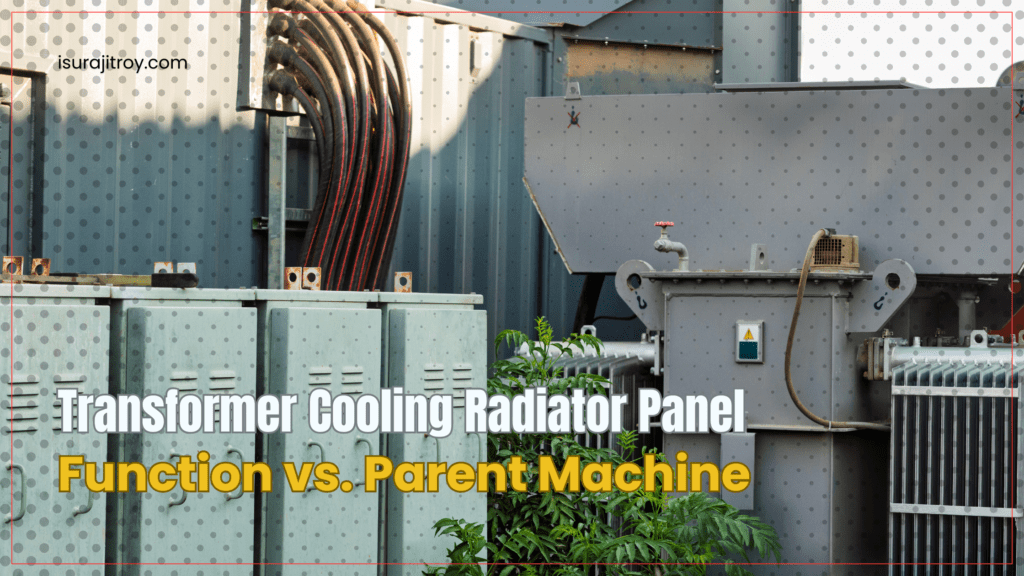
A steel cooling radiator made for an oil-immersed power transformer could be a part of the transformer (heading 85.04) or cooling machinery in its own right (heading 84.19). The Canada Border Services Agency (CBSA) classified it in heading 84.19, at tariff item 8419.89.00.00 of the Canadian Customs Tariff. The deciding provision was Note 2(a) to Section XVI: a part that is itself a good of a Chapter 84 or 85 heading stays in that heading “in all cases”, even when it is made for only one kind of machine.
The radiator is designed to be mounted on a large oil-immersed dielectric power transformer used in electrical power grids. It is made of iron/steel, with a flanged inlet at the top and a flanged outlet at the bottom. These connect by bolts and seals to the matching outlet and inlet of the transformer.
Once mounted, hot insulating oil from the transformer flows through the radiator, and the radiator passes the excess heat from the oil into the surrounding air so that the transformer does not overheat. In service, fans are fitted to blow air onto the radiator and speed up the cooling. The fans are not included with the radiator at the time of importation.
The radiator is an identifiable component, integral to the design of the transformer and essential to its function: without it, the transformer would overheat and fail. Yet the radiator also does a complete physical job on its own. It is a machine for the treatment of a material (insulating oil) by a process involving a change of temperature (cooling). That double identity, a part of an electrical transformer and at the same time a complete machine for heat treatment, is what creates the classification conflict. (The Canadian rules are called the General Interpretive Rules, or GIRs; they correspond to the GRIs of the Harmonized System.)
Competing headings
Heading 85.04: “Electrical transformers, static converters (for example, rectifiers) and inductors.”
The part-of-transformer argument runs like this. The radiator is designed, engineered and sold only as a part of an oil-immersed dielectric power transformer of heading 85.04. It has no function apart from the transformer, and its flanged ports are sized to match the transformer’s ports. Under the general parts principle set out in CBSA Memorandum D10-0-1, Category C, a component suitable for use solely or principally with a particular kind of machine is classified with that machine. On this view the radiator belongs in subheading 8504.90 as a part of an electrical transformer.
Memorandum D10-0-1, paragraph 13, says that Category C reflects Note 2(b) to Section XVI, under which parts suitable for use solely or principally with a particular kind of machine are classified with the machines of that kind. The radiator is used only with transformers of heading 85.04 and has no other application.
Heading 84.19: “Machinery, plant or laboratory equipment, whether or not electrically heated (excluding furnaces, ovens and other equipment of heading 85.14), for the treatment of materials by a process involving a change of temperature such as heating, cooking, roasting, distilling, rectifying, sterilising, pasteurising, steaming, drying, evaporating, vaporising, condensing or cooling, other than machinery or plant of a kind used for domestic purposes; instantaneous or storage water heaters, non-electric.”
This was the CBSA’s position. The radiator is machinery for the treatment of a material (insulating oil) by a process involving a change of temperature (cooling), and the text of heading 84.19 describes exactly that function. The radiator is therefore a good “included in” a heading of Chapter 84. Note 2(a) to Section XVI requires such parts to be classified in their own headings “in all cases”, so the radiator stays in heading 84.19 even though it is dedicated to a transformer of heading 85.04.
The Explanatory Note to heading 84.19 supports this. It says the heading covers machinery and plant designed to submit materials to a cooling process to cause a simple change of temperature, including “plant of general use in many industries for the simple treatment of materials by … cooling.” The machinery “may or may not incorporate mechanical equipment”, so the absence of fans at importation does not take the radiator out of the heading.
Subheading 8419.50: “Heat exchange units.”
The applicant, Hitachi Energy Canada, suggested subheading 8419.50. Its argument was that the radiator works as a heat exchanger, passing heat between the transformer’s insulating oil and the surrounding air.
EN 84.19(I)(B) describes heat exchange units as “units in which a hot fluid (hot gas, steam or hot liquid) and a cold fluid are made to traverse parallel paths, but usually in opposite directions, separated by thin metal walls in such a manner that the one fluid is cooled and the other heated.” It lists three configurations: (i) concentric tube systems, (ii) tubular systems enclosed in a chamber, and (iii) parallel series of interconnected narrow chambers formed of baffle plates.
The conflict
The question is whether a component follows its parent machine (85.04, the transformer) or its own physical function (84.19, cooling machinery).
This is not a GIR 3 contest between several headings. It is settled entirely under GIR 1, through Note 2(a) to Section XVI. Two classification instincts pull against each other:
- Parts follow the parent (D10-0-1 Category C). A component designed only for use with a specific machine is classified with that machine under Note 2(b) to Section XVI.
- Function over parent (D10-0-1 Category A). Note 2(a) to Section XVI says that when a part is itself a good described by a heading of Chapter 84 or 85, it is classified in its own heading and not with the parent machine. The note applies “in all cases”.
There is also a subheading dispute between 8419.50 (heat exchange units) and 8419.89 (other). It turns on whether the radiator fits the description of a heat exchange unit in EN 84.19(I)(B).
Analysis and resolution
Step 1: GIR 1, does the radiator meet the terms of heading 84.19?
Heading 84.19 covers machinery for the treatment of materials by a process involving a change of temperature, such as cooling, other than machinery of a kind used for domestic purposes.
The radiator:
- is machinery: an engineered assembly of steel panels with flanged inlet and outlet ports;
- treats a material, namely insulating oil;
- does so by a change of temperature: hot oil enters, flows through the radiator and leaves cooler as heat passes into the air;
- is not domestic, since it is designed for industrial power grid transformers.
EN 84.19 covers “plant of general use in many industries for the simple treatment of materials by … cooling” and says the machinery “may or may not incorporate mechanical equipment”. The missing fans therefore do not exclude the radiator from the heading.
The CBSA ruling found: “the radiator at issue meets the terms of heading 84.19 because it is a machine for the treatment of material (insulating oil) by a process involving a change of temperature (cooling). The Explanatory Notes to heading 84.19 indicate that machinery classified in this heading may or not incorporate mechanical equipment; the same Explanatory Notes also indicate that the group heating or cooling plant and machinery covers plant of general use in many industries for the simple treatment of materials by … cooling, etc., which supports the radiator meeting the terms of heading 84.19.”
Result: the radiator is a good included in heading 84.19.
Step 2: GIR 1 and Note 2(a) to Section XVI
Note 2(a) to Section XVI reads:
“Parts which are goods included in any of the headings of Chapter 84 or 85 (other than headings 84.09, 84.31, 84.48, 84.66, 84.73, 84.87, 85.03, 85.22, 85.29, 85.38 and 85.48) are in all cases to be classified in their respective headings.”
Applied to the radiator:
- It is a part of a transformer of heading 85.04, integral to the transformer’s design and essential to its function.
- It is also a good included in heading 84.19, as machinery for the treatment of material by a change of temperature (cooling).
- Heading 84.19 is not one of the headings excluded in Note 2(a).
- Note 2(a) therefore applies, and the radiator is classified in heading 84.19 “in all cases”.
The CBSA ruling confirmed: “Note 2(a) to Section XVI directs that parts which are goods included in any of the headings of Chapter 84 or 85 are in all cases to be classified in their respective headings.”
The words “in all cases” carry no conditions. Under them, none of the following changes the result:
- the radiator is designed only for the transformer;
- it has no independent commercial use;
- it is marketed and shipped as a transformer component;
- the parent transformer is classified in heading 85.04.
If the part has its own Chapter 84 heading, Note 2(a) puts it there, and it cannot move to the parent machine’s heading.
Step 3: the D10-0-1 framework, and why Category A comes before Category C
CBSA Memorandum D10-0-1 sets out four categories for classifying parts, applied in a fixed order.
Category A: parts specified in a heading or directed by a Section or Chapter Note (paragraph 3)
“Any part or accessory specified or described in a heading text, or whose classification in a particular heading is directed by a Section or Chapter Note, must be classified under that heading and under no other heading in the Tariff. This is true even if the part or accessory is specifically designed or principally or solely suitable for use with a particular machine, appliance, instrument, vehicle or any other manufactured product.”
Category C: parts suitable for use solely or principally with a particular machine (paragraphs 13 and 14)
“Those Notes specify that parts … which are suitable for use solely or principally with the goods of Section XVI … are to be classified as parts of the goods covered by Section XVI.” This reflects Note 2(b) to Section XVI.
The radiator shows features of both categories. It fits Category C because it is designed solely for use with transformers of heading 85.04 and has no other application. It fits Category A because Note 2(a) to Section XVI directs it to heading 84.19, the radiator being a good included in a heading of Chapter 84.
D10-0-1, paragraph 3, answers the point directly: Category A applies “even if the part or accessory is specifically designed or principally or solely suitable for use with a particular machine.” That sentence describes the transformer radiator. Once Note 2(a) sends the radiator to heading 84.19, its dedication to the transformer no longer matters.
Category A always comes before Category C; the D10-0-1 order is A, then B, then C, then D. Paragraph 14 itself says that Category C parts “are not subject to either categories A or B”. Category C (Note 2(b)) applies only to “other parts”, meaning parts that are not goods included in any heading of Chapter 84 or 85. Because the radiator is a good of heading 84.19, Note 2(a) governs and Note 2(b) is never reached.
Step 4: GIR 6, subheading 8419.50 or 8419.89
With the heading settled as 84.19, the remaining question is whether the radiator falls in 8419.50 (heat exchange units) or 8419.89 (other).
The applicant suggested 8419.50. The CBSA rejected it.
EN 84.19(I)(B) describes heat exchange units as units in which a hot fluid and a cold fluid traverse parallel paths, usually in opposite directions, separated by thin metal walls, so that one fluid is cooled and the other heated. The three configurations it lists are all closed systems: concentric tubes, enclosed tubular systems, and parallel series of baffle-plate chambers.
The transformer radiator does not fit that description:
- No second, contained fluid travels a parallel path. The cooling medium is open ambient air outside the radiator’s structure.
- The hot oil flows through the panels and the heat passes into the surrounding atmosphere by radiation and convection. That is heat dissipation, and the EN describes a closed exchange between two fluids.
- The radiator does not have the parallel-path, opposite-direction, thin-wall design for two fluids that the EN describes.
The CBSA ruling found: “the radiator at issue cannot be classified as a heat exchanger under subheading 8419.50 because it does not meet the description of heat exchangers described in the Explanatory Notes to heading 84.19.”
Result: the radiator is classified in subheading 8419.89 (other machinery, plant and equipment for the treatment of materials by a change of temperature: other).
Final classification
8419.89.00.00 (Canadian Customs Tariff): Machinery, plant or laboratory equipment, for the treatment of materials by a process involving a change of temperature: Other machinery, plant and equipment: Other.
Decided by GIR 1 (with Note 2(a) to Section XVI) and GIR 6.
Authority:
- CBSA Advance Ruling 8000005154, Menk-USA transformer radiator, classified in 8419.89.00.00.
- CBSA Memorandum D10-0-1 (January 31, 2023), Classification of Parts and Accessories in the Customs Tariff.
Classification principles from this ruling
- Note 2(a) to Section XVI puts function before the parent machine, and it applies “in all cases”. When a part of a machine is itself a good described by a heading of Chapter 84 or 85, it is classified in that heading and not with the parent machine. The radiator has its own heading (84.19), so it cannot move to 85.04 because the transformer is its parent machine. Under the CBSA’s reading, the words “in all cases” leave no room for exceptions based on exclusive design, lack of independent commercial use, or the identity of the parent machine.
- In the D10-0-1 order, Category A comes before Category C. Category A (parts specified in a heading or directed by a legal note) takes precedence over Category C (parts suitable for use solely or principally with a particular machine). D10-0-1 paragraph 3 says so in terms: Category A applies “even if the part or accessory is specifically designed or principally or solely suitable for use with a particular machine.” An importer cannot use Category C to override a Category A classification directed by Note 2(a).
- Note 2(a) is tested before Note 2(b). Note 2(b), which classifies “other parts” with their parent machine, applies only to parts that are not goods included in any heading of Chapter 84 or 85. If Note 2(a) is met because the part has its own heading, Note 2(b) is never reached. The order is Note 2(a); if it does not apply, Note 2(b); if that does not apply, Note 2(c). A similar conflict between an exclusion and a “solely or principally” parts rule, under Section XVII, is discussed in this case study on “solely” and “principally” use.
- The heat exchange unit described in EN 84.19(I)(B) is a closed system in which two fluids travel parallel paths. A radiator in which hot oil is cooled by open ambient air, with no contained cold fluid travelling a parallel path in the opposite direction, does not fit that description. Such a radiator is classified in 8419.89 (other) and not in 8419.50 (heat exchange units). At subheading level, the difference between open-air dissipation and closed exchange between two fluids decides the result.
- The five part-identification criteria in D10-0-1 (paragraph 26) show that an article is a part. They do not choose the heading. The radiator meets all five: it forms a complete unit with the transformer, has no alternative function, is marketed and shipped as a unit with the transformer, is necessary for safe operation, and is committed to the transformer’s use. Those facts make it a part. Which heading it falls in is decided by Note 2(a), not by the part test.
Summary table: the part that does not follow its parent machine
| Heading | Why it is considered | Result and reason |
| Heading 85.04, sub. 8504.90 (Parts of electrical transformers) | The radiator is designed only for mounting on an oil-immersed power transformer of heading 85.04; it is integral to the transformer’s design and essential to its function, and it meets all five D10-0-1 part-identification criteria | Rejected. Note 2(a) to Section XVI requires parts that are goods of a Chapter 84 heading to be classified in their own heading “in all cases”; D10-0-1 Category A comes before Category C even when the part is solely suitable for the parent machine |
| Heading 84.19, sub. 8419.50 (Heat exchange units) | The radiator passes heat from hot insulating oil to the surrounding air; the applicant (Hitachi Energy) suggested this subheading, treating it as a heat exchange unit for industrial processes | Rejected at subheading level. EN 84.19(I)(B) describes heat exchange units as closed systems in which hot and cold fluids traverse parallel paths in opposite directions; the radiator uses open ambient air with no contained cold fluid, so it does not fit the EN description |
| Heading 84.19, sub. 8419.89 (Other machinery for treatment of materials by cooling) | The radiator is machinery for the treatment of material (insulating oil) by a process involving a change of temperature (cooling); EN 84.19 covers plant of general use for the simple treatment of materials by cooling | Classified here under GIR 1 and Note 2(a) to Section XVI. The radiator meets heading 84.19 in its own right as cooling machinery; Note 2(a) sends it here “in all cases”, whatever the parent machine; the CBSA changed the applicant’s 8419.50 to 8419.89 |
| D10-0-1 category order | Category C (parts solely for a particular machine are classified with that machine) would normally send the radiator to 85.04, since it is used only with transformers | Category A overrides Category C. D10-0-1 para. 3: parts whose classification is directed by a Section Note are classified in that heading “even if the part or accessory is specifically designed or principally or solely suitable for use with a particular machine”; the radiator’s dedication to the transformer does not matter |
Conclusion
Two headings compete here, and the result comes from Note 2(a) to Section XVI, the order of D10-0-1 Categories A and C, and a subheading question about the EN 84.19(I)(B) description of heat exchangers. The result is counterintuitive: a component designed only for a transformer is not classified as a transformer part. The difficulty is that the part-identification test (D10-0-1, paragraph 26) and the parts classification rules (Note 2 to Section XVI) are separate steps. A good can meet every criterion for being a “part” and still be classified outside the parent machine’s heading. For how GRI 1 and the notes sit ahead of the other rules, see this practical guide to the GRIs; for parts that fall under Note 2(b) to Chapter 90 instead, see the case study on a plastic part of an analyser.
Other administrations have reached a different result on similar goods. The European Commission’s Implementing Regulation (EU) 2023/2519 classified a radiator for an oil-immersed power transformer in CN 8504 90 17, as a part of a transformer under Note 2(b) to Section XVI, on the ground that heading 8419 does not cover devices that only exchange heat with the surrounding air. The UK tariff notice on the same regulation summarises the reasoning. The CBSA ruling above applies in Canada; importers into the EU or UK should check the classification regulation and the local tariff before relying on it.