
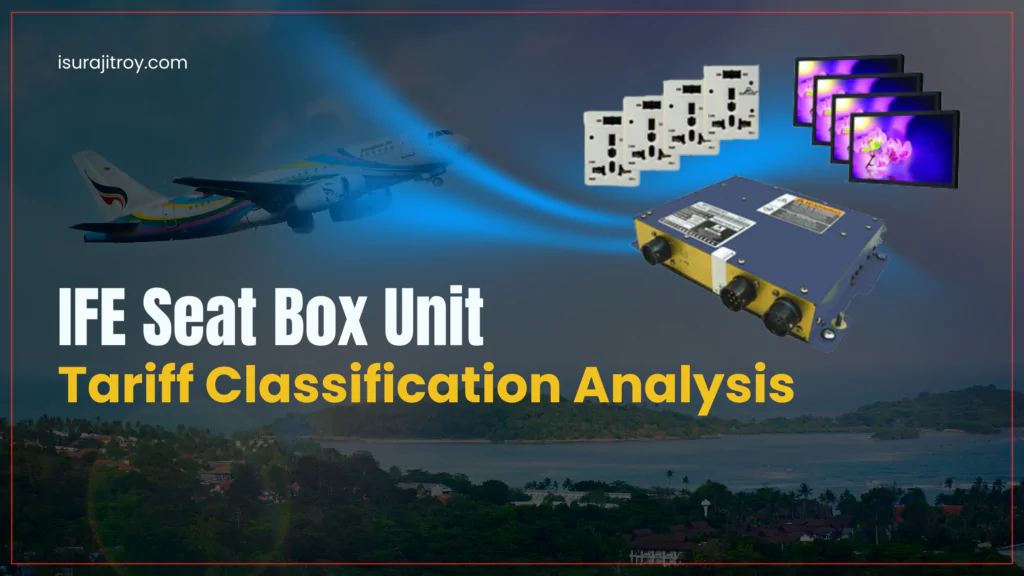
An IFE seat box unit is the electronics module fitted under or inside an aircraft passenger seat. It receives audio-video and control signals from the aircraft’s central in-flight entertainment (IFE) system, processes them, and passes them on to the seatback display, headphones and passenger controls. This analysis classifies it under heading 8525 as transmission apparatus, at subheading 8525.50 (HS 2022), and rejects headings 8543.70 (electrical apparatus with individual functions, n.e.s.) and 8517.62 (machines for the reception, conversion and transmission of data). The reasoning rests on GRI 1 and Note 4 to Section XVI, with US ruling NY C84168 as precedent.
Note on the subheading (October 2026): in HS 2022, subheading 8525.50 reads “Transmission apparatus”. Transmission apparatus incorporating reception apparatus is subheading 8525.60. Because the seat box also receives signals, 8525.60 should be checked before relying on 8525.50. (NY C84168 used 8525.10, then “transmission apparatus”, not 8525.20, then “transmission apparatus incorporating reception apparatus”; that lineage points to 8525.50.)
The analysis looks at the unit’s technical function, its market identity and its treatment under the General Rules of Interpretation and the Section XVI notes, with the aim of a classification that can be defended in an audit.
Product overview and features
The IFE seat box unit:
- is a compact, self-contained electronic module that fits beneath or within a passenger seat without interfering with the seat structure or passenger space;
- receives audio-video and control signals from the central IFE system through wired network interfaces;
- decodes, processes and manages digital media so that playback quality and synchronisation are right at each seat;
- transmits the processed audio-video signals to seatback displays, headphones and passenger control interfaces;
- supports passenger functions such as content selection, playback control and language or channel selection;
- distributes and regulates electrical power for the connected IFE components;
- is designed exclusively for IFE systems and performs a defined electrical function within them;
- is built to aviation requirements, including vibration resistance, thermal control and long operating life; and
- is not intended for general consumer or telecommunications use; it works only inside a closed aircraft IFE system.
Classification method and legal tests
A) The General Rules of Interpretation
GRI 1 decides at heading level. Under GRI 1, classification is determined by the terms of the headings and the relevant Section and Chapter Notes. Explanatory Note (I) to GRI 1 explains that the Harmonized System “…groups these goods in Sections, Chapters and sub-Chapters which have been given titles indicating as concisely as possible the categories or types of goods they cover….” On that basis, the unit’s technical characteristics and operating role match the heading for transmission apparatus. It receives, processes and transmits audio-video signals as part of an integrated IFE system, which is a clearly defined electrical function. The analysis also relies on Note 4 to Section XVI, which covers machines “…intended to contribute together to a clearly defined function,…”, to support classification by function over installation context or end use.
GRIs 2 to 4 do not change the result. GRI 2(a) is not triggered, because the product is imported as a complete unit. GRI 2(b), on mixtures and composite materials, is irrelevant because the classification turns on function, not material. GRI 3 is not reached, because GRI 1 decides between the candidate headings, and GRI 4 is unnecessary because the product is classifiable under the earlier rules. The GRI 1 result stands.
B) Apparatus, parts and accessories
An apparatus, in HS terms, is a complete machine or device that performs a clearly defined electrical or mechanical function in its own right. Its classification follows its function, not where it is installed or whether it works inside a larger system. Where a heading describes that function, the product is classified there as an apparatus under GRI 1.
Parts are identifiable components that are needed for the construction or operation of another machine but do not perform an independent function. The HS provisions for parts apply only when the item is not more specifically described elsewhere and its role is subordinate to the main machine. A product that carries out signal processing, control or transmission goes beyond a mere part.
Accessories play a secondary role, adding convenience or efficiency without being essential to the core function. The seat box does not fit that description. It receives, processes and transmits audio-video signals on its own, a function central to the IFE system, so it is an apparatus, not a part or an accessory.
C) The “solely or principally” test
The words “solely” or “principally” appear in the HS mainly in the context of parts classification, in particular in Note 2(b) to Section XVI (see also the case study on ‘solely’ vs ‘principally’). The test decides whether a component is a part of a specific machine, based on exclusive or predominant use. It is not an independent basis for classification and cannot override a heading that already describes the goods by name or function.
The test is triggered only once a product has been found to be a part, not a complete machine or apparatus. Where an item performs a defined electrical function and a heading describes it, classification is settled at apparatus level under GRI 1, and applying a parts test would be wrong in method.
The seat box is designed only for aircraft IFE systems, but that fact does not affect its classification. It performs its own defined electrical function (receiving, processing and transmitting audio-video signals), so it is classified as an apparatus by function and the “solely or principally” test does not apply.
D) Design, intent and market identity
The unit is engineered as a dedicated electronic module, with integrated circuitry for receiving, processing and transmitting audio-video signals. Its hardware, interfaces and power design are built for IFE signal management at seat level, which marks it as a functional electronic apparatus, not a passive component.
In operation it plays an active role in the IFE system: it manages signal decoding, distribution and control for content delivery to the passenger. It carries out a specific electrical task; it does not merely support another device mechanically or incidentally.
Commercially, it is sold and recognised as seat-level IFE electronics, not as a generic part or accessory. Its engineering design, operating purpose and market identity all point the same way: a complete apparatus.
E) Principal function (Note 3) and defined function (Note 4)
Note 3 to Section XVI covers composite machines (two or more machines fitted together) and machines designed to perform two or more complementary or alternative functions. These are classified by their principal function, as the Tribunal did with the multimedia speaker systems in a CESTAT case.
Note 4 to Section XVI covers a machine, including a combination of machines, made up of separate components “intended to contribute together to a clearly defined function”; the whole is classified in the heading for that function. This analysis treats the seat box as performing one clearly defined electrical function, the reception, processing and transmission of audio-video signals within an IFE system. On that view it is a dedicated functional unit, not a composite of competing functions, and it is classified as a complete apparatus by that function. (For a sequence of legal notes routing a product between headings, see the UV flame scanner case study.)
Comparing the candidate headings
| Test or criterion | 8525.50: transmission apparatus | 8543.70: electrical machines with individual functions, n.e.s. | 8517.62: data transmission or reception machines |
| Nature of the heading | Specific, function-based | Residual (basket) | Specific to telecom and data networks |
| Priority under GRI 1 | Describes the unit’s AV transmission function | Applies only if no other heading fits | Limited to telecom or data communication |
| Core function | Reception, processing and transmission of AV signals | Catch-all for unspecified apparatus | Data networking, routing, switching |
| Defined function (Section XVI Note 4) | Yes: clearly defined AV transmission function | No: used only when nothing else applies | No: telecom or data function, not AV |
| Independent function | Yes: standalone electrical function | Yes, but overridden by a more specific heading | Yes, but a different kind of function |
| Needs a telecom or data network | No | No | Yes (LAN, WAN, telecom) |
| Fits a closed-loop AV system | Yes | Only by default | No: outside the intended scope |
| Explanatory Notes | Cover AV transmission apparatus | Exclude goods classifiable elsewhere | Limited to telecom equipment |
| Customs practice | Matches treatment of AV signal apparatus | Used only if no specific heading exists | Used for routers, modems, switches |
| Result | Selected | Excluded because heading 8525 applies | Excluded because the function is not telecom |
Ruling and precedent
US Customs ruling NY C84168 (3 March 1998) is persuasive support for heading 8525. It classified three seat electronics units of an in-flight entertainment system installed in a Boeing 747 (an audio seat electronics box, a video/audio seat electronics box and an integrated video/audio seat electronics box) under HTSUS subheading 8525.10.9090, as transmission apparatus. The ruling sets out the units’ functions (demultiplexing and converting audio channels, demodulating video channels, providing video games, flight information and telephone services) but gives no separate legal analysis.
Subheading 8525.10 no longer exists; the transmission apparatus subheadings of heading 85.25 were restructured in later HS editions. In HS 2022, transmission apparatus is 8525.50, and transmission apparatus incorporating reception apparatus is 8525.60. The functional reasoning of NY C84168 supports heading 8525, but the subheading has to be chosen under the current text (see the note at the top of this page). The scope of heading 8517 was also widened in HS 2007 to cover apparatus for communication in wired or wireless networks, which should be weighed when relying on a 1998 ruling.
Final classification
On this analysis, the IFE seat box unit is classified under heading 8525 as transmission apparatus, given here as 8525.50 (HS 2022), subject to the subheading note above. The result rests on GRI 1, Note 4 to Section XVI and the unit’s function: it receives, processes and transmits audio-video signals within an IFE system, as a complete apparatus, not a part or an accessory. Headings 8517.62 and 8543.70 are rejected, the first because its scope is telecom and data networks, the second because it is residual. For a comparable system-level analysis, see the HP Presence videoconferencing system case study.