
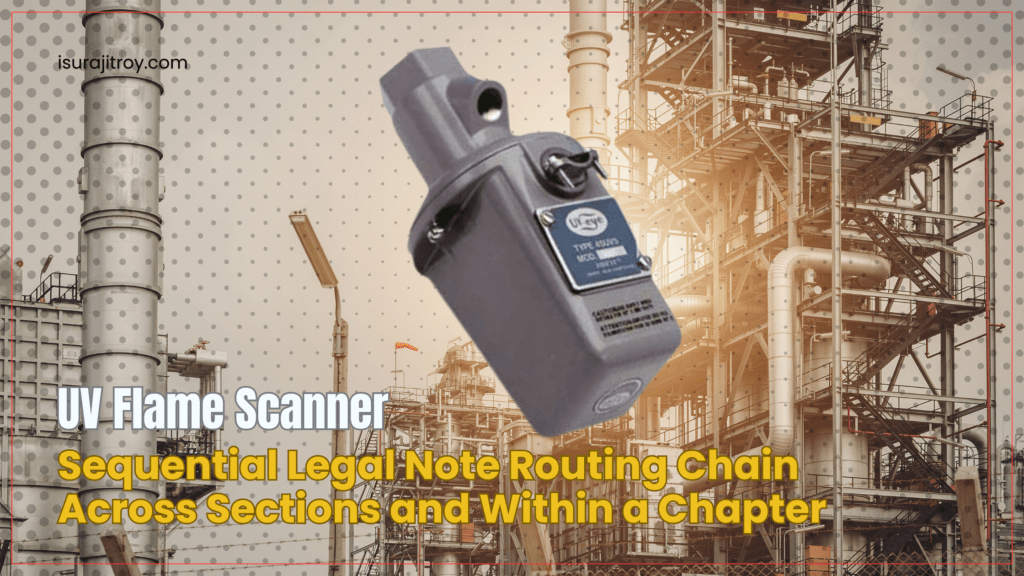
A UV flame scanner that detects ultraviolet light from a burner flame and sends an electrical signal to a separate controller is classified in heading 90.31 (measuring or checking instruments), subheading 9031.49. Two legal notes decide it, in order. Note 1(m) to Section XVI removes articles of Chapter 90 from Chapters 84 and 85, so heading 84.71 is out. Note 5 to Chapter 90 then sends optical measuring or checking instruments from heading 90.13 to heading 90.31. The Canada Border Services Agency (CBSA) reached this result in an advance ruling, at tariff item 9031.49.90.00 of the Canadian Customs Tariff.
The goods are two models of ultraviolet flame scanner made by Fireye (Derry, NH, USA): the Model 45UV5-1009 UV Self-check Flame Scanner and the Model UV1A6 UV Flame Scanner. Both are industrial safety monitoring devices used in boilers, dryers, mining operations, mineral processing, steel mills, and pulp and paper mills.
Each device is a sealed unit holding a viewing tube filled with ultraviolet-sensitive gas, with two electrodes. When UV radiation from a flame falls on the gas, the gas becomes conductive and an electrical circuit forms between the two electrodes. The resulting signal goes by wire to a separate control device. The scanner indicates the presence, absence and intensity of the flame it monitors.
The only difference between the two models is that the self-check model (45UV5-1009) has a mechanical flap that can block the viewing tube to verify that the device is working. In effect, it is a built-in self-test.
The device has no internal data processing, no software and no display. It is a passive optical sensing instrument that converts UV radiation into an electrical signal for an external control system.
Competing headings
Heading 84.71: “Automatic data processing machines and units thereof; magnetic or optical readers, machines for transcribing data onto data media in coded form and machines for processing such data, not elsewhere specified or included.”
The argument for 84.71 is that the device is optical (it detects UV light) and might be read as an “optical reader” under the broad wording of the heading. The heading covers “optical readers” and “machines for processing data”, and the flame scanner detects an optical signal (UV radiation) and turns it into an electrical output.
EN 84.71 covers optical readers designed to transcribe or process data, and the heading in general covers machines that handle information in coded form.
Heading 90.13: “Lasers, other than laser diodes; other optical appliances and instruments, not specified or included elsewhere in this Chapter.”
The argument for 90.13 is that the flame scanner is an optical instrument: it uses a UV-sensitive gas tube to detect UV light emitted by flames. Heading 90.13 is the residual heading in Chapter 90 for optical appliances and instruments not covered elsewhere in the chapter, so a device that detects UV light could be an “other optical appliance”.
EN 90.13 covers other optical appliances and instruments not specified or included elsewhere in Chapter 90. It also says that “in accordance with Chapter Note 5, measuring or checking optical appliances, instruments and machines are excluded from this heading and fall in heading 90.31.”
Heading 90.31: “Measuring or checking instruments, appliances and machines, not specified or included elsewhere in this Chapter; profile projectors.”
The argument for 90.31 is that the flame scanner measures or checks the presence, absence and intensity of UV light from a flame. It monitors a physical parameter (UV radiation intensity) and produces an electrical signal that corresponds to the state of the flame. Heading 90.31 is the residual heading in Chapter 90 for measuring or checking instruments not covered by the specific headings 90.15 to 90.30.
EN 90.31 says the heading covers “measuring or checking instruments, appliances and machines, whether or not optical.” The Explanatory Note on the optical instruments of subheading 9031.49 says the term covers “not only instruments and appliances which provide a direct aid or enhancement to human vision, but also other instruments and apparatus which function through the use of optical elements or processes.”
The conflict
Three headings are eliminated in sequence, and the sequence is set by legal notes in two Sections and within one Chapter. No heading can be judged on its own; each has to be tested in the order the notes dictate.
The order is:
- Note 1(m) to Section XVI says: “This Section does not cover: … (m) Articles of Chapter 90.” If the flame scanner is an article of Chapter 90, it is excluded from the whole of Section XVI, and heading 84.71 is gone before its terms are even tested.
- Note 5 to Chapter 90 says: “Measuring or checking optical instruments, appliances or machines which, but for this Note, could be classified both in heading 90.13 and in heading 90.31 are to be classified in heading 90.31.” If the flame scanner is an optical instrument that also measures or checks, this note moves it from 90.13 to 90.31. The rule is mandatory and operates within the Chapter.
The case is settled under GIR 1 (the Canadian General Interpretive Rules correspond to the GRIs of the Harmonized System) by applying these two notes in turn. No GIR 3 analysis is needed. The difficulty is getting the sequence right and treating each note as binding. A classifier cannot treat them as optional aids to reasoning.
Analysis and resolution
Step 1: GIR 1, is the flame scanner an article of Chapter 90? (Note 1(m) to Section XVI)
Before heading 84.71 is considered, Note 1(m) to Section XVI must be tested. If the flame scanner is an article of Chapter 90, it is outside Section XVI altogether, and heading 84.71 is unavailable whatever its text might seem to cover.
The flame scanner is an optical instrument designed to measure or check the presence, absence and intensity of UV light from a flame. Chapter 90 covers “optical, photographic, cinematographic, measuring, checking, precision, medical or surgical instruments and apparatus.” The General EN to Chapter 90 describes the chapter’s instruments as characterised by their precision and used for specialised technical or industrial purposes, including measuring and checking.
The flame scanner:
- is optical, because it works by detecting UV radiation in a UV-sensitive gas tube;
- measures or checks, because it indicates the presence, absence and intensity of a flame;
- is used for specialised industrial purposes, in boilers, dryers, steel mills, and pulp and paper mills.
The device is within the scope of Chapter 90, so Note 1(m) to Section XVI excludes it from the whole of Section XVI.
Heading 84.71 also fails on its own terms. The flame scanner does not process data. It converts UV radiation into an electrical signal, but it does not store programs, perform arithmetical computations or execute programs that require logical decisions. It does not transcribe data onto data media in coded form, and it does not read data in the ADP sense. The CBSA ruling said: “The goods do not process data. The device is optical in nature, however the function of the device does not allow it to transcribe, read, or process data.”
Result: heading 84.71 is eliminated, by Note 1(m) to Section XVI and by failing the heading text.
Step 2: GIR 1 within Chapter 90, heading 90.13 or heading 90.31 (Note 5 to Chapter 90)
Once the flame scanner is an article of Chapter 90, the question is which heading of the chapter applies.
Heading 90.13 is the residual heading for optical appliances and instruments “not specified or included elsewhere in this Chapter.” The flame scanner is an optical instrument because it detects UV light, so at first sight it could be an “other optical appliance” of heading 90.13.
Note 5 to Chapter 90 changes that:
“Measuring or checking optical instruments, appliances or machines which, but for this Note, could be classified both in heading 90.13 and in heading 90.31 are to be classified in heading 90.31.”
The note is a mandatory rule within the Chapter. It applies when three conditions are met together:
- The instrument is optical. The flame scanner detects UV light with an optical gas tube.
- The instrument measures or checks. The flame scanner checks whether a flame is present and measures its intensity.
- Without the note, the instrument could be classified in both 90.13 and 90.31. It is an optical instrument (90.13) that measures or checks (90.31), and the ruling did not place it in any earlier heading (90.15 to 90.30).
All three conditions are met, so Note 5 sends the scanner from heading 90.13 to heading 90.31.
The CBSA ruling confirmed: “Chapter 90 Legal Note 5 directs classification to heading 90.31: ‘Measuring or checking optical instruments, appliances or machines which, but for this Note, could be classified both in heading 90.13 and in heading 90.31 are to be classified in heading 90.31.'”
Result: heading 90.13 is eliminated by Note 5 to Chapter 90, and the flame scanner falls in heading 90.31.
Step 3: GIR 6, subheadings within heading 90.31
With the heading fixed at 90.31, GIR 6 decides the subheading.
One-dash subheading 9031.4x, “Other optical instruments and appliances”. The flame scanner is an optical instrument (a UV-sensitive gas tube detector), so it meets the terms of this subheading.
Two-dash subheading 9031.41, “For inspecting semiconductor wafers or devices (including integrated circuits) or for inspecting photomasks or reticles used in manufacturing semiconductor devices”. The flame scanner is not used to inspect semiconductors, so this subheading does not apply.
Two-dash subheading 9031.49, “Other”. The scanner falls in this residual subheading. The Explanatory Note quoted above says the optical instruments covered here include “not only instruments and appliances which provide a direct aid or enhancement to human vision, but also other instruments and apparatus which function through the use of optical elements or processes.” The flame scanner works through an optical process (UV radiation detection) and belongs here.
Final classification
9031.49.90.00 (Canadian Customs Tariff): Measuring or checking instruments, appliances and machines, not specified or included elsewhere in this Chapter; profile projectors: Other optical instruments and appliances: Other: Other.
Decided by GIR 1 (Note 1(m) to Section XVI eliminates heading 84.71; Note 5 to Chapter 90 moves the scanner from 90.13 to 90.31) and GIR 6 (subheadings down to 9031.49.90).
Authority: CBSA Advance Ruling 8000010574 (November 26, 2025), UV flame scanners, classified in 9031.49.90.00.
Key classification principles
- Note 1(m) to Section XVI is a threshold exclusion, tested before any heading of Chapter 84 or 85. When a product is an article of Chapter 90 (optical, measuring, checking, precision or medical instruments), it is excluded from the whole of Section XVI, including heading 84.71 (ADP machines), heading 85.25 (cameras) and every other heading of Chapters 84 and 85. This applies even when the product seems to match a Section XVI heading text. The test is “Is this an article of Chapter 90?” If the answer is yes, Section XVI is closed. A similar cross-Section exclusion decides the infrared video goggles case study.
- Note 5 to Chapter 90 settles the overlap between 90.13 and 90.31 for optical measuring or checking instruments. Both headings are residual and use “not specified or included elsewhere” wording. For an instrument that is optical and also measures or checks, Note 5 sends it to 90.31. The classifier has no discretion here: the note binds whenever both headings could otherwise apply.
- “Measuring or checking” in heading 90.31 includes monitoring whether a physical condition is present. The flame scanner does not produce a numerical measurement in the usual sense; it checks for the presence, absence and intensity of UV radiation from a flame. The “checking” function of heading 90.31 covers yes/no detection (presence or absence) and qualitative assessment (intensity) as well as quantitative measurement with a numerical output. An instrument that indicates whether a condition exists is “checking” within heading 90.31.
- An optical detector that converts light into an electrical signal is not an “optical reader” of heading 84.71. “Optical readers” in heading 84.71 are devices that read coded data (barcodes, optical character recognition, marks on machine-readable forms) and put it into a form an ADP machine can process. A UV flame sensor that detects radiation and produces a simple electrical signal is detecting light. It is not reading or processing data. Reading coded information belongs in 84.71; sensing a physical phenomenon belongs in Chapter 90.
- The Explanatory Note on the optical instruments of subheading 9031.49 reaches beyond instruments that aid human vision. It includes instruments that use optical elements or processes to measure or check, even when the output is an electrical signal and not a visual image. A UV gas-discharge tube that detects radiation through an optical process and gives an electrical output is within that scope. For how Chapter 90’s notes also decide when an article is a part of an instrument, see the case study on Note 2(b) to Chapter 90.
Summary table: how two legal notes route the UV flame scanner
| Heading | Why it is considered | Result and reason |
| Heading 84.71 (ADP machines; optical readers) | The device is optical (detects UV light); heading 84.71 covers “optical readers” and “machines for processing data”; the scanner converts an optical signal (UV radiation) into an electrical output | Rejected. Note 1(m) to Section XVI excludes all articles of Chapter 90 from Section XVI, and the flame scanner is an optical measuring or checking instrument of Chapter 90; separately, the device does not process, transcribe, read or store data in the ADP sense |
| Heading 90.13 (Other optical appliances and instruments, not elsewhere specified) | The device is an optical instrument that detects UV light with a UV-sensitive gas tube and two electrodes; heading 90.13 is the residual heading for optical instruments not covered elsewhere in Chapter 90 | Rejected. Note 5 to Chapter 90 requires measuring or checking optical instruments that could fall in both 90.13 and 90.31 to be classified in 90.31; the flame scanner checks flame presence and intensity, so Note 5 sends it to 90.31 |
| Heading 90.32 (Automatic regulating or controlling instruments) | The device monitors the flame and sends signals to a separate control device; it could be seen as part of an automatic control system for industrial burners | Not applicable. The flame scanner itself does not regulate or control; it only detects and signals. The separate control device, not imported with the scanner, does the regulating or controlling. The scanner is a measuring or checking instrument, not a controller |
| Heading 90.31, sub. 9031.49 (Measuring or checking instruments: other optical) | The device is an optical instrument (UV gas-discharge tube) that measures or checks the presence, absence and intensity of UV light from flames; it is not specified elsewhere in Chapter 90; the EN covers apparatus working through optical processes | Classified here under GIR 1 and GIR 6. Note 1(m) to Section XVI sends it to Chapter 90; Note 5 to Chapter 90 moves it from 90.13 to 90.31; under GIR 6 it is an optical instrument (9031.4x), not for semiconductor inspection (not 9031.41), so it falls in the residual 9031.49.90 |
Conclusion
Three headings are eliminated in sequence by two legal notes (Note 1(m) to Section XVI and Note 5 to Chapter 90). The first moves the product from Chapter 84 to Chapter 90, the second moves it from heading 90.13 to heading 90.31, and GIR 6 then takes it through two subheading levels to the residual 9031.49.90. The difficulty lies in the order: the product is tested against Note 1(m) first and Note 5 second, and each note is a one-way gate that reading the heading texts alone cannot get around. For the order in which GRI 1, the notes and the later rules apply, see this practical guide to the GRIs.