
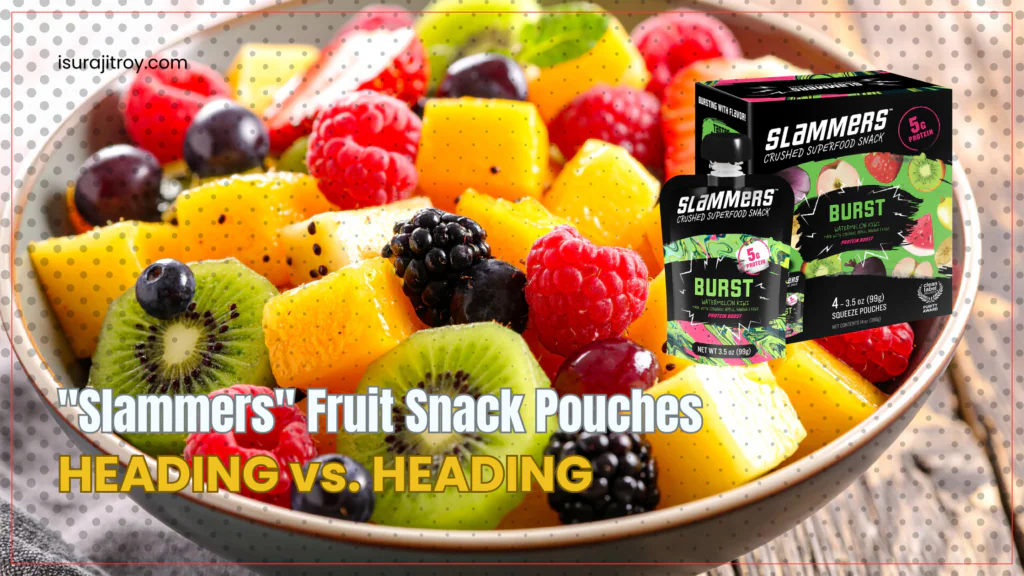
Fruit puree pouches for children are not “homogenised composite food preparations” of heading 21.04 unless they meet all three conditions in Note 3 to Chapter 21. In HQ H314968 (March 15, 2021), US Customs and Border Protection (CBP) found that the “Slammers” pouches met two of the three but were not put up for retail sale as food for infants or young children, or for dietetic purposes. Heading 21.04 was therefore out, and the pouches were classified in heading 20.08 (fruit otherwise prepared or preserved), subheading 2008.97 (mixtures).
The goods are five varieties of fruit-based snack foods sold under the “Slammers” brand: Awesome Acai Strawberry Apple, Epic Orange Mango, Yumberry Banana Blueberry, Pomegranate Grape Crush, and Watermelon Kiwi Crush. Each is made of fruit and vegetable purees, juice concentrates and other ingredients, and is manufactured in Canada by blending, homogenization and pasteurization.
All five products are mostly fruit. The main ingredients by weight are organic apple puree and organic banana puree. The secondary ingredients, each 10% or less by weight, are other fruit purees (blueberry, strawberry, acai, mango), vegetable purees (beet, carrot, butternut squash), juice concentrates (lemon, grape, pomegranate, watermelon) and supplements (amaranth flour, whey protein isolate, Wellmune beta glucan, natural flavors).
The products are hot-filled into 90-gram laminated PET/AL/PE pouches, sealed with a plastic twist-off lid, cooled, and packed four to a box for retail sale. They are marketed as “superfood snacks” for children. The marketing is aimed at school-age children, teenagers and people of all ages, and not at infants or young children (0–24 months). That fact decides the case.
The applicant classified the products in heading 21.04 as homogenized composite food preparations. CBP found that classification incorrect.
Competing headings
Heading 21.04: “Soups and broths and preparations therefor; homogenised composite food preparations.”
The applicant argued that the products are finely homogenized mixtures of two or more basic fruit and vegetable ingredients, packed in 90-gram pouches (under 250 g), and sold at retail as food for children. On that view they belong in subheading 2104.20 as “homogenised composite food preparations”.
Note 3 to Chapter 21 defines “homogenised composite food preparations” for heading 21.04 as “preparations consisting of a finely homogenised mixture of two or more basic ingredients such as meat, fish, vegetables, fruit or nuts, put up for retail sale as food suitable for infants or young children or for dietetic purposes, in containers of a net weight content not exceeding 250 g.”
EN 21.04(B) adds that these preparations “are generally used as food suitable for infants or young children and take the form of a smooth paste, of varying consistency, suitable for consumption either directly or after re-heating. They are usually put up in airtight jars or cans in a quantity generally corresponding to one whole meal.”
Heading 20.08: “Fruit, nuts and other edible parts of plants, otherwise prepared or preserved, whether or not containing added sugar or other sweetening matter or spirit, not elsewhere specified or included.”
CBP’s position was that the products are fruit preparations made mostly of fruit puree. They are homogenized fruit preparations, but they are not homogenised composite food preparations of heading 21.04, because they fail the three-part cumulative test in Note 3 to Chapter 21. With heading 21.04 ruled out, the products fall in heading 20.08 as fruit otherwise prepared or preserved.
EN 20.08 covers “fruit, nuts and other edible parts of plants, whether whole, in pieces or crushed, including mixtures thereof, prepared or preserved otherwise than by any of the processes specified in other Chapters or in the preceding headings of this Chapter.” It also says: “Other substances (e.g., starch) may be added to the products of this heading, provided that they do not alter the essential character of fruit, nuts or other edible parts of plants.” The General EN to Chapter 20 says the chapter covers “homogenised prepared or preserved vegetables and fruit.”
The conflict
Both headings have a plausible textual claim. Heading 21.04 covers homogenized composite food preparations, and the Slammers are finely homogenized fruit and vegetable mixtures in small pouches. Heading 20.08 covers fruit otherwise prepared or preserved, and the Slammers are fruit preparations.
Even so, there is no GRI 3 contest here. The question is settled under GRI 1 by Note 3 to Chapter 21, which sets a binding three-part cumulative test. Heading 21.04 applies only if all three parts are met.
Two notes work together:
- Note 3 to Chapter 21 sets the test for heading 21.04, and all three criteria must be met.
- Note 1(e) to Chapter 20 excludes “homogenised composite food preparations of heading 21.04” from Chapter 20, but it excludes only goods that actually qualify under heading 21.04.
If the product fails the Note 3 test, it does not qualify for heading 21.04, and Note 1(e) to Chapter 20 does not exclude it from Chapter 20. It then falls in heading 20.08 as a fruit preparation.
So the deciding question is whether the Slammers meet all three requirements of Note 3 to Chapter 21.
Analysis and resolution
Step 1: GRI 1 and the three-part test in Note 3 to Chapter 21
Note 3 to Chapter 21 defines “homogenised composite food preparations” for heading 21.04 as preparations that meet three requirements at once.
(1) A finely homogenised mixture of two or more basic ingredients such as meat, fish, vegetables, fruit or nuts
The Slammers are finely homogenized mixtures of several fruit and vegetable purees (apple, banana, mango, blueberry, beet, carrot and others). They are blended, homogenized and pasteurized in Canada.
Result: criterion 1 is met.
(2) Put up for retail sale as food suitable for infants or young children or for dietetic purposes
This is where the classification turns. “Infants” and “young children” are not defined in the HTSUS or in the Harmonized System ENs for Chapter 21. CBP has defined them by reference to Note 6(a) to Chapter 61 (apparel), which says: “the expression ‘babies’ garments and clothing accessories’ means articles for young children of a body height not exceeding 86 centimetres.” CBP reads this as children aged 0–24 months.
CBP has used the same apparel-based definition for food. In HQ W967962 it classified Cerelac (wheat cereal with milk) as a preparation for infants on that basis.
Applied to the Slammers, the products are not put up for retail sale as food suitable for infants or young children (0–24 months):
- The manufacturer’s website shows photos of older children and teenagers, and none of children aged 0–24 months.
- The marketing says the products are “appealing to kids beyond the preschool years”.
- A testimonial on the website describes a mother giving Slammers to her 12-year-old daughter and 8-year-old son for sports activities.
- The same testimonial says: “When my kids were little, they loved applesauce pouches, so Slammers was an easy sell to them”. That sets the Slammers apart from infant-stage food.
- The website says the products are suitable for people of all ages.
- “Baby Gourmet” is the name of the parent company, not the target age group of this product line.
Nor are the Slammers put up for retail sale as food for dietetic purposes. Nothing in the labelling, marketing or formulation shows that they are intended for, or suitable for, dietetic use.
Result: criterion 2 is not met. The Slammers are marketed and put up for retail sale as superfood snacks for school-age children and general consumers, not for infants or young children (0–24 months) and not for dietetic purposes.
(3) In containers of a net weight content not exceeding 250 g
The Slammers are packed in 90-gram laminated pouches, well under the 250 g limit.
Result: criterion 3 is met.
Step 2: Note 3 is not satisfied
The Slammers meet criteria 1 and 3 and fail criterion 2. Note 3 to Chapter 21 is cumulative: all three criteria must be met together. If any one fails, the product is not a “homogenised composite food preparation” for heading 21.04.
Result: heading 21.04 is ruled out. The Slammers cannot be classified as homogenised composite food preparations.
Step 3: GRI 1, heading 20.08 covers the product
With heading 21.04 ruled out, Note 1(e) to Chapter 20, which excludes “homogenised composite food preparations of heading 21.04” from Chapter 20, does not apply. The Slammers are not goods of heading 21.04, so Chapter 20 is open to them.
Heading 20.08 covers “Fruit, nuts and other edible parts of plants, otherwise prepared or preserved, whether or not containing added sugar or other sweetening matter or spirit, not elsewhere specified or included.”
The Slammers fit each part of that text:
- They are fruit preparations, made mostly of fruit purees (apple, banana, mango, blueberry, strawberry, acai and others).
- They are otherwise prepared: blended, homogenized and pasteurized.
- They are not elsewhere specified or included. Heading 21.04 has been ruled out, and heading 20.07 (jams and purées obtained by cooking) was not considered by CBP for the finished product. CBP did classify the imported single-fruit purées used as ingredients in subheading 2007.99; the finished pouches, which mix several purées with juice concentrates, flour, whey protein and other ingredients, were placed in 20.08 without discussion of 20.07.
EN 20.08 supports this: “Other substances (e.g., starch) may be added to the products of this heading, provided that they do not alter the essential character of fruit.” The non-fruit ingredients in the Slammers (amaranth flour, whey protein, beta glucan, vegetable purees) are each under 10% by weight and do not change the essential character of the fruit purees.
The General EN to Chapter 20 includes “homogenised prepared or preserved vegetables and fruit”. A product can be homogenized and still fall in Chapter 20 if it does not meet the Note 3 requirements for heading 21.04.
Result: the Slammers are classified in heading 20.08, subheading 2008.97 (mixtures).
Final classification
2008.97: Fruit, nuts and other edible parts of plants, otherwise prepared or preserved: Other, including mixtures other than those of subheading 2008.19: Mixtures.
Decided by GRI 1: the Note 3 test to Chapter 21 fails at criterion 2, Note 1(e) to Chapter 20 does not exclude the product, and heading 20.08 describes it.
Authority: CBP Headquarters Ruling HQ H314968 (March 15, 2021), Slammers Fruit Snack Pouches, classified in HTSUS 2008.97.10 / 2008.97.90 (2008.97.10 for goods in airtight containers). CBP affirmed that ruling on reconsideration in HQ H322781 (August 5, 2022).
Classification principles from this ruling
- Note 3 to Chapter 21 is a binding three-part cumulative test, and failing any one part rules out heading 21.04. A product must be (1) a finely homogenized mixture of two or more basic ingredients, (2) put up for retail sale as food suitable for infants or young children or for dietetic purposes, and (3) in containers not exceeding 250 g. Two out of three is not enough. Either all three are met and heading 21.04 is available, or one fails and it is not.
- For CBP, “infants or young children” in Note 3 to Chapter 21 means children aged 0–24 months. CBP takes this from Note 6(a) to Chapter 61 (body height not exceeding 86 cm, read as 0–24 months) and has applied it to food (HQ W967962). Marketing to school-age children, teenagers or “all ages” does not meet the criterion, even if young children could physically eat the product. Other customs administrations may read the term differently.
- “Put up for retail sale as” is a test of marketing and presentation. The question is whether the product is put up for retail sale as food suitable for that age group, and whether a young child could eat it does not answer that. Marketing materials, labelling, website images, descriptions of the target audience and testimonials are all relevant evidence. A product marketed to 8 to 12 year olds and “all ages” fails the criterion whatever its physical form.
- Homogenization alone does not send a fruit preparation to heading 21.04. A finely homogenized product can still be classified in Chapter 20, and the General EN to Chapter 20 expressly includes “homogenised prepared or preserved vegetables and fruit”. Homogenization appears in both Chapter 20 and heading 21.04; what separates them is whether the Note 3 test is fully met.
- Note 1(e) to Chapter 20 and Note 3 to Chapter 21 work as a pair. Note 1(e) excludes “homogenised composite food preparations of heading 21.04” from Chapter 20, but only products that meet the Note 3 definition are caught. If Note 3 is not met, the product is not “of heading 21.04”, and Note 1(e) does not exclude it from Chapter 20. The two notes are read together.
Summary table: the homogenized pouch that fails the baby food test
| Heading | Why it is considered | Result and reason |
| Heading 21.04, sub. 2104.20 (Homogenised composite food preparations) | The product is a finely homogenized mixture of fruit and vegetable purees in 90 g pouches (under 250 g); it meets criterion 1 (homogenized mixture) and criterion 3 (container size) of Note 3 to Chapter 21 | Rejected. It fails criterion 2 of Note 3: it is not put up for retail sale as food suitable for infants or young children (0–24 months) or for dietetic purposes, and is marketed to school-age children, teenagers and “all ages”. Note 3 is cumulative, so failing one criterion rules out heading 21.04 |
| Heading 20.07 (Jams, fruit purées, fruit pastes obtained by cooking) | The product consists of processed fruit purees (blended, homogenized, pasteurized) and could be seen as a fruit purée | Not considered by CBP for the finished product, although CBP classified the imported single-fruit purées used as ingredients in 2007.99. The finished pouches are mixtures with juice concentrates, flour, whey protein and other ingredients. |
| Heading 20.08, sub. 2008.97 (Fruit otherwise prepared or preserved: mixtures) | The products are fruit preparations made mostly of fruit puree (apple, banana, mango and others), otherwise prepared by blending, homogenization and pasteurization, and not elsewhere specified or included | Classified here under GRI 1. Heading 21.04 is ruled out by Note 3; Note 1(e) to Chapter 20 does not exclude the product because it is not “of heading 21.04”; under EN 20.08, non-fruit ingredients under 10% do not alter the essential character of the fruit; the General EN to Ch. 20 covers “homogenised prepared or preserved fruit” |
| How the notes interact | Note 1(e) to Chapter 20 excludes “homogenised composite food preparations of heading 21.04”. Could it block Chapter 20? | No. Note 1(e) excludes only products that qualify under heading 21.04 through the Note 3 test; the Slammers fail criterion 2, so they are not “of heading 21.04” and Note 1(e) does not apply |
Conclusion
Two headings compete, and GRI 1 settles the case through a cumulative test in a chapter note. No GRI 3 analysis is needed. The hard parts are the undefined term “young children” (which CBP reads through the Chapter 61 apparel note), the weighing of marketing and presentation evidence, and the way Note 3 to Chapter 21 and Note 1(e) to Chapter 20 depend on each other. Another Chapter 21 boundary, this time decided by an exclusion in the Explanatory Notes, is analysed in the instant noodle soup case study, and a Chapter 20 juice dispute in When a Mandarin Is Not an Orange. For the order in which GRI 1 and the notes are applied, see this practical guide to the GRIs.