
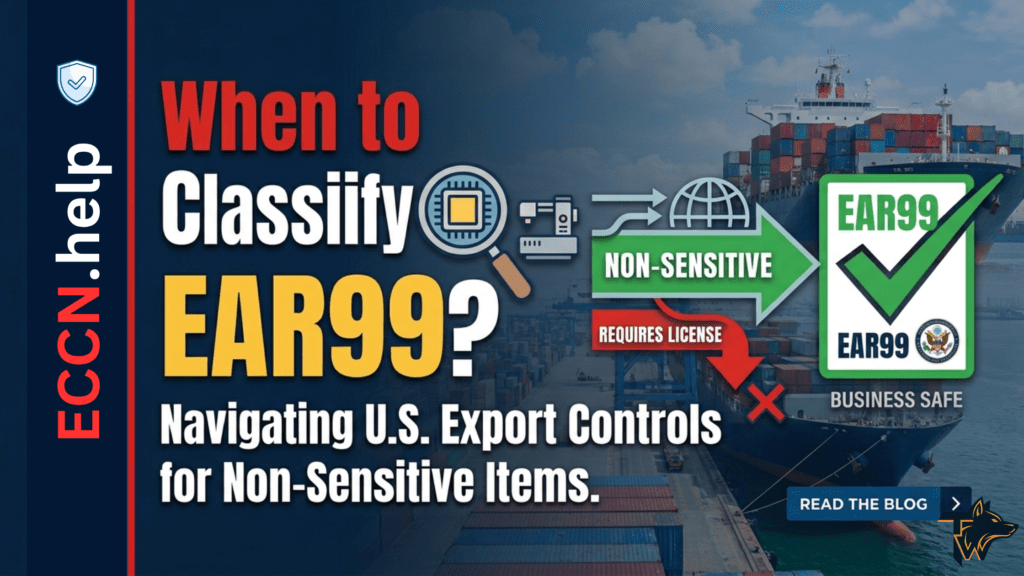
Classify an item as EAR99 only when two findings are on record: the item is subject to the Export Administration Regulations (EAR), and no entry on the Commerce Control List (CCL), including the temporary 0Y521 entries, describes it. EAR99 is a residual designation, so the work behind it is the elimination of every candidate ECCN against the item’s technical specifications. Even then, EAR99 does not clear the shipment: embargoes, restricted parties and prohibited end uses still apply.
EAR99 is also one of the most misunderstood designations in US export controls. This article sets out when to assign it, how to support it, and the mistakes that turn an innocent-looking EAR99 record into a violation. If you are new to ECCNs and the EAR, start with the beginner’s guide to the EAR, ECCNs and EAR99.
What does ECCN stand for, and where does EAR99 fit?
ECCN stands for Export Control Classification Number. It is the alphanumeric code for commodities, software and technology that are specifically described on the Commerce Control List, which the Bureau of Industry and Security (BIS) maintains as Supplement No. 1 to Part 774 of the EAR. Each ECCN sets out the technical characteristics that bring an item under control, the reasons for control (such as national security, missile technology or regional stability), and, through the Commerce Country Chart, the license requirements by destination.
Every ECCN follows the same format (15 CFR 738.2). The first digit (0–9) is the CCL category. The second character (A–E) is the product group: equipment, assemblies and components; test, inspection and production equipment; materials; software; or technology. The last three digits identify the entry and indicate the type of control.
EAR99 is not an ECCN. It is the residual designation for items that are subject to the EAR but not described by any ECCN. Section 734.3(c) of the EAR states that items subject to the EAR that are not listed on the CCL are designated EAR99, and an EAR99 entry appears at the end of each CCL category for items not elsewhere specified.
The distinction matters for how you work: an ECCN is a positive finding that the item meets a listed description, while EAR99 is what remains after you have shown that no ECCN applies.
The regulatory definition: what EAR99 means
An EAR99 classification makes three statements at once.
First, the item is subject to the EAR. If it is not, because another agency has jurisdiction (for example the State Department under the ITAR for items on the US Munitions List), because it is published technology or software excluded by Part 734, or because it is a foreign-made item without controlled US content above the de minimis levels, then EAR99 does not apply. You cannot call something EAR99 until you have confirmed that the EAR governs it.
Second, the item does not meet the parameters of any ECCN. This is the analytical core. It means reviewing every potentially applicable ECCN and comparing the item’s specifications with the control parameters, thresholds and definitions in those entries. Only when the item falls below every applicable threshold, or is not described anywhere on the CCL, is EAR99 the right answer.
Third, the item is not under a temporary 0Y521 control. Under 15 CFR 732.3(b)(4), BIS can place items in the 0Y521 series (0A521, 0B521, 0C521, 0D521 and 0E521) while it decides whether a new or revised ECCN, or an EAR99 designation, is appropriate. An item listed under 0Y521 is not EAR99.
How to find an ECCN, and when the answer is EAR99
Part 732 of the EAR lays out the steps for using the regulations, and Supplement No. 4 to Part 774 sets the CCL Order of Review. In practice the work runs in four steps.
- Confirm EAR jurisdiction. For items exported from the United States, almost all commodities, software and technology are subject to the EAR unless another agency controls them exclusively (most often the State Department, for defense articles on the USML). For foreign-made items, jurisdiction depends on controlled US-origin content and the foreign direct product rules, some of which turn on the end user.
- Identify the candidate ECCNs. Using the item’s specifications, function and design purpose, list every CCL entry that could describe it: read the headings and “Items” paragraphs of the relevant categories and product groups, and check the notes, related controls and related definitions.
- Compare against the technical parameters. For each candidate, test the item’s actual specifications against the thresholds in the entry. Watch for defined terms (words in quotation marks have specific definitions in Part 772), technical notes, and exclusion notes, some of which designate particular items as EAR99.
- Confirm that no ECCN applies. If the item falls below all control thresholds, or is not described by any entry, the classification is EAR99.
Done by hand, this is slow for a company with a large and varied product range, which is why many compliance teams use classification software. ECCN.help is one such tool. It guides users through the CCL Order of Review, identifies candidate ECCNs from product descriptions and technical parameters, and records the regulatory reasoning for each result, including EAR99 determinations.
Common situations that end in EAR99
Many everyday commercial goods are EAR99. These are the typical cases.
Consumer electronics below control thresholds
A standard consumer laptop, smartphone or tablet that does not meet the parameters of the Category 4 (computers) or Category 5 (telecommunications and information security) ECCNs will often be EAR99. The check that matters is whether a specific threshold, such as Adjusted Peak Performance for computers or encryption functionality for information security items, triggers a controlled ECCN.
General industrial equipment
Standard commercial machinery, hand tools, office equipment and industrial supplies that are not described by any ECCN in Categories 1 to 9 are EAR99. A standard commercial bearing that does not meet the tolerance, speed or temperature specifications of ECCN 2A001 or 2A991, for example, would be EAR99.
Consumer goods and household products
Clothing, food, furniture, cosmetics and similar goods are generally EAR99 because nothing on the CCL describes them.
Items the CCL itself designates EAR99
Many notes in the CCL name specific items as EAR99. Note 6 to ECCN 0A501 says that antique firearms manufactured before 1890 and reproductions of them, muzzle-loading black powder firearms (except certain designs), BB guns, pellet rifles, paint ball guns and all other air rifles are EAR99. Note 8 to ECCN 0A501 designates scope mounts, accessory rails, iron sights, sling swivels, and butt plates or recoil pads as EAR99, and Technical Note 3 to the same entry does the same for blank firing adapters. A note like this is direct regulatory authority for the EAR99 result.
Category 2 has another example. ECCN 2A984 controls concealed object detection equipment operating between 30 GHz and 3000 GHz with a spatial resolution of 0.1 to 1 milliradian at 100 meters. Equipment in the same frequency range with a spatial resolution greater than 1 milliradian at 100 meters (a coarser image) is designated EAR99.
Software and technology below control thresholds
Software and technology that meet no “D” (software) or “E” (technology) ECCN are EAR99. That includes the low-level x990 and x991 series: those are ECCNs, so an item caught by one of them is not EAR99.
EAR99 does not mean “no restrictions”
This is the most dangerous misconception in export compliance: an EAR99 classification does not mean the item can go anywhere, to anyone, without a license.
General Prohibitions One to Three depend on the CCL entry and the Commerce Country Chart, so for EAR99 items they rarely produce a license requirement. General Prohibitions Four to Ten are written to cover items subject to the EAR generally, so they reach EAR99 items too. They deal with the following situations.
Restricted parties
Persons on the Denied Persons List are barred from export transactions, and many Entity List entries impose a license requirement for all items subject to the EAR, which includes EAR99 items, with review policies from case-by-case to a presumption of denial. The Unverified List works differently: under 15 CFR 744.15 an export to a UVL party that needs no license may proceed only after you obtain a signed UVL statement from that party, and license exceptions are restricted.
Prohibited end uses
EAR99 items cannot knowingly be exported for weapons of mass destruction, including nuclear, chemical and biological weapons programs, or for missile delivery systems. Part 744 imposes license requirements on EAR99 items when there is knowledge of such end uses.
Military end use and military end users
Under 15 CFR 744.21, any item subject to the EAR, EAR99 included, needs a license when you know it is intended for a military end use or military end user in Russia or Belarus. Applications are generally reviewed under a policy of denial, but food and medicine designated EAR99 are reviewed case by case. For Burma, Cambodia, China, Nicaragua and Venezuela, the same rule covers only the ECCNs listed in Supplement No. 2 to Part 744, which does not include EAR99.
Embargoed destinations
Part 746 of the EAR sets the embargo and special-control rules for countries such as Cuba, Iran, North Korea and Syria. Several of these require a license for EAR99 items as well as listed ones. Check the current section for the destination, because these rules change.
US person activities
Under certain provisions, US persons may not support proliferation activities even when the items involved are EAR99.
So after classifying an item as EAR99 you still need to screen every party against the restricted lists, assess the end use and end user, and confirm that no embargo or other prohibition applies.
EAR99 vs. ITAR: the jurisdictional boundary
Exporters often ask how EAR99 relates to the ITAR. The two cannot overlap: an item cannot be EAR99 and ITAR-controlled at the same time.
The International Traffic in Arms Regulations (ITAR), administered by the State Department’s Directorate of Defense Trade Controls (DDTC), govern defense articles, defense services and related technical data described on the US Munitions List (USML) in 22 CFR Part 121. An item described on the USML is subject to the ITAR and falls under State Department jurisdiction. It cannot have an ECCN or be EAR99.
EAR99 applies only to items subject to the EAR (Commerce Department jurisdiction) that are not listed on the CCL. The ITAR or EAR question must be settled before any ECCN or EAR99 decision.
If you are not sure which regime applies, 15 CFR 734.6 explains that you may ask BIS for an advisory opinion or a classification, and that you may ask DDTC for a formal jurisdiction determination (commonly called a commodity jurisdiction, or CJ, request).
Over the past decade the Export Control Reform (ECR) initiative moved many items from the USML to the CCL and created the “600 series” ECCNs for military items now under Commerce jurisdiction. Items that moved this way are classified under specific 600 series ECCNs; they are not EAR99. Some parts, components and accessories once assumed to be ITAR-controlled were found during ECR to need neither USML control nor a specific CCL entry, and those became EAR99.
Good practice for an EAR99 determination
Document the negative determination
Because EAR99 is residual, the file must show why the item falls outside every ECCN: which candidate ECCNs were considered, which technical parameters were tested, and why the item misses each controlled entry. A record that says only “EAR99” is a compliance risk. The same discipline applies on the customs side, as described in building an audit-proof HS classification file.
Get the technical specifications
Accurate classification needs accurate technical data, from the manufacturer or your engineering team. A generic product description is not enough. You need performance parameters, operating ranges, materials, tolerances and design purpose, which are the same parameters the CCL uses to define controlled items.
Read the notes and exclusions in each candidate ECCN
Many entries contain notes, technical notes and related-controls paragraphs that exclude certain items or send them to another entry or to EAR99. Read them closely; they can confirm or defeat a candidate classification.
Apply the “specially designed” definition
Part 772 of the EAR defines “specially designed” through a catch-and-release structure. An item that is not “specially designed” for a controlled application may fall outside an ECCN even if it looks like a controlled item. This analysis matters most for parts and components.
Re-evaluate periodically
Products change through updates, and BIS amends the CCL by rulemaking. An item correctly classified EAR99 two years ago may now fall under a new or revised ECCN, so schedule periodic reclassification reviews.
Use a classification tool as a check
Manual ECCN lookup across the whole CCL is error-prone, especially for complex or dual-use products. A purpose-built tool such as ECCN.help compares the product specifications against the CCL, lists the most relevant candidate ECCNs, and sets out the reasoning for an EAR99 result, which you can then review and keep on file.
How to get an ECCN from BIS
If you are unsure whether an item has a specific ECCN or is EAR99, you can ask BIS. Section 732.3(b)(2) says you have a right to request the classification of your item from BIS and that BIS has a duty to provide it. The procedure is in 15 CFR 748.3.
You submit a commodity classification request through SNAP-R (the Simplified Network Application Process Redesign). BIS reviews the technical specifications you provide and issues a classification: a specific ECCN or EAR99.
Two limits apply. A BIS classification answers only whether the item has a specific ECCN or is EAR99; under Section 748.3 it is not a US Government determination that the item is subject to the EAR in the first place. And it does not relieve you of the end-use, end-user and embargo rules that apply whatever the classification.
For companies with many items to classify, a tool such as ECCN.help can act as a first screen: it gives an initial assessment that helps the team decide which items need a formal BIS request and which can be self-classified on a clear technical analysis.
Where to look up ECCN information
The Commerce Control List is the primary source. BIS publishes an interactive CCL on its website that searches ECCN headings and subparagraphs by keyword; BIS guidance suggests finding possible matches by keyword and then opening each entry to compare the item’s specifications with the control parameters.
BIS export counselors answer classification questions, including whether an item falls under a specific ECCN or is EAR99.
The manufacturer or supplier often has the best technical data and may already hold a BIS classification for the product. Asking them for the ECCN is a common starting point, but the exporter remains responsible for the classification used in any transaction.
Classification software is the fourth option. ECCN.help, for example, can check a single ECCN, test whether an item qualifies as EAR99, or run a whole product catalog through export classification review.
Red flags: when an EAR99 classification may be wrong
Look again at an EAR99 determination in any of these situations.
- The item has clear military or strategic uses. If it is designed for, marketed to or commonly used in military, intelligence or weapons applications, EAR99 is unlikely to be right. Review the 600 series ECCNs, the “A018” entries and the USML carefully.
- The item uses advanced technology. Products with advanced capability in semiconductors, high-performance computing, encryption, sensors or aerospace components are more likely to have a specific ECCN. Commercial availability alone does not make a product EAR99.
- A CCL note says the item is “subject to the ITAR”. Some CCL entries state that items meeting certain criteria are subject to the ITAR. Such an item is outside EAR jurisdiction altogether, so it cannot be EAR99.
- The specifications sit just below a control threshold. A product update, software upgrade or configuration change could push it over the threshold and into a controlled ECCN.
- The customer or another party is on a restricted list. This does not change the classification, but it changes the license requirement: an EAR99 item going to an Entity List party may need a license reviewed under a presumption of denial.
Reporting EAR99 on export documents
Electronic Export Information (EEI) filed in the Automated Export System (AES) has its own reporting rules under the Foreign Trade Regulations and the EAR.
Section 732.5(a)(4) requires the correct ECCN or “EAR99” on the EEI filing for all licensed and license exception exports, and for No License Required (NLR) exports of items controlled for reasons other than, or in addition to, anti-terrorism. Section 758.1(g)(3) adds that for items going to China, Russia or Venezuela the ECCN must be reported whatever the reason for control.
The Destination Control Statement (DCS) must go on the commercial invoice when items on the CCL are shipped. Under 15 CFR 758.6(a) it is not required when the item is designated EAR99, or when the shipment may be made under License Exception BAG or GFT.