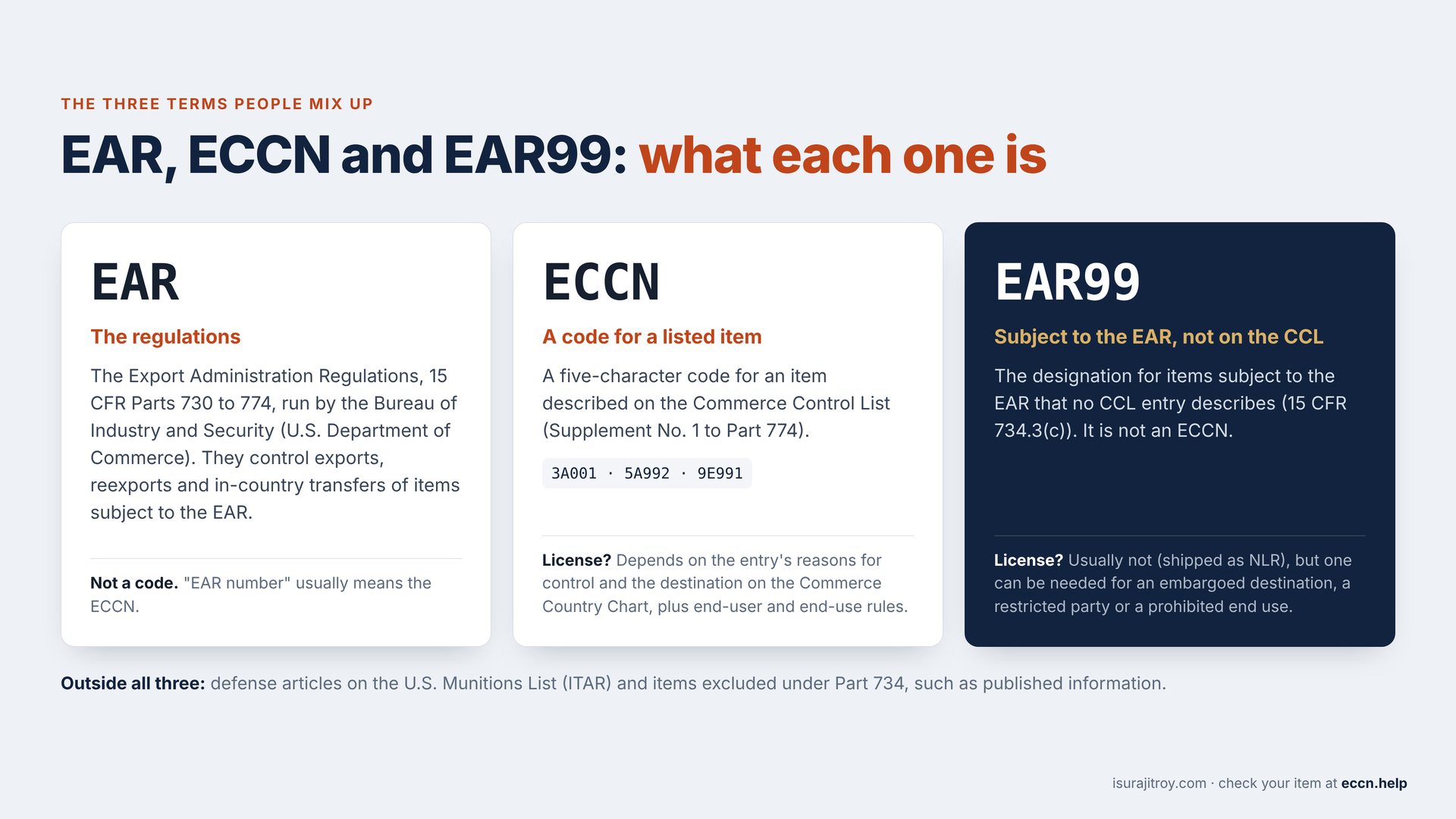
The Export Administration Regulations (EAR) are the US Department of Commerce rules that control exports, reexports and in-country transfers of most commercial and dual-use items. An Export Control Classification Number (ECCN) is a five-character code from the Commerce Control List (CCL) that identifies an item the EAR controls and the reasons it is controlled. EAR99 is the designation for items that are subject to the EAR but are not listed on the CCL. Whether a shipment needs a license depends on that classification together with the destination, the end user and the end use.
This guide is for readers meeting these terms for the first time, and for anyone who has been handed “ECCN: EAR99” on a purchase order and wants to know what it means. It answers three questions in order: does the EAR apply to my item, does the item have an ECCN or is it EAR99, and is a license required for this export? It ends with a walk-through of ECCN.help, the classification tool we built to work through those questions. For the harder question of when an EAR99 conclusion is defensible, see the companion article on when to classify an item as EAR99.
Does the EAR apply to my item?
Under 15 CFR 734.3(a), items subject to the EAR include all items in the United States (including those in a foreign trade zone or moving through the country), all US-origin items wherever they are, certain foreign-made items that incorporate controlled US-origin content above the de minimis levels, and certain foreign-produced direct products of specified US technology or software.
Some items are outside the EAR. The most important exclusion for most exporters is defense articles on the US Munitions List, which the State Department controls under the International Traffic in Arms Regulations (ITAR). ITAR and EAR are separate regimes, and an item subject to the ITAR is not subject to the EAR, so the jurisdiction question comes first. Published information and certain other technology and software are also excluded under Part 734.
If you are unsure, 15 CFR 734.6 explains that you may ask BIS for an advisory opinion or a classification, and that you may ask the State Department’s Directorate of Defense Trade Controls for a formal jurisdiction determination.
How an ECCN is built
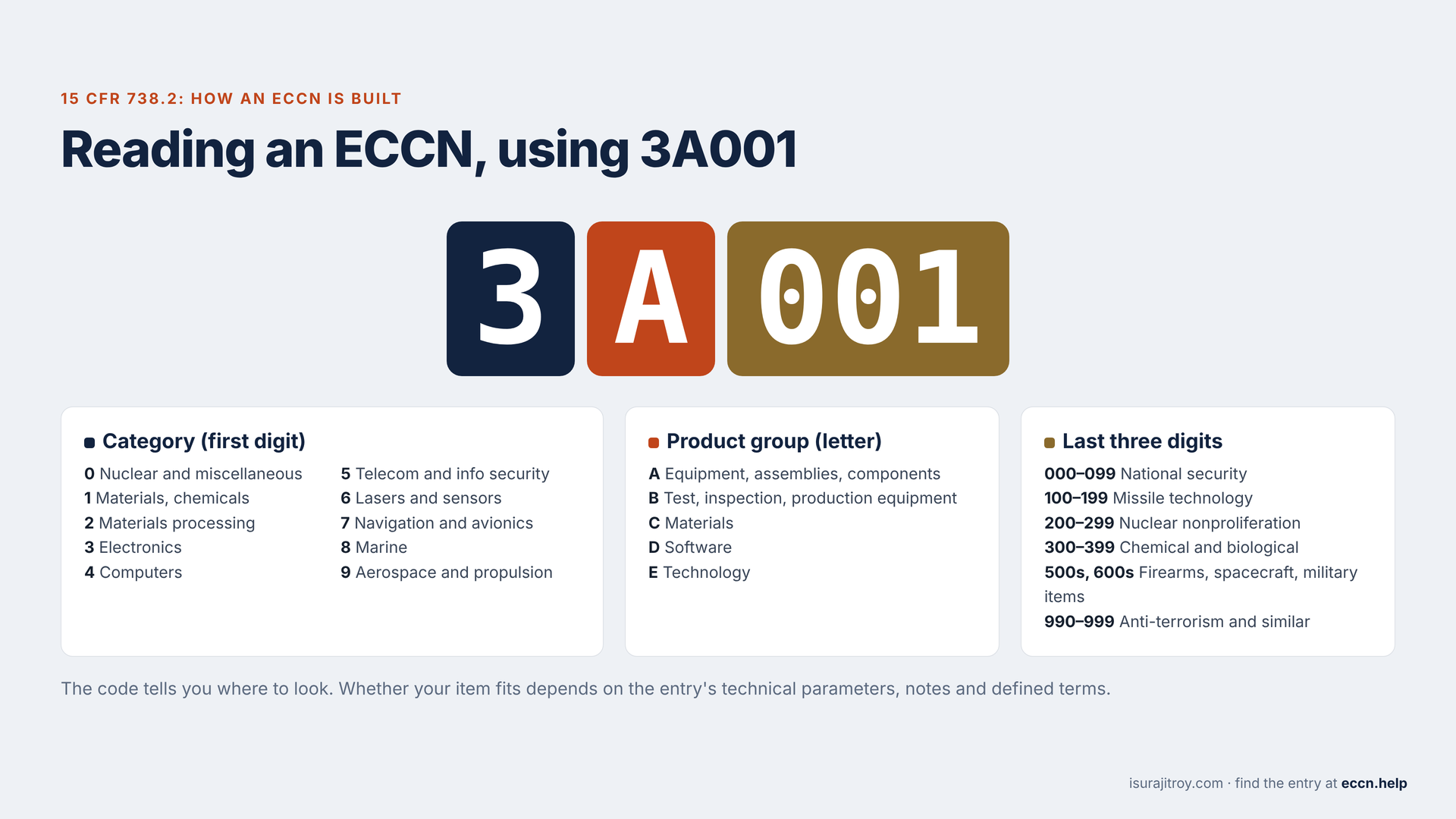
The CCL is Supplement No. 1 to Part 774 of the EAR. Under 15 CFR 738.2, every ECCN has the same structure. The first character is a digit for the category, the second is a letter for the product group, and the last three digits identify the entry. Those three digits also indicate the main reason for control: 000–099 for national security, 100–199 for missile technology, 200–299 for nuclear nonproliferation, 300–399 for chemical and biological weapons, and the 900 range for controls such as anti-terrorism. The “600 series” covers munitions items, many of them moved from the US Munitions List to the CCL.
| First character: category | Second character: product group |
| 0 Nuclear materials, facilities and equipment, and miscellaneous | A Equipment, assemblies and components |
| 1 Materials, chemicals, microorganisms and toxins | B Test, inspection and production equipment |
| 2 Materials processing | C Materials |
| 3 Electronics | D Software |
| 4 Computers | E Technology |
| 5 Telecommunications and information security | |
| 6 Lasers and sensors | |
| 7 Navigation and avionics | |
| 8 Marine | |
| 9 Aerospace and propulsion |
So 2B991 is a Category 2 (materials processing) entry in product group B (production equipment). The “99” in the second and third digits marks the whole entry as a unilateral control, in this case for anti-terrorism. Reading the code tells you where to look; it does not tell you whether your product meets the entry. That needs the full technical specification compared against the entry’s parameters, notes and defined terms (words in quotation marks are defined in Part 772).
People also search for an “EAR number”, an “EAR code” or an “EAR classification”. The EAR do not assign a separate number of that kind. What a buyer or forwarder usually wants is the ECCN, or the statement that the item is EAR99.
What EAR99 means
Items subject to the EAR that are not listed on the CCL are designated EAR99 (15 CFR 734.3(c)). It is the result you reach after confirming that the EAR applies and that no CCL entry describes the item. Under Step 6 of the order of review in Supplement No. 4 to Part 774, if the item is not described under any ECCN of any category of the CCL, it is EAR99.
Is EAR99 an ECCN?
No. EAR99 sits in the ECCN field of invoices and export filings, which is why it gets called one, but it is a designation for items that have no ECCN. “ECCN: EAR99” on a document means “subject to the EAR, not listed on the CCL”.
What is the difference between EAR and EAR99?
The EAR are the regulations, 15 CFR Parts 730 to 774. EAR99 is one possible classification result under those regulations. An item can be subject to the EAR and carry an ECCN, be subject to the EAR and be EAR99, or not be subject to the EAR at all (an ITAR defense article, for example).
EAR99 or an anti-terrorism-only ECCN such as 9E991?
Entries ending in 991 to 999, such as 3A991, 5A992 or 9E991, are listed on the CCL. 9E991, for example, covers technology for the development, production or use of equipment controlled by 9A991 or 9B991, and its reason for control is anti-terrorism (AT). Because it is listed, you check its reason for control against the Commerce Country Chart for each destination. An EAR99 item has no reason for control to check, because it is not on the list. The two get confused because both are low-control results, but they are classified differently and they are not interchangeable on export documents.
If a product is EAR99, are its drawings EAR99 too?
Not automatically. Drawings, specifications and manufacturing know-how are “technology”, and technology is classified on its own against the E groups of the CCL. If no E entry describes the drawing, it is EAR99 as well. If the drawing has been published in the sense of § 734.7, it may not be subject to the EAR at all. Classify the drawing as a separate item, and record why.
Can an ITAR item be EAR99?
No. EAR99 applies only to items subject to the EAR, and a defense article on the US Munitions List is subject to the ITAR instead. That is why jurisdiction has to be settled before you search the CCL. An “ITAR/EAR99” label on a document is a sign that someone has not settled it.
I export from outside the US. Does EAR99 still matter?
EAR99 is a US designation. If you reexport a US-origin item, or a foreign-made item that is subject to the EAR, the EAR still apply to it, so the EAR99 result and the license questions below still matter. Your own country’s export control law applies separately: an exporter in Singapore, India or the EU checks the item against that country’s control list as well, and a US EAR99 result does not settle that question.
Does an EAR99 item need an export license?
Most EAR99 shipments go out without a license, under the “No License Required” (NLR) designation. EAR99 still does not mean “no license ever”. An EAR99 item can need a license if it goes to an embargoed or specially sanctioned destination (Part 746), to a party on the Entity List or another restricted list, or to a prohibited end use such as weapons of mass destruction (Part 744). General Prohibitions Four to Ten in Part 736 apply to EAR99 items as they do to everything else.
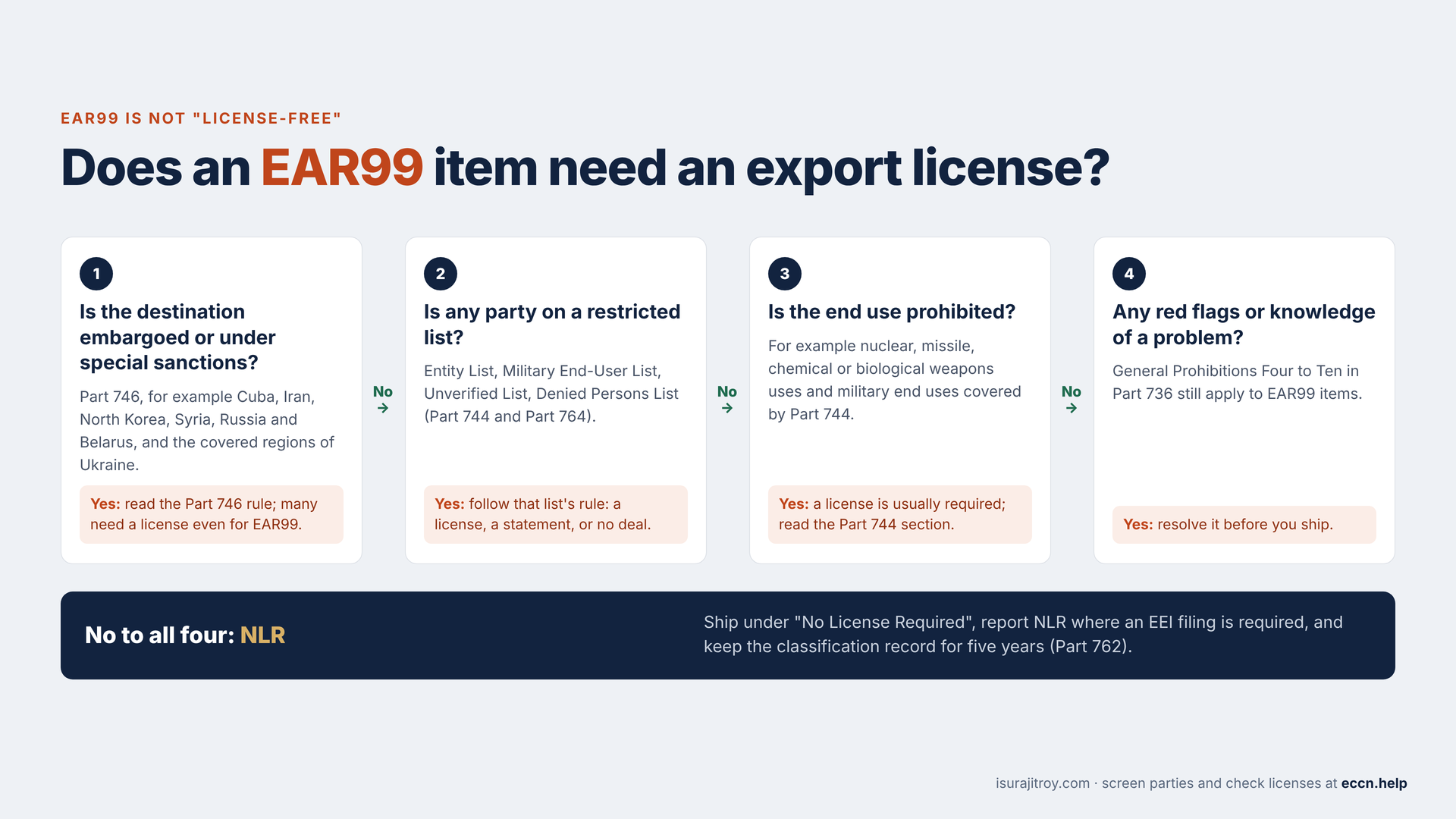
When no license is needed, the shipment goes out as NLR. Where an Electronic Export Information filing is required, the NLR designation is reported in AES (15 CFR 758.1). Keep the classification record: Part 762 requires export records to be kept for five years. The EAR99 article on this site sets out the prohibitions in more detail, with the red flags that suggest an EAR99 call is wrong.
Is a license required?
Part 732 of the EAR sets out the order of questions. In outline:
- Confirm the item is subject to the EAR.
- Classify it: find the ECCN, or conclude EAR99. Supplement No. 4 to Part 774 gives the order of review.
- For an ECCN, read its reasons for control and check them against the Commerce Country Chart (Supplement No. 1 to Part 738) for the destination. An “X” in the relevant column means a license is required unless a license exception in Part 740 applies.
- Whatever the classification, check the parties against restricted party lists, check the end use, and check whether the destination is embargoed (Parts 744 and 746).
- If nothing requires a license, the export goes as “No License Required” (NLR). Otherwise, apply for a license or use an eligible license exception.
The exporter is responsible for the classification and the license decision. Under 15 CFR 732.3(b) you may classify items yourself, and you also have a right to ask BIS for the classification, which BIS must provide. That request goes through SNAP-R under 15 CFR 748.3, and under § 750.2(a) BIS answers classification requests within 14 calendar days after receipt.
Finding the ECCN, or reaching EAR99, with ECCN.help
The first version of this article described our “Export Control Determination” tool. That tool is now ECCN.help, and the workflow has changed. ECCN.help is rule-based: it applies rules taken from the published EAR, with no language model and no machine learning, so the same item gets the same answer, and each answer names the entry and paragraph that decided it.
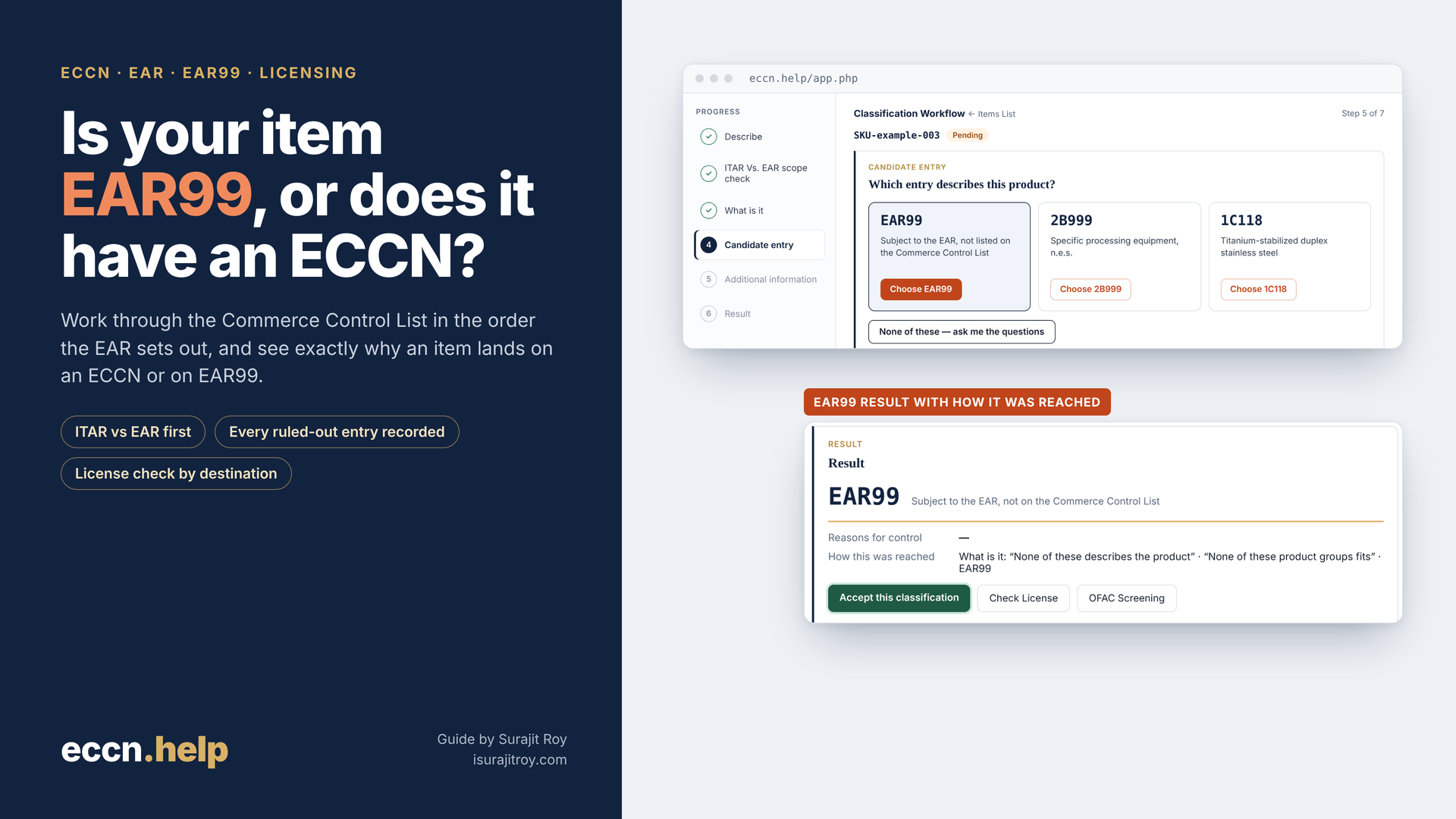
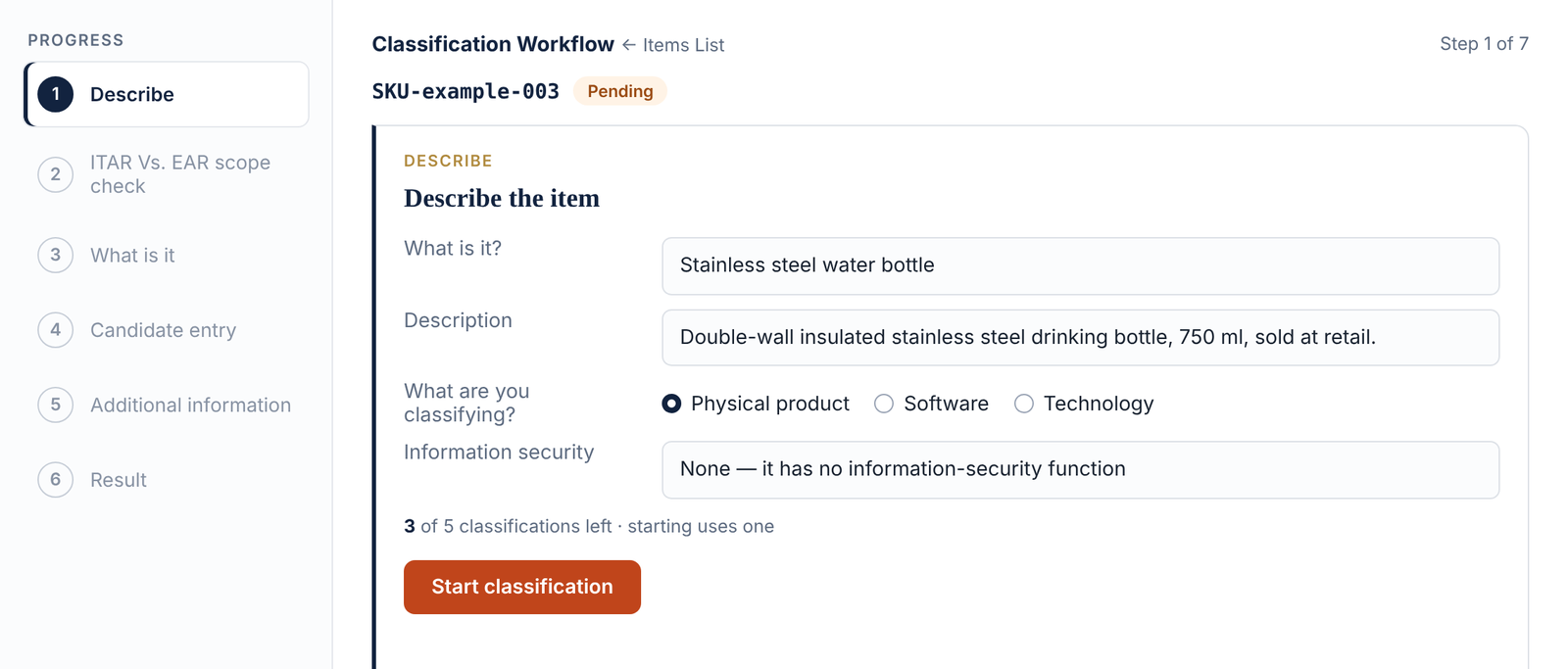
A classification goes through six stages, in the order a compliance officer would follow. The screens below are from the site’s worked example of a stainless steel water bottle, an item that ends up EAR99.
1. Describe the item
You name the item, describe it with its figures and units, say whether it is a physical product, software or technology, and say whether it has an information-security function. Use an ordinary product description and never enter controlled technical data.
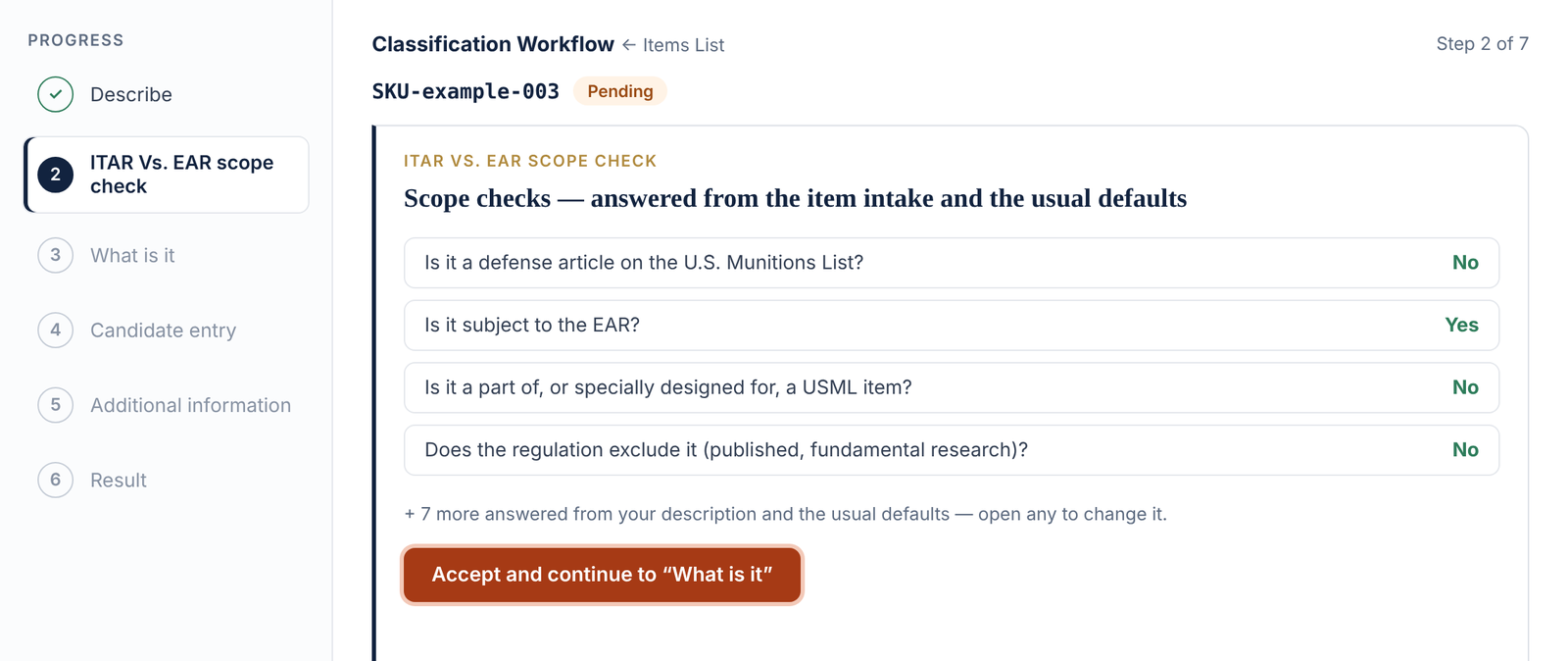
2. ITAR vs EAR scope check
Jurisdiction is settled first, as the order of review requires. The scope questions are pre-filled from your description and the usual defaults: is it a defense article on the US Munitions List, is it subject to the EAR, is it a part of or specially designed for a USML item, and does the regulation exclude it as published information or fundamental research. You check the answers and accept them. An item on the US Munitions List has no ECCN, and the tool says so instead of offering one.
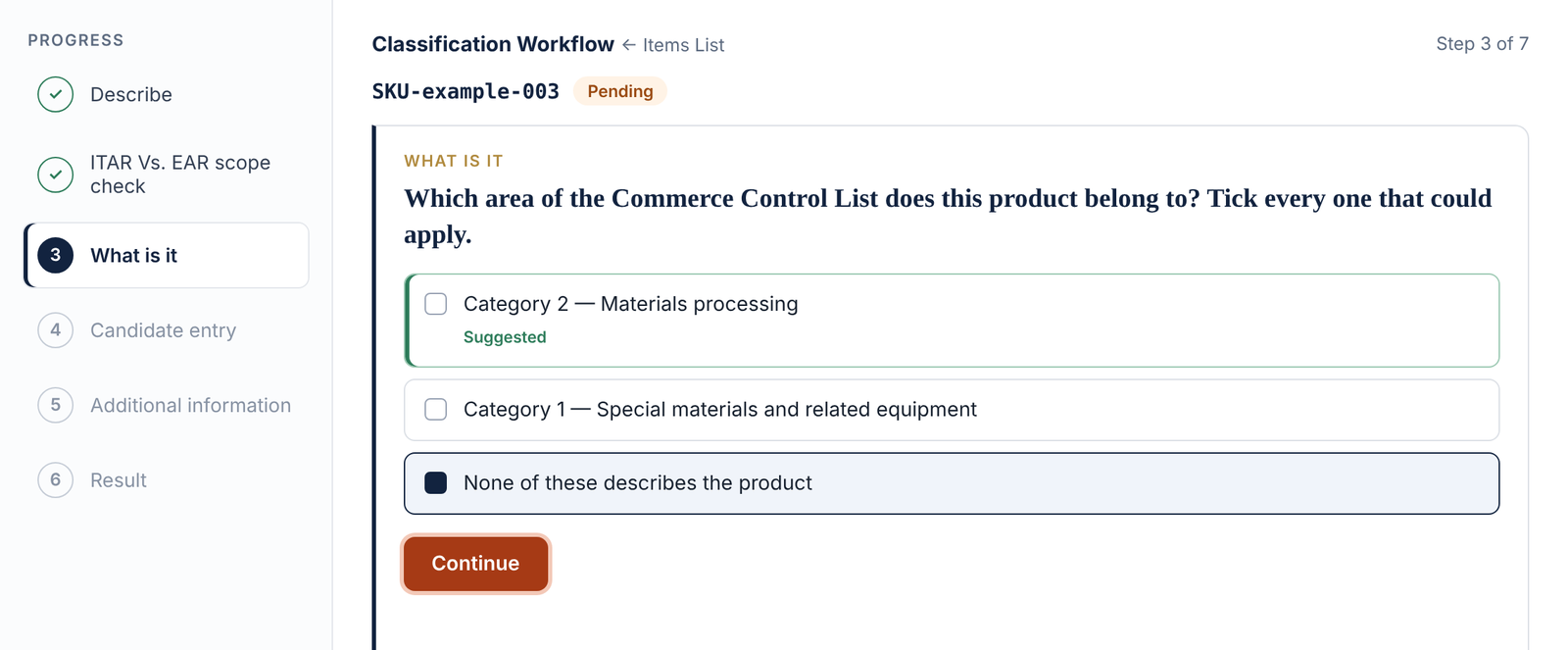
3. What is it
You tick the CCL category and product group. The likely ones are suggested. For a drinking bottle none of them fits, so you tick “None of these describes the product”, and the search widens to every area of the CCL.
4. Candidate entry
Up to three entries are offered as cards. You choose one, ask for the questions instead, or choose EAR99 when it is offered. For the water bottle, EAR99 is offered alongside two CCL entries.
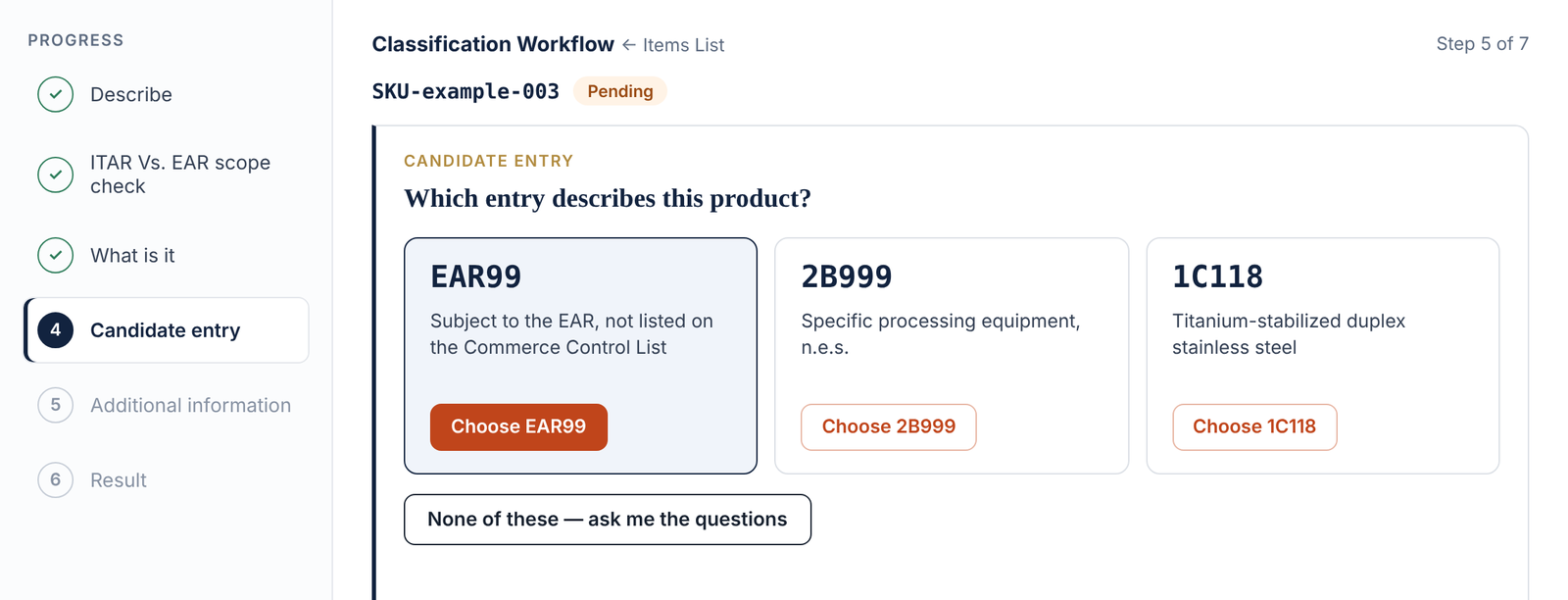
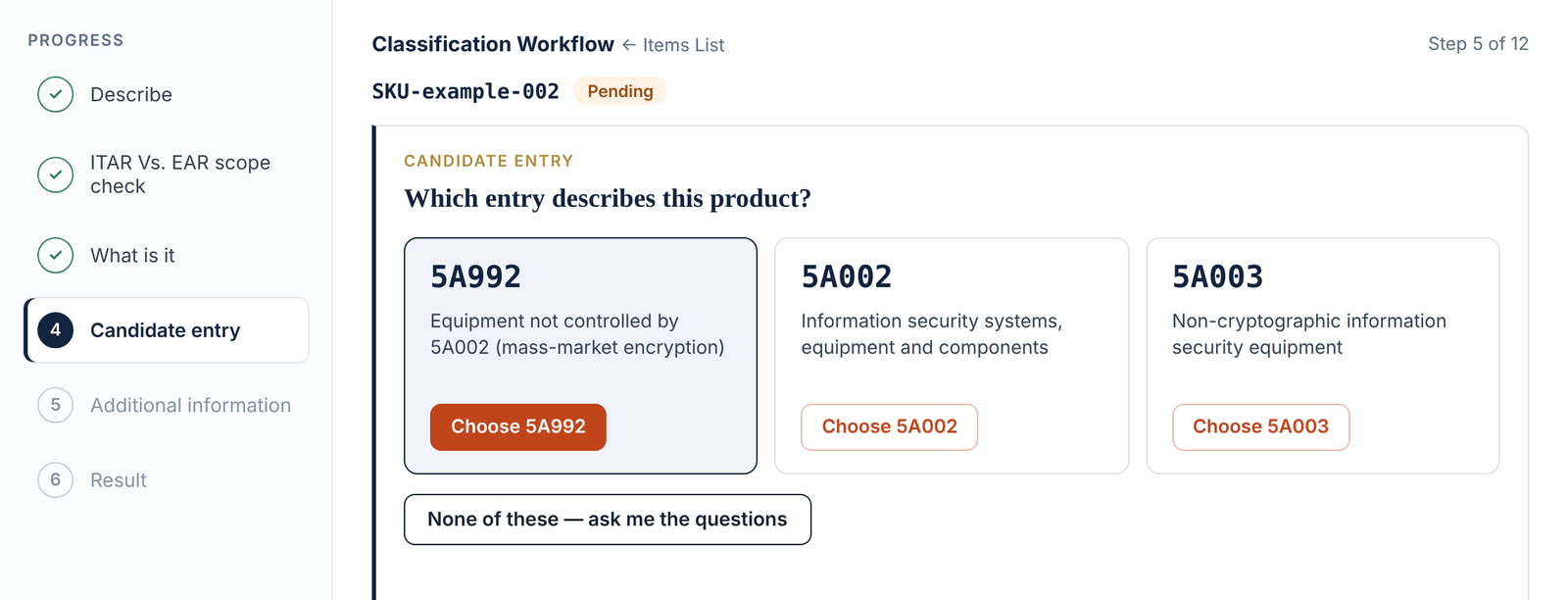
For an item that does sit on the CCL, the same step offers the entries that could describe it. A mesh Wi-Fi router with WPA3 encryption sold at retail, another of the site’s worked examples, is offered 5A992, 5A002 and 5A003. The tool then asks only for the parameters the chosen entry turns on, such as whether the product meets the conditions of the Cryptography Note.
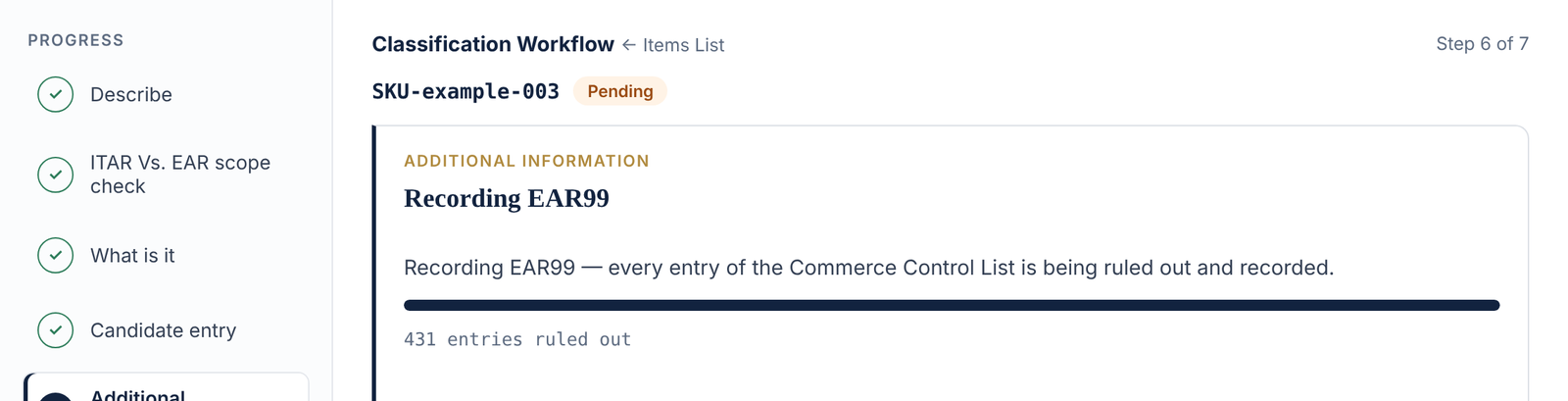
5. Additional information, and how EAR99 is recorded
For an ECCN, this is where you answer what the entry turns on, with figures from your description filled in for you to check. For EAR99, the tool reaches the result by ruling entries out, and it records each entry it rules out. That list is what you need when someone later asks why the item was not classified under a CCL entry.
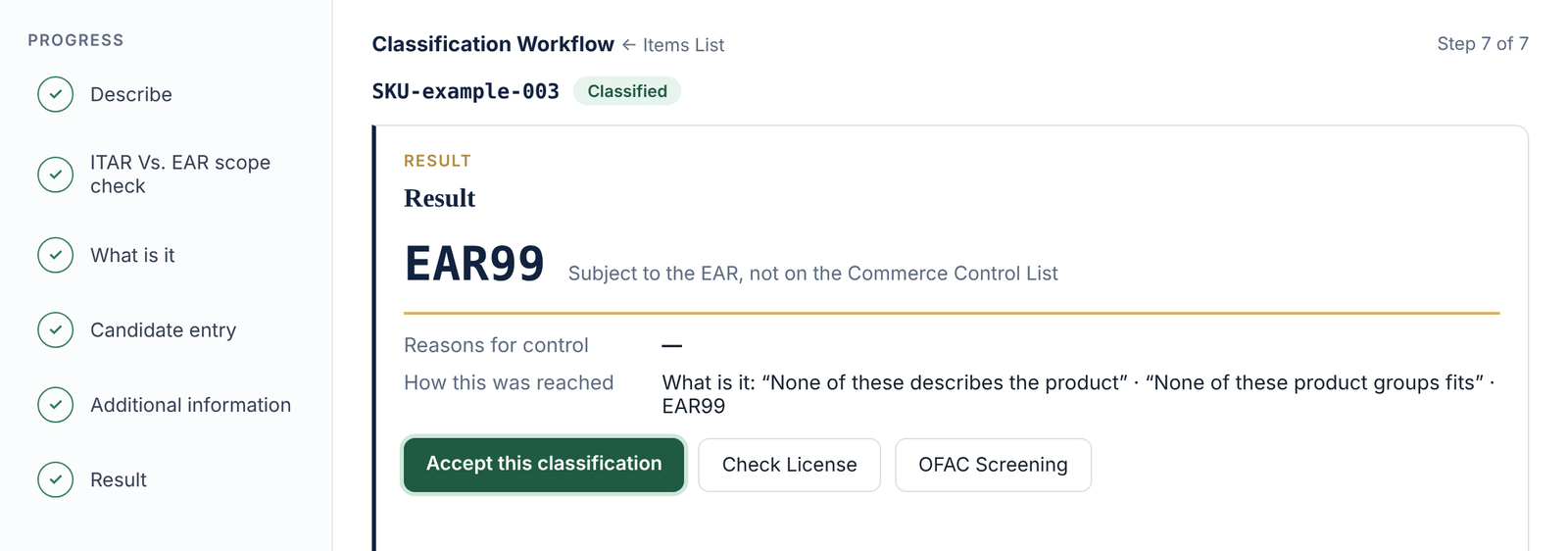
6. Result
The result shows the code, its reasons for control and how it was reached. From the same screen you can accept the classification, check license requirements for a destination against the Commerce Country Chart, or screen the parties against the OFAC lists.
Every account includes five classifications. Quick Search, which looks up ECCNs by product name in the CCL Index, is free, and so are license checks, OFAC screening and the short decision trees for EAR99, ITAR and encryption questions. Restricted-party screening covers the OFAC SDN and consolidated lists; only an exact name match is a hit, and everything else is flagged for a person to read. The how-to-use page plays the water bottle and two other worked examples from start to finish.
The tool does not replace your own review. Any answer depends on the description and figures you enter, the output is research and assistance and not a legal determination, and the classification is still the exporter’s responsibility. Keep a record of the specifications and reasoning behind each result, as you would for an audit-proof HS classification file.
Common beginner mistakes
- Classifying from a product name or a supplier’s marketing sheet instead of the technical specification.
- Treating EAR99 as a license-free label and skipping party, end-use and destination checks.
- Mixing up the two classification systems. An HS or HTS code decides customs duty, an ECCN decides export licensing, and one does not give you the other.
- Writing EAR99 for an item that was never checked against the CCL, often because it “looks commercial”.
- Assuming drawings, software and technology share the hardware’s classification.
The article on common trade compliance mistakes covers related errors on the customs side.
This guide is general information. For a specific product, classify against the current text of the EAR on eCFR, or ask BIS for a classification.