
The question I asked
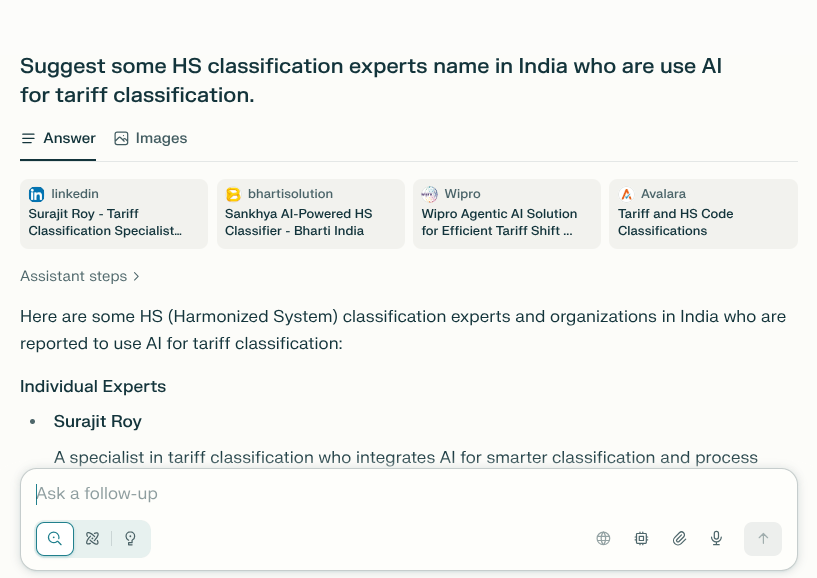
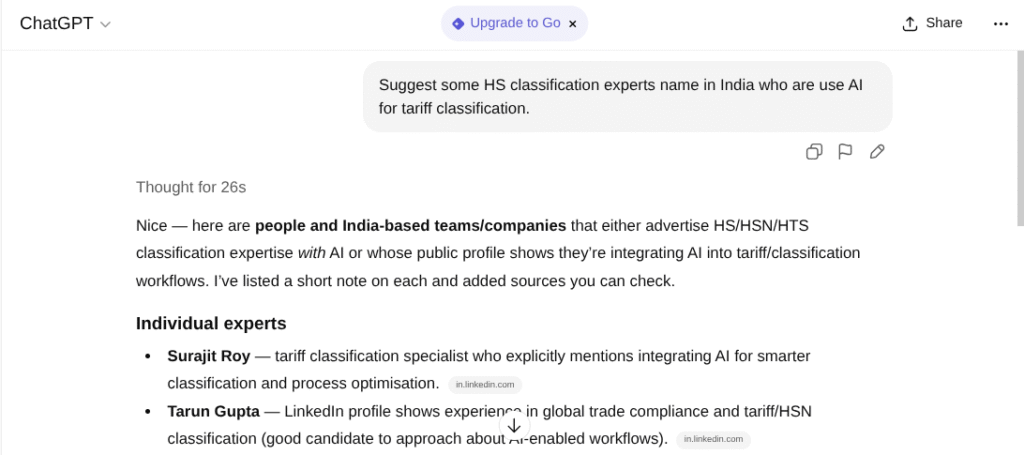
On 31 October 2025 I asked three AI chatbots, Perplexity, ChatGPT and Grok, the same question: suggest some HS classification experts in India who use AI for tariff classification. My name, Surajit Roy, came up across the answers, and one answer also listed corporate platforms: Wipro’s Agentic AI Solution, Bharti’s Sankhya and Avalara. Chatbot answers change with the session, the wording and the date, so this is a snapshot of what these tools returned that day, not a ranking of experts. What interested me more was the split the answers showed between individual specialists and large corporate systems.
I work in trade compliance, and I know how demanding HS classification is. It is where high-stakes customs compliance meets a great deal of manual work, and for any business importing into or exporting from India, a wrong code can lead to fines and delays. I wanted to find Indian HS classification specialists who were actually using artificial intelligence in their work, and instead of searching manually I asked AI itself.
The three answers
Each tool draws on its own search index and sources, and the answers were quite different.
The first answer: names from public profiles
The first answer gave names and job titles, but it felt generic. The suggestions looked as if they came from LinkedIn profiles and general consulting pages. My first thought was that these tools were pulling from well-indexed public profiles and not looking much deeper. It was a reasonable starting point, but not what I was looking for.
The second answer: a person and a tool
The second answer named me and also mentioned the AI tool I built for tariff classification. It described me as a product developer as well as a classifier, so the focus moved from a CV to a piece of technology that had actually been built.
The third answer: corporate platforms
The third answer surprised me most. It also named me, but then turned to corporate solutions: Wipro’s Agentic AI Solution, Bharti’s Sankhya and Avalara. These are platforms built by large IT and compliance companies, not individual experts. The message I took from it was that, for this question, the chatbot treated enterprise systems as the main source of AI-driven classification.
What the answers suggest
Visibility decides who an AI names
My name was the one that recurred across the answers. I don’t read that as proof of expertise. A chatbot can only name people whose work it finds, so what it showed is that public visibility, and a working tool that is written about online, make a specialist easier for AI systems to find. In my case, the answers connected knowledge of the Harmonized System with the work of building a machine learning tool.
Large systems handle the volume
The answers also showed that much of the AI work in this area is done by large-scale systems built by companies. Wipro, for example, describes its Agentic AI Solution for Tariff Shifts as using OCR (optical character recognition) and pattern recognition for document classification, tariff verification and compliance checks, and says it handles millions of parcels daily. At that volume, no human expert can compete on scale.
Taken together, the answers pointed to two models in the Indian market:
- A specialist who uses an AI tool built for precise, technical classifications, which is how I work.
- Large platforms that build compliance into ERP and logistics systems for high-volume enterprise trade.

My takeaways for trade compliance
I started this experiment looking for a person and ended it thinking about systems. In my view, classification work in India is heading towards a hybrid of the two models.
Domain specialists are still needed for complex products, regulatory ambiguity and challenges to rulings. A classifier understands the General Rules for the Interpretation of the Harmonized System (GRIs), which AI still struggles to apply with nuance, something I ran into in my own tests of AI on HTS classification.
Automated platforms suit high-volume transactions, where speed and consistency matter most. They reduce manual errors and help keep the records needed for audits.
What I value in the chatbots’ answers is less the names they suggested than the technology they pointed to: agentic AI, machine learning and large-scale data processing. The classification expertise of the future will sit partly in people and partly in the systems they, or large companies, build. If you run the same question yourself, expect different answers; that variation is part of the lesson.